


They discovered graves on the hillside just down the street.
Down on the south end of LaBelle, just behind the laundromat, construction workers tore up the vacant lot that’s been empty for as long as I’ve lived here. I was sorry, because there’s so little nature here in LaBelle. I wish they’d let every vacant lot grow up wild and turn back into prairie, but of course, they can’t. Workmen came in their noisy excavators and flayed away the grass and weeds, leaving a strip of copper-colored mud. And then their work halted suddenly, because they found the graves of six people, two of them children.
These were graves from the 1860s, which is really not remarkably old. The state of Ohio is two hundred twenty-three years old, the city of Steubenville is one year younger, and humans have been living and dying in Ohio since 500 BC or earlier. The first things the settlers saw when they got to the Ohio river valley, were mounds where the prehistoric Americans had buried their dead. You’ll find little churchyards dotted with graves everywhere around here, even when the actual churches have been torn down. Still, it was a little unsettling to think that there had been 160-year-old bodies lying under the crabgrass in a lot I’ve walked beside many times, with nobody remembering them.
The construction site has stood vacant and quiet ever since the discovery.
I saw it as I drove out of town for my hike. The soil was bare and muddy, with pink flags stuck in the spots where the graves had been found, as if they were decorated for Easter.
I stopped to get gas within sight of Union Cemetery, where the Civil War veterans are buried. I drove west, past Mount Calvary cemetery where the Catholics are buried, past the B’nai Israel Jewish cemetery. I passed the stone marker outside the Methodist church, where Morgan’s Raiders shot a farmer’s wife dead through a second story window in 1863. I passed the Fort Steuben burial estates and kept driving, all the way down Route 43, to get to the lake. Driving to Jefferson Lake State park was like driving back in time: from the chain fast food restaurants at the Wintersville shopping center, through the respectable 1950s housing development, then suddenly through farmland with modest clapboard houses that look like something out of a history book. And then I was at the park, at the lake all rich and murky with duckweed, screaming with the songs of a thousand spring peepers, so far away from town it felt as if the human race didn’t even exist.
It had been raining for days. The earth was so muddy, I could barely find a place to step. Wind troubled the normally placid surface of the lake, and the crick swelled well over her banks.
I trudged down the lake trail, my feet squelching in every puddle. The sides of the trail were dotted with violets, a symbol of faithfulness, and Spring Beauty, a symbol of hope. Up above me soared a turkey vulture, a bird which is supposed to be a grim harbinger of death, but I rather like them. They look majestic from a distance and are comfortingly ugly up close. Trees were just beginning to get their buds, and the moss was so green it didn’t even look real. Being in a place so full of life on Good Friday seemed scandalous, somehow. Still this has become my tradition. On Holy Thursday and in the Holy Night that Saturday, I go to Mass. On Good Friday, I go find a place to pray in nature.
Sometimes, when I pray in nature, I feel peace, but just then I didn’t. All I could feel was worry– about the state of the country and the world, the wars breaking out all around. About what’s going to happen tomorrow and the day after that. About what’s going to happen to Adrienne and the gang of funny classmates who are graduating from the eighth grade in just a few weeks. And to the children at the church outreach, and to Jimmy’s boy, the Baker Street Irregulars, the Artful Dodgers, and even the Lost Children who I haven’t seen in years. To all those children in other parts of the world, whose names I don’t know, who are already suffering and dying. If it was just me who was going to suffer, I wouldn’t mind so much. But I cannot stand the thought of children suffering.
The world is so cruel, and it’s getting crueler.
I rounded the bend in the trail by the crick, which was high and noisy. If it had been a little later in the year, I’d have taken off my shoes and waded, but I knew the water would be ice cold in early April. I stood on the bridge, leaning on the railing, watching the water flow, to try to ground myself, but it didn’t work.
Suppose when I got out of the park, back to where my phone could get a signal, I found out there’d been a catastrophe? Suppose Jimmy’s boy’s terrible premonition had come true, and there was a nuclear war? No one would drop a nuke on a ridiculous little steel mill town in Northern Appalachia, but the thought of that almost made it worse. I’d far rather be vaporized by surprise one day, then sit in relative safety, watching the whole earth descend into hell. I’d rather die than watch other people die. If I could take all the suffering in the world on myself, I would.
I guess that’s a sign that God hasn’t abandoned me. I am a Christian, and I believe that God Himself had the same instinct. The Son of God descended into hell to stop others from having to go there, and to free the people who were there already. Whatever our differences, on that issue, we see eye to eye.
I trudged uphill, where the mud was much less thick. As I trudged, I went from fear to anger, and grumbled under my breath. Lately, I haven’t been so angry with God, for stranding me in Northern Appalachia, and for all the unpleasant adventures I’ve had there. But just at that moment, my heart exploded with anger again– about my own life first, and then about all the lives all over the world that are upended by misfortune. And I let the Father know how I felt.
Even more flowers lined the path, like the trim on the bottom of a royal robe. Up above, the sky was glorious, and the trees were flecked with the first buds of their leaves. A world so beautiful had no business being so terrible. A God Who made springtime had no right to also make human beings to muck up the face of the earth.
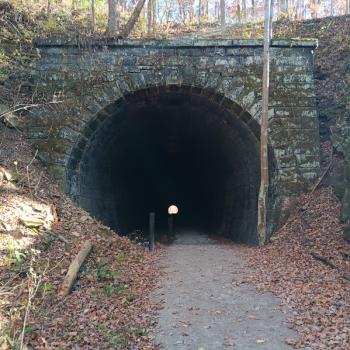
Down the trail went, on a grade so steep I practically had to slide on my back. At the bottom, it was muddy again. No matter how hard I tried to stay out of the wettest places, it was no use. Before long, my shoes and socks were neatly coated with red-brown earth.
I thought of those graves in my neighborhood again. How terrible to go under the ground, with no one but God to know where they laid you. How terrible to be a human being, living on the surface of a beautiful, mysterious, vulnerable planet like this one, teeming with life but also so full of the dead. One moment you’re here, and the next you’re forgotten under the ground. The people on top of the earth are cruel and getting worse, and the people under the earth are forgotten.
It was about three o’clock. I wanted to kneel, but there was no clean place to do it.
I closed my eyes and said “Into your hands, I commend my spirit,” and apologized for complaining so much.
Surely He heard me.
Surely there’s meaning to all of this.
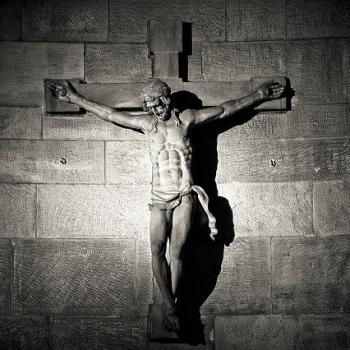
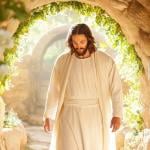
Surely, God hasn’t abandoned us. The earth isn’t just a ball of mud gorged full of forgotten corpses. The earth is alive and pregnant with the dead, eager to give birth to them once more. The time is coming, always immanent, always near, always just ahead of us, when the Son of God will appear and call all the forgotten dead out of their graves to life eternal. As Spring follows Winter and Easter Follows Lent, so the crucified Man will rise up and ascend to the Father. And as just as we saw Him ascend, we will see Him come down to make this right.
I don’t even know if I felt that hopefulness inside me there on the trail, or later as I got back to LaBelle where those strange graves lie decorated with pink flags. But I feel it now.
Mary Pezzulo is the author of Meditations on the Way of the Cross, The Sorrows and Joys of Mary, and Stumbling into Grace: How We Meet God in Tiny Works of Mercy.






 Ad-Free & Subscriber Log-In