

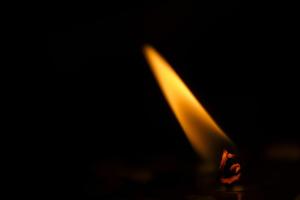
The lights went out at midnight.
Michael was at his night shift and Adrienne was asleep in bed. I was sitting on the sofa with the computer on my lap, trying to coax myself to finish some writing. The lights flashed twice, and then they went dark. The electric fan and the window air conditioner slowly groaned to a stop, and then the house was silent. All of a sudden, there was no light but the glowing laptop screen. I turned it off so as not to waste the battery, and for a moment, there was no light at all, not even from the street lamps in the alley.
I would find out later that a reckless driver hit a pole at the edge of the neighborhood, knocking out the power for a few hours. But all I knew now was that I couldn’t see.
Jimmy’s boy had been playing with the bric-a-brac in my dining room earlier, which is why there was a Christmas candle on the table. The sharp, acrid, astringent scent that was supposed to remind me of pine trees did a better job of filling the room than the weak yellow light did.
I used the candle to check on the guinea pig, and to find my phone and keys; then I used my phone’s flashlight to go outside. The cat’s collar jingled at me as she came from the direction of the neighbor’s bushes and rubbed her back against my ankle, but I couldn’t see her.
The street lamps were out all over LaBelle, up and down the block.
I turned off the flashlight, to give my eyes a moment to adjust. The firmament above the neighbor’s house slowly went from black to that odd shade of brown-gray that a light polluted sky takes on at night, when there are lights nearby but not overhead. There were a few stars. The moon was already down.
I walked to the end of the block, past the haunted house, almost to the Baker Street Irregulars‘ house. There were no signs of life except a car parked with the lights on, and the driver charging his phone. Up the block next, and there was nothing– nobody out smoking in the glow of a porch light, nobody checking on their neighbors. A few houses had solar powered lights glowing eerily in the flowerbeds, and that was all.
The cat followed me, jingling that bell. I would lose sight of her for a moment, and then a shadow would move underneath a car or a bush, and she’d rub against my leg again.
“Let’s go to the edge of the neighborhood,” I said to the cat.
She had never followed me so far before. I thought, perhaps, she’d turn back when she got to the side street, but she crossed it. I went to where the road starts sloping downhill to the cliff, and she followed. Again, I kept thinking I’d lost her, but she kept darting back into the places I could see: a gray and white cat against an off-white sidewalk, three shades of gray in the dark. Sharp, tormented shadows where those solar lights lit up the flowerbeds, and then a shadow would move, and step into the darkness. Chiaroscuro.
I thought, again, of the parable of the Good Shepherd. What would it be like if the Shepherd was herding cats? What if He wanted to save a traumatized cat like Charlie, who never does what she’s told and attacks every four-legged creature that picks a fight with her? He couldn’t carry such a creature on His shoulder. He couldn’t even put her on a leash. He’d have to do what I was doing: walk a few steps ahead, pause, and say “Here I am.” Speak softly in response to a soft meow. Call the cat by name, and wait for the jingling bell. Smile patiently when the cat darted out ahead as if to choose the walking route, and keep going.
There are two parts to LaBelle. The majority of LaBelle is the poor part, where unimportant people like Jimmy’s family and the Baker-Street Irregulars and Adrienne and I live. The eastern edge of the neighborhood is the rich part, where important people like Franciscan University professors live. The houses there are much nicer than the houses in the poor part. It used to be the location of Father Mike Scanlan’s cult, back in the 80s, and it’s still the “Catholic” part of the neighborhood. The very end of the neighborhood is a place where there used to be a school, and now there is a house where Catholic priests live, with a statue of the Virgin Mary out front. Beyond the Virgin Mary is a shale cliff with a steep drop, and a staircase where homeless people camp. At the bottom of the cliff is downtown, and the Ohio river. I wanted to see if the lights were also out downtown.
From where I was standing, I could only see the lights of Weirton and Follansbee, across the river. Downtown was blocked from my sight by the trees that have grown up against the cliff. The cat and I continued down Belleview Boulevard.
Suppose I thought about the relationship between the cat and the Good Shepherd differently. Suppose that the cat was the Good Shepherd, and not I. Imagine that Christ Himself was taking me on a walk, and I was so silly and naive that I thought it was my walk that I was taking by myself. Suppose that as I’ve stumbled through the dark, God has been following me, sometimes responding when I called God’s name, sometimes completely invisible in the shadows, sometimes darting out to take the lead. Suppose that every time I whispered, trying to get God’s attention, God responded by jingling up close to me, as the cat did just then.
Perhaps the Kingdom of Heaven could be likened to a walk with a cat. Maybe this terrible, miserable, dark and anxious twenty-year journey towards a God Who seems invisible, in a church that seems beautiful, but isn’t, is similar taking a walk with a cat, in a dark dangerous neighborhood that isn’t beautiful but is called “La Belle,” “the beautiful,” in French.
We finally got to a place where we could see downtown.
The city at the bottom of the cliff was still bright, still lit up with stoplights and street lights and lights in the windows, much brighter than the dim stars overhead.
Is this what God sees?
When God looks down on Heaven and Earth, does God see the stars below?
I had a whispered talk with God just then. I told him that I was sorry if He was angry. That I, myself, was terribly angry and hurt and afraid. That I desperately wished I could get over my religious trauma and just go back to being an ordinary Catholic, but that wasn’t something I could control. That I used to want to go home to Columbus, but just now I was content to stay where I was, if I could. That I was terrified of the Communion of Saints and I panicked when I tried to pray. That this whole terrible journey through the dark would be worth it, if I could one day see the Light of God.
No, I would need more than that. I would have to see God, and scream and rage and yell at Him for a bit. I would have to see all the tears that the people I love and I have cried, streaming down the face of God, and hear our “Eloi, eloi, lama sabachthani” coming forth from the mouth of God, and compare our scars to the scars of God, and count them all to make sure that God had been right here bleeding with us all the time. And then I would have to hear His answer, for why this all had to hurt as much as it has.
No, still more. I would have to see all of us that the Church destroyed and drove away, here in Steubenville and all over the world, entering the Kingdom to be happy in the Light of God. And then I would go in to be happy with them.
Maybe God answered, “Here I am.”
The cat rubbed against my leg.
“All right,” I said. “Let’s go home.”
We went back in the dark, but it was light again before I went to bed.
Mary Pezzulo is the author of Meditations on the Way of the Cross, The Sorrows and Joys of Mary, and Stumbling into Grace: How We Meet God in Tiny Works of Mercy.










 Ad-Free & Subscriber Log-In