

I can’t tell you what it’s like to be a good Christian. But I can tell you a few things about nature, in northern Appalachia, in the springtime.
I hadn’t seen nearly enough of nature this Spring. I had been so tired. I was finishing up my school year of classes at the church outreach, nearly done for the year but not quite. I was trying to get things in order to plant the backyard garden since it’s nearly May. Meanwhile, Adrienne’s latest passion is fitness, but she’s a bit young to use the weight room at the community center by herself, so I ended up getting into fitness as well. That took a toll on me. I enjoy the cardio part of the twice-weekly discipline. Swimming laps is a wonderful, meditative exercise. I despise lifting weights. I hadn’t lifted weights regularly since I was an undergraduate in Westerville twenty years ago, and I’m far too old for this sort of thing now. My muscles felt like they’d been run over by an ice cream truck. I wanted to stay in bed. But this is the end of peak ephemeral season for the year in Northern Appalachia. I had to make a pilgrimage to see the wildflowers, whether my sore muscles let me or not.
I got to the Wildflower Reserve, still feeling like death warmed over.
I changed into my hiking shoes that were still sandy from my walk through the tunnel with Jimmy’s boy. I asked Jesus to walk with me, and talk if He has anything to say. And then I stumbled onto the Jennings trail, to drink in the beauty.
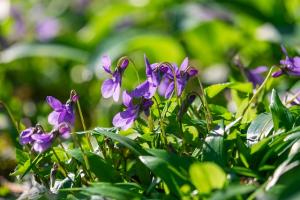
I got to the Wildflower Reserve a little late for the bluebells I’d expected, but the trails were overrun with an ocean of violets and wild phlox. Phlox, in shades from cool periwinkle to nearly pink, carpeted the ground between the hickory trees all the way down to the skunk cabbage lining the vernal pool. Violets in deep purple, pure white, and butter yellow crept over every spot the phlox had neglected, and even clung to the mud and moss on the sides of rotting logs. The tiny little pale purple flower known as “Quaker Ladies” nodded in the breeze on the side of the trail. The magenta wild geranium winked at me from the shale banks of the crick. It was all so beautiful I couldn’t possibly deserve it, and yet there it was, free of charge.
There has never been a religion that wasn’t embodied in a person. There isn’t religion out there somewhere in its pure form, with no people mucking it up. There are only people, who practice religion. It takes a human to live a Christian life. You can’t find a faith out in nature somewhere, where you could observe it and learn about it and delineate what it is, unattached to a messy human being. There has never been a faith that wasn’t embodied, enculturated, inculturated, lived in, lived by, sometimes faltering, sometimes dying, sometimes rising from the dead inside of a human believer. That’s what faith is. So I couldn’t possibly tell you, in the abstract, what it’s like to be a Christian. I can only tell you what it’s like to be me, a Christian, smarting from self-inflicted muscle pain, wandering on a trail in western Pennsylvania, in April, in a country fast falling into ruin, in a world burning to death. It felt peaceful, majestic, and a little bit uncanny.
I think I prayed, but I don’t even remember much of what I said.
I think I told Him what I usually do: that I’m lonely and anxious, and always afraid He doesn’t love me. Jesus answered in the way He usually does, with beautiful things. I walked through a patch of golden ragwort, a lovely yellow flower with a silly name. I stopped to watch robins hopping on the scrubby meadow grass. At one point, I heard rustling near the trail’s edge, and bent down thinking I’d see a chipmunk. I came face to face with a garter snake. He was quite fat for a garter snake, not at all ugly, with a bright yellow garter down his back. He looked astonished to see me, as garter snakes always do. Before I could get out my camera to take a photo, he retreated into the dry leaves.
I guess a Christian is supposed to have a bad feeling about a snake in the middle of a glorious tree-filled sanctuary. That is, after all, how all the trouble entered into the world. A younger me would have wondered if the snake was a sign that God was angry, but I wasn’t afraid just then. I like garter snakes. They keep the slugs under control.
Hope is like faith: always attached to a person. You can’t find a hope free-floating in space, unmarred by a human life. Hope is hoped BY somebody, IN something or someone, sometimes with good reason and sometimes in spite of good reason, sometimes swelling madly in the face of despair, sometimes disappearing for a time only to return later. That’s what hope is. I can’t tell you what it’s like to have perfect hope in the mercy of a loving God. But I can tell you I have felt total despair more times than I can count, and just then I couldn’t feel despair at all. In its place, I had a bit of hope.
Getting up after bending to greet the snake was a bit of an ordeal. My muscles reminded me yet again that I was not a college student: I was a ridiculous chronically ill woman in her forties who needed to go home and take a nap. But I ignored them, and kept walking.
I found my way down to Raccoon Creek itself: a shallow body of water, bigger than a crick, smaller than a river. The water ran noisily down between the pebbly shore where I was standing and a marvelous wall of shale, so nubbly and wrinkled and scarred. I wanted to try and climb that wall, knowing that I’d only succeed in shattering the shale and slide down into the river with a wonderful noise: a rockfall of breaking shale sounds like bells, or ice breaking. I wanted to go wading in Raccoon Creek, even though it was below freezing two nights ago and water holds onto its chill for a long time after the air warms up. I wanted to drink the water, even though I’m sure it would make me sick.
I don’t remember where Raccoon Creek goes, but I think it must eventually run down into the Ohio river. The Ohio runs south to the Mississippi. The Mississippi runs all the way down to the gulf which opens out into the Atlantic ocean. The water is constantly flowing, pouring from the tiny little cricks into the tributaries, to the rivers, to the sea. The water was flowing long before I was born, carving riverbeds out of noisy shale rock, cutting its way through mountains older than bones. The water will go on flowing after I’m gone. The water will flow, whether anyone’s there to see it or not, unto the ages of ages, amen. But just then, at that moment in history, I got to see the water for myself, and it felt like a prayer.
Vidi aquam egredientem de templo, a latere dextro, alleluia: et omnes, ad quos pervenit aqua ista, salvi facti sunt, et dicent, alleluia, alleluia.
I saw water coming from the right side of the temple, alleluia, and all to whom the water came were saved. Alleluia, alleluia.
And now these three remain: faith, hope and love. But the greatest of these is love.
The greatest is love, sang the river, over and over again as it flowed by. The greatest is love. The greatest is love. The greatest is love.
Love is different than faith and hope. Love is prior to everything else, and will exist after everything else passes away. Love doesn’t need to be a part of a human person like me to be real: love is, Loveself, Three Persons. Love pours out into creation, moving mountains and making a way in the wilderness, whether there’s anyone there to receive Love or not. That is why Love is the greatest. I couldn’t say all there was to say about that Love. I can only tell you that I believe in love, and I have faith in love, and I hope in love. As sure as the wildlflowers return every year, and even after the wildflowers have ceased to be, Love Is.
I think God loves me.
I made my way back to the car, my muscles still aching.
I drove home in the perfume of a glorious April afternoon, and all was well.
Mary Pezzulo is the author of Meditations on the Way of the Cross, The Sorrows and Joys of Mary, and Stumbling into Grace: How We Meet God in Tiny Works of Mercy.






 Ad-Free & Subscriber Log-In