

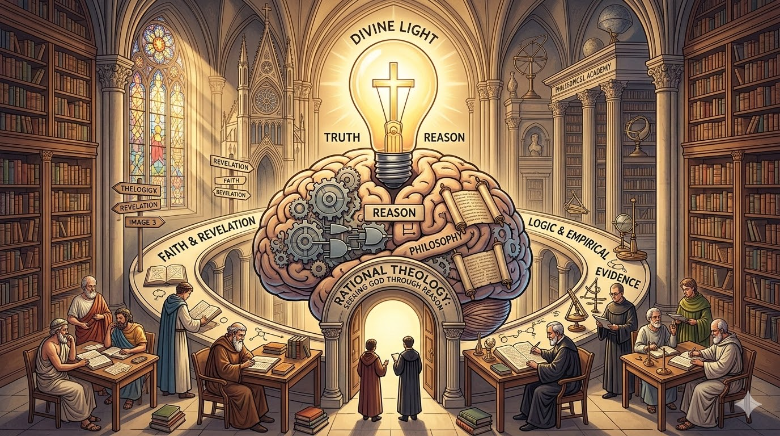
In any attempt to explore the relationship between God and man, one must be cognizant of the influences of time, place, and culture. One of the fundamental effects of these influences is to create a stress or emphasis upon one of two components of the theological enterprise. Schematically, this can be understood as a spectrum ranging from rationality at one end to mysticism at the other. Our time tends to stress rationality (albeit myopically).
In this essay, I will explore both camps and suggest that an orthodox theology lies in the middle.
Rationality
A hallmark of the great Western philosophical tradition is the view of man as a rational animal. What exactly does that entail; what does it mean to be a rational animal?
Rationality, as it pertains to human beings, is the capacity for abstract thought, logic, and the desire for truth. This is as it should be, for rationality is in accord with human nature. As with most things, however, the danger lies in the extremes, in this case, extreme rationalism. Extreme rationalism is the epistemological position that holds that reason is the only source and test of knowledge. There are two fundamental problems with this position.
First, it ignores other aspects that are natural to the human being. Emotion and intuition are often discarded under extreme rationalism.
Second, and more relevant to the theological enterprise, extreme rationalism acts as a barrier to grace and mystery. Because grace is the unmerited favor of God in one’s life, it is, by definition, suprarational. Said differently, the transcendent cannot be entirely reduced to human reason.
Mystery, in a theological context, is that which cannot be completely comprehended by the human intellect. Since mystery is, by definition, suprarational, extreme rationalism blocks out mystery or anything related to God or the transcendental experience of religion.
In a sense, extreme rationalism is a consequence of living in a post-Kantian world. Immanuel Kant’s view that the mind creates the structure by which we interpret reality has led many to exclude anything extrinsic to the mind, which, of course, is precisely what God and grace are. It should be admitted that such a consequence was not Kant’s intention, however.
A recent and prevalent example of extreme rationalism is scientism. By arguing that scientific knowledge provides truth, scientism reduces human epistemological experience to what is quantifiable, empirical, or technical. Once again, anything transcendent is ignored.
Nothing that has been said thus far should imply that theology disdains reason. Rather, I have argued that there are aspects of the human experience and condition that exhaust finite reason. As such, faith is not the abdication of reason, but a consent at the far side of reason.
If one imagines extreme rationalism as existing at one end of an epistemological/philosophical spectrum, then there also exists an extreme mysticism at the other end.
Mystery
As stated above, mystery has a specific meaning, comprehension, and significance in theology – specifically, Catholic theology. Mystery may be best defined as a divinely revealed truth whose very possibility cannot be rationally conceived before it is revealed by God. Moreover, even after it is revealed, the inner essence or logic of what has been revealed cannot be fully understood by the human mind. The most obvious and commonly cited example of a mystery is the Holy Trinity.
The incomprehensibility of revealed mysteries derives from the fact that they are manifestations of God, who is infinite and therefore beyond the complete grasp of a created intellect. Nevertheless, though incomprehensible, mysteries are intelligible. This claim requires an explanation.
The subject of God is intelligible in that the Church provides a clearly presented, coherent, and understandable explanation. However, the inner logic of God remains incomprehensible to the extent that the nature of God is too deep, complex, or profound to be fully understood, grasped, or fathomed by the human intellect.
The error of extreme mysticism in theology is that it tends to reject God’s intelligibility while emphasizing the incomprehensibility of the divine nature. Such a form of mysticism can lead to the theological problems of fideism.
Fideism is a term applied to various theories that claim that faith is the only or ultimate source of all knowledge of God and spiritual things. One readily sees that fideism is the antithesis of scientism. The name was originally coined by followers of Immanuel Kant and Friedrich Schleiermacher, both of whom denied the capacity of reason to know God or the moral law with certainty.
First, this position can easily devolve into a form of irrationalism or radical apophatic theology. In turn, this risks turning God into an unknowable concept rather than a revealed mystery. By overemphasizing divine incomprehensibility, it neglects the biblical truth that God has made Himself truly, though not exhaustively, known.
Second, the influence of apophatic language about God lends itself to skepticism, which, in turn, renders theological language meaningless and significantly undermines the intentionality of revelation.
How then can these two camps – extreme rationalism and extreme mysticism – be reconciled?
A Middle Ground
If we are to find a middle ground between extreme rationalism and extreme mysticism, we must include elements of both. Aristotle’s golden mean exemplifies this middle way. Aristotle held that virtue was the mean (middle ground) between two extremes. For example, the virtue of temperance was the mean between an asceticism that finds no enjoyment in the goods of life and gluttony, which is the uncontrolled desire for pleasure.
If we apply this concept of a golden mean theologically, one arrives at rational mysticism. By employing theological safeguards, such as filtering experiences through the deposit of faith and Scripture, rational mysticism avoids “subjectivism” by ensuring they lead to humility and charity rather than to deviant or unverified phenomena.
In taking an a posteriori approach, rational mysticism emphasizes the use of sensory experience and natural theology, thereby grounding divine experience in logical and theological frameworks.
Within the Catholic tradition, rational mysticism is actualized by stressing infused contemplation. As a gift from God, infused contemplation transcends human effort but is prepared for by rational, ascetic practices such as purgation and illumination.
Catholicism holds up figures such as Saints Teresa of Avila and John of the Cross to exemplify this, combining deep, experiential union with precise, analytical descriptions of the soul’s journey.
It is convenient to think of rational mysticism as being the purview of a small group of mystics and monks. However, interpretations such as those suggested by Karl Rahner highlight that Catholics are called to be everyday mystics, that is, those who cultivate a conscious yet grounded awareness of God’s presence in daily life.
Conclusion
As rational creatures, human beings are meant to be logical. However, we are also spiritual beings made in the image of our Creator. As such, we are also aware of a latent spiritual realm. Owing to our fallen human nature, we often fail to achieve a balance between the two, stressing one aspect over the other.
Rational mysticism acts as the golden mean by rejecting both extreme rationalism, which limits knowledge to what can be strictly demonstrated by reason, and extreme mysticism, which claims direct revelation outside the scope of Catholic dogma.












 Ad-Free & Subscriber Log-In