


The pivotal role of Henri de Lubac in shaping the Second Vatican Council, particularly through his challenge to neo-scholastic dualism and his advocacy for a ressourcement theology, solidifies his legacy as one of the most important and transformative Catholic thinkers of the 20th century.
In this paper, I will examine de Lubac’s theology, his influence on Vatican II, and why he remains one of the most important theologians of the 20th century.
Who Was Henri de Lubac?
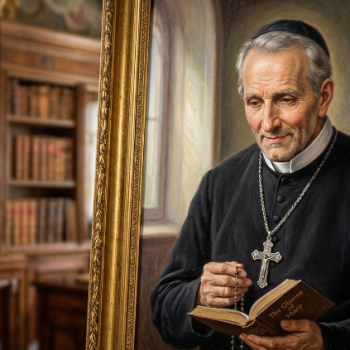
When one envisions a theologian, it likely involves an individual leading a quiet life within the structure of academia. Henri de Lubac’s life was hardly quiet, at least not in youth. Born in Cambrai, France, in 1896, de Lubac received a Jesuit education before being drafted into the French army at the outbreak of World War 1. After the war, he studied in England and France, was ordained a priest in 1927, and began teaching theology at the Institut Catholique de Lyon in 1929.
During the Nazi occupation of France, he co-founded the sources chrétiennes (Christian sources) series to publish early Christian texts. He helped lead a spiritual resistance movement through the journal Témoignage chrétien (Christian testimony). His opposition to anti-Semitism put him at risk, and he had to go into hiding several times.
Despite the historical difficulties encountered, de Lubac would become one of the leading figures in the nouvelle théologie movement (circa 1935-1960), which sought to renew Catholic theology by returning it to its sources in the writings of the Church Fathers.
The Theology Of Henri de Lubac
Henri De Lubac’s work covers a wide range of subjects. This included recovering early Christian texts, studying modern atheism, and promoting a theological approach that emphasized the relationship between nature and grace. De Lubac critiqued the Thomist conception of the supernatural. Specifically, he focused on whether man has a natural desire for the supernatural.
In his book Surnaturel (1946), de Lubac argues against the neo-scholastic distinction between the “natural” and “supernatural” orders that was prevalent in the early 20th century. Neo-scholasticism posited that human beings could naturally pursue their own end—happiness—independent of divine grace. In aligning himself with the Church Fathers (e.g., Saint Augustine), de Lubac argued that human beings are inherently oriented toward God and that this desire for the divine is critical to Catholic anthropology. De Lubac challenged the dualism of nature and grace by emphasizing that the desire for God is intrinsic to human nature.
The critical aspect that de Luback sought to elucidate was that the desire for God is not merely contingent but integral to human nature, making the separation artificial. De Lubac’s rejection of certain principles of neo-scholasticism and his effort to recapture the work of the Church Fathers would have an enormously influential impact on the Second Vatican Council.
De Lubac’s Theology And Vatican II
Henri de Lubac’s theological ideas, particularly his focus on the relationship between human nature and divine grace, influenced his understanding of the Catholic Church and its role in the world. His writings were instrumental in shaping the intellectual climate of the Second Vatican Council, and he served as an expert advisor to the bishops during the Council, including Karol Wojtyła (later Pope John Paul II).
It is worth briefly examining four key areas of influence that de Lubac brought to the Council.
First, de Lubac was a leading figure and proponent of what is called the ressourecment movement. The movement, closely aligned with the above-mentioned nouvelle théologie, emphasized a return to the early Church Fathers and to Scripture as sources for theological renewal.
Notably, de Lubac’s theology enabled the Church to counter a rigid and often dry formulation of neo-scholasticism. His work paved the way for a broader renewal in Catholic theology. It influenced the intellectual climate leading up to the Council by allowing the Catholic Church to move past the post-Tridentine/neo-scholastic rigidity and speak to the modern world in a fresh, more universal way.
Additionally, du Lubac’s ecclesiogical theology encouraged a view of the Church as the community of the whole people of God, not just the clergy, which was a significant influence on the Lumen Gentium (Dogmatic Constitution on the Church).
De Lubac also significantly affected the Catholic Church’s position on ecumenism. De Lubac’s emphasis on the Church’s relationship with other Christians and the modern world influenced the Council’s focus on ecumenism and dialogue, as seen in documents like Gaudium et spes (Constitution on the Church in the Modern World).
Finally, de Lubac was also a strong advocate of the Church as the “Mystical Body of Christ.” He emphasized the unity of the Church not just as a visible institution but also as a spiritual reality rooted in the life of Christ. This theological perspective significantly influenced the ecclesiology developed at Vatican II, especially in Lumen Gentium.
Controversy And Vindication
Henri de Lubac’s theological career was not without difficulty. In 1950, Pope Pius XII issued the encyclical Humani generis, which appeared to be critical of de Lubac’s theological position regarding nature and grace. Despite appearances, de Lubac argued that the encyclical did not condemn his position. As he pointed out, the encyclical was critical of the “false opinion” that God cannot create intellectual beings without calling them to a supernatural end.
Nevertheless, de Lubac’s superiors at the time, along with others, believed Pope Pius XII was critical of de Lubac’s theology, and he was temporarily barred from teaching and publishing. De Lubac and his supporters were vindicated, however, when de Lubac was named an advisor for the bishops during the Second Vatican Council, including a future Pope (Pope John Paul II).
Conclusion
Henri de Lubac’s ideas on the relationship between nature and grace, the Catholic Church, and patristic theology remain influential today. His appointment as a cardinal by Pope John Paul II in 1983 symbolized the Catholic Church’s high regard for his contributions to the faith. His works remain central to contemporary theological discussions of humanity’s relationship with God and with the ecclesial community.









 Ad-Free & Subscriber Log-In