

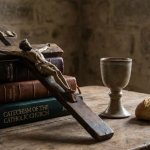
“The celebration of Holy Mass has the same value as the Death of Jesus on the Cross.” – Saint Thomas Aquinas.
The Mass is often the most familiar, yet least understood, aspect of Catholic life. Nevertheless, it is the pinnacle of worship and the center of the Catholic faith. Not surprisingly, therefore, the subject of the Catholic Mass is rich and complex. For this essay, I will limit myself to examining and explaining the order of the Mass. First, however, it is beneficial to review what the Mass is and the history of this most remarkable of sacraments.
The Meaning And History Of The Catholic Mass
It is no exaggeration to claim that the Mass is the sine qua non of the sacraments and of Catholic worship. Sacrament, or sacre, in Latin means sacred or hallowed. From the Greek translation of the word sacrament, we derive musterion, which we translate as “mystery.” These two ancient languages offer a working definition of the sacraments as sacred mysteries.
The pinnacle of the sacraments is, of course, the Mass. The term is predicated on a Latin phrase, “ite, missa est.” The closest English comes to translating this phrase is as “it has been sent.” There are two ways of understanding this. First, the Mass sends the laity out to live and share the Gospel. In this sense, the Mass is not meant to end at the Church doors.
A deeper, more theologically profound approach suggests that the antecedent of the indefinite pronoun “it’ is sacrifice. Therefore, this approach renders the translation as “the sacrifice has been sent.” The sacrifice is, of course, Christ crucified.
The latter interpretation takes in both the Incarnation (the sending) and the Crucifixion (the sacrifice). This interpretation also provides a definition of the Mass as the sacramental re-presentation of the Paschal Mystery – the Passion, Death, and Resurrection of Christ. As such, the Mass makes Christ’s saving actions, undertaken two thousand years ago, present to the modern person. It is in the Mass that Christ’s words echo through history, “This is my body, which will be given up for you.”
While the Mass ritual would develop over the centuries, there is early evidence that it was celebrated in homes that served as makeshift churches. (1 Corinthians 11:23-26). The Edict of Milan (313 AD) allowed public churches, which in turn enabled more elaborate liturgies, including processions and choirs. The language of the Mass shifted from Greek to Latin in the West, making the liturgy accessible to a larger population. Following the Council of Trent (1545-1563), Pope Pius V standardized the Roman Rite, creating a uniform Latin Mass that would be used for nearly 400 years.
Significant changes to the Mass occurred in the aftermath of the Second Vatican Council (1962-1965). Vernacular replaced Latin as the language of the Mass. Additionally, the priest began to face the congregation rather than the tabernacle, and greater emphasis was placed on the reading of Scripture. Primarily, this was done to encourage the congregation’s participation and to improve understanding of the Mass.
Having explained the evolution of the Mass, we can now step inside the Liturgy itself.
Order And Explanation
The Mass unfolds in four distinct movements. The introductory rites are intended to unite the congregation and prepare them to hear the Word and celebrate the Eucharist. As the Mass begins, everyone stands as an expression of attentiveness to the Word of God and of readiness to carry it out.
The introduction generally begins with a hymn as the priest approaches the altar, symbolizing the community’s gathering to worship. The Mass is initiated with the sign of the Cross, which acts as a reminder of one’s baptism. The priest greets the congregation with the words “The Lord be with you.” The greeting recalls Christ’s declaration that “… where two or three are gathered together in my name, there am I in the midst of them” (Matthew 18:20).
The ritual response to this greeting is “And with your spirit,” which acknowledges that the priest has received the Spirit of God through his ordination. Next, Catholics are asked to recall their sins and the salvific work of Christ in the penitential rite.
A declaration of praise of “Glory to God in the Highest” (Luke 2:13-14) follows as the congregation praises the Holy Trinity. This closes the introductory aspect of the Mass and introduces the second part, the Liturgy of the Word.
Liturgy Of The Word
In the Liturgy of the Word, the Mass breathes with the rhythm of salvation history. It draws on the Old Testament, the Psalms, and, finally, the Gospels to show that Christ is the fulfillment of all that came before.
Except for the Easter season, the first reading will be from the Old Testament. A reading from the Book of the Acts of the Apostles replaces the Old Testament reading during Easter. A psalm from the Book of Psalms follows the first reading.
The second reading will usually be from one of the letters of Paul or another apostolic writing. The third reading is drawn from one of the four Gospels. Owing to the belief that Christ is present during the proclamation of the Gospel, the congregation must stand.
The priest will repeat the greeting “The Lord be with you,” and, along with the congregation, will make the sign of the Cross on the forehead, lips, and heart. This act symbolizes that the Gospel is understood, is proclaimed, and is lived out. The priest will silently pray that God cleans his mind and his heart so that his lips may worthily proclaim the Gospel.
The Gospel reading concludes with the ritual formula “The Gospel of the Lord,” and the laity will respond, “Praise to you, Lord Jesus Christ,” thereby again proclaiming faith in Christ’s presence in the Gospel. At this point, the congregation will again be seated to listen to the priest’s homily. The homily is an act of worship rooted in the texts of the Mass and Scripture, especially the readings that have just been proclaimed.
A recitation of the Nicene or Apostles’ Creed and a universal prayer for all conclude the Liturgy of the Word portion of the Mass.
Liturgy of the Eucharist
This part of the Mass commences with the preparation of the altar in anticipation of the Eucharist. The bread and wine that are to be used are then brought forth and received by the priest. The use of the bread and wine not only connects the Mass to the Last Supper but also has significant soteriological implications, as the bread becomes the body of Christ and the wine His blood, thereby making the Paschal sacrifice. (Luke 22:19-20).
Next, the priest will mix the wine with water and wash his hands. Known as the Lavabo Rite, it indicates the priest’s desire for the cleansing of sins and is accompanied by prayer: “Lord, wash away my iniquity; cleanse me from my sin.” It should also be observed that the mixing of water with wine symbolizes the hypostatic union; Jesus as both God and man.
The Eucharistic Prayer that follows is addressed to God the Father and is central to the Mass. While the language may vary slightly, the Eucharistic Prayer will include the priest calling on the Holy Spirit to descend upon the bread and wine. The priest recounts Jesus’s words and actions at the Last Supper, consecrating the elements, and recalling Christ’s saving mysteries (Passion, Death, Resurrection). The Church then offers Christ’s sacrifice and prays for the Pope, bishops, the living, the dead, and the whole world.
The congregation then prepares to eat and drink at the Lord’s Table. This is done by reciting the Lord’s Prayer and exchanging a sign of peace.
The priest then lifts the host, which is the Body of Christ, and invites us to come to the table, echoing the words of John the Baptist: “Behold the Lamb of God….” The response is “Lord, I am not worthy….” (Matthew 8:8). It is at this time that the transubstantiation occurs. Without delving into philosophical and theological language, transubstantiation holds that the essence of bread and wine is changed into the body and blood of Christ.
The members of the assembly now approach the altar in procession to receive communion and are reminded that they are consuming “The Body of Christ.” Upon returning to their seats, the faithful will pray silently, thanking and praising God.
Concluding Rites
At the closing of the Mass, the priest will invoke the Holy Trinity and make the sign of the Cross. The priest will then dismiss the assembly with the words “Go in peace,” to which the congregation will respond “Thanks be to God.”
While the Mass may appear overly ritualistic and somber, Thomas Aquinas reminds us that the Holy Mass has the same value as the Death of Jesus on the Cross.





 Ad-Free & Subscriber Log-In