

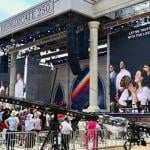
There was something deeply unsettling about watching “Rededicate 250” unfold on the National Mall this past weekend. Draped in flags, saturated with praise music, and promoted by some of the most powerful officials in the federal government, the event presented itself as a patriotic celebration ahead of the country’s 250th anniversary. But beneath the revivalist aesthetics and civil religious language was something much more troubling: a state-adjacent promotion of Evangelical nationalism masquerading as historical memory.
The organizers and speakers framed the United States as a fundamentally Christian nation that had somehow strayed from its divine mission and now needed to be “rededicated” to God. That message may resonate emotionally with many conservative Christians, especially Evangelicals, but it collapses both history and constitutional principle into toxic ideology.
And as a scholar of religion in the Americas, I could not help but notice the uncomfortable parallels between this movement and the very theocratic systems that American conservatives routinely condemn abroad. The irony is extraordinary.
At the event, Paula White-Cain, one of Trump’s senior faith advisers, declared that the U.S. “was built on Christian values, on the Bible.” Speaker of the House Mike Johnson, Secretary of State Marco Rubio, and Defense Secretary Pete Hegseth all lent the symbolic authority of the federal government to an event that critics correctly described as erasing the line between church and state.
President Donald Trump himself delivered a prerecorded Bible reading invoking 2 Chronicles and national repentance. None of this was subtle.
This was not merely politicians attending church. Politicians do that all the time. This was government power, national symbolism, and Evangelical theology fused into a single public spectacle on federally managed ground, backed in part through government-affiliated semiquincentennial initiatives.
And the historical revisionism was astonishing. The architects of Rededicate 250 repeatedly invoked the Founding Fathers as advocates for a Christian nation. Yet the actual founders were far more divided, cautious, and intellectually shaped by Enlightenment liberalism than Christian nationalists would like to admit.
My fellow Virginian, Thomas Jefferson, famously cut miracles out of the New Testament. James Madison warned repeatedly against religious establishments. The Treaty of Tripoli, signed under John Adams in 1797, explicitly stated that “the Government of the United States of America is not, in any sense, founded on the Christian religion.” That sentence alone should permanently end the mythmaking.
The founders certainly lived in a culturally Protestant society. Christianity deeply influenced early American life. But that is entirely different from establishing a Cristocracy, a theocratic state. The genius of the American experiment, created here in Virginia, was not that it erected a Christian nation. It was that it refused to create one.
The First Amendment was revolutionary precisely because it broke from the European model of state-imposed religion that had produced centuries of resentment and sectarian violence.
Christian nationalism attempts to reverse that achievement. And what makes Rededicate 250 especially alarming is that it increasingly mirrors the logic of theocracies that American conservatives so often denounce.
Listen carefully to the rhetoric coming from some of the movement’s most influential figures.
Pete Hegseth has openly called for an “American crusade” and described politics in quasi-apocalyptic religious terms. In his book American Crusade, he wrote of a “360-degree holy war for the righteous cause of human freedom.” He has portrayed secularism, leftism, and Islam as existential enemies of “Americanism.”
That language should disturb anyone committed to pluralistic democracy. When governments begin dividing citizens into righteous believers and corrupt enemies, democracy starts mutating into something much darker.
The same pattern appears in the rhetoric surrounding Rededicate 250 itself. Speakers and organizers repeatedly framed America as engaged in a spiritual battle between good and evil. That framework is politically potent because it transforms opponents into heretics rather than fellow citizens. And that is precisely how theocratic states function.
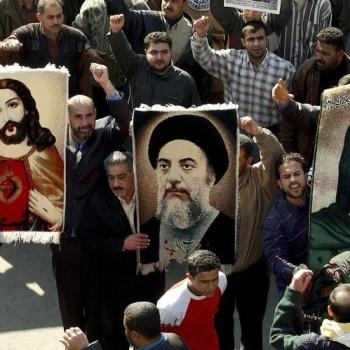
In Iran, political legitimacy becomes tied to religious orthodoxy. In Taliban-controlled Afghanistan, state authority derives from enforcing a particular interpretation of Islam. Of course, Evangelical nationalism in the United States is operating in a very different historical and institutional context.
But structurally, the impulse is hauntingly similar: fuse national identity with religious identity, claim divine legitimacy for political authority, and marginalize those outside the favored faith tradition. Once a nation begins defining “real Americans” through religion, pluralism inevitably weakens.
And who exactly was missing from Rededicate 250?
Mainline Protestants were largely absent. Muslims were absent. Hindus were absent. Buddhists were absent. Indigenous religious leaders were absent. Religious Nones — now one of the largest demographic groups in the country — were effectively invisible.
Many non-Evangelical Christians felt excluded because the event reflected a very specific fusion of charismatic Evangelicalism, MAGA politics, and nationalist mythology.
This matters because civil religion can either unify or exclude. At its healthiest, American civil religion invokes broad democratic ideals — liberty, equality, human dignity, constitutional order. At its worst, it becomes ethnoreligious nationalism wrapped in sacred language. Rededicate 250 veered dangerously toward the latter.
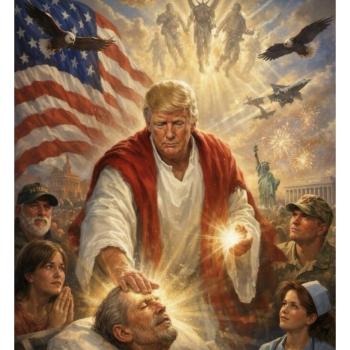
Marco Rubio has increasingly framed American global leadership in overtly civilizational religious terms, while Mike Johnson regularly describes biblical authority as foundational to his politics. Meanwhile, Trump himself has embraced the role of divinely chosen protector for many within the Evangelical nationalist movement.
That convergence is not accidental. What we are witnessing is the emergence of a distinctly American form of soft theocracy — one that still uses democratic elections for now but increasingly treats conservative Christianity as the authentic spiritual identity of the state.
As someone who studies religion across the Americas, I have seen how dangerous these mixtures of nationalism, populism, and sacralized politics can become. Whether on the Catholic or the Evangelical right, when political leaders begin presenting themselves as defenders of God’s nation against internal enemies, democratic norms erode quickly.
Religious freedom survives only when the state belongs equally to believers and nonbelievers alike. The tragedy is that Christianity itself often suffers under these arrangements. Once faith becomes fused with state power, it loses its prophetic independence. The church ceases speaking truth to power because it has become part of the ruling class.
That is one of history’s oldest lessons. And it is a lesson many Americans seem determined to relearn the hard way.










 Ad-Free & Subscriber Log-In