

One of my favorite works of art—whether visual, musical, or otherwise—is Mozart’s Requiem. Its beauty reflects something far beyond the mundane, lifting the listener toward unimaginable spiritual heights. When I listen to it, I often experience a mixture of awe and sadness: awe at the God-given genius required to compose such a masterpiece, and sadness for its composer, Wolfgang Amadeus Mozart, whose personal life seems to have lacked the deep piety one might expect from someone used by God in so extraordinary a way.
The awe I experience before works such as the Requiem stands in stark contrast to what I feel when confronted with religious art, architecture, and music shaped by the horizontal vision of progressive Christianity. This vision often reduces Christianity to service of others—especially the poor—and treats that service as the center of the Gospel rather than the fruit of something greater: the worship of God and the salvation of souls.
We can see this emphasis in much contemporary sacred music, particularly the work of Dan Schutte, including Table of Plenty. We can also see it in the church architecture that emerged during the 1970s and 1980s. Both reflect a broader shift in focus—from God to man, from transcendence to utility, and from worship to community. That shift helps explain why I cannot be a progressive Catholic.
The Horizontal Turn
Anyone familiar with the music of Dan Schutte will understand my reaction. His catalog includes:
These songs repeatedly emphasize gathering, mission, community, inclusion, and service. All of these themes reflect legitimate Christian concerns. The question is whether they constitute the whole of Christian life.
What of sin, repentance, judgment, sacrifice, holiness, and salvation? What of the Cross and the eternal destiny of the soul?
When sacred music consistently emphasizes the horizontal dimensions of Christianity while giving comparatively little attention to its vertical dimensions, it inevitably shapes how people understand the faith itself. Over time, the Church begins to look less like an ark of salvation and more like a religiously inspired social movement. The mission shifts subtly but significantly—from reconciling man to God to improving man’s relationship with his neighbor.
Christianity certainly calls us to love and serve others. Yet love of neighbor flows from love of God, not the other way around. When the vertical dimension fades from view, the horizontal eventually loses its foundation as well.
From Altar to Table
For Catholics, the Mass is far more than a communal meal. In the Eucharist, Christ presents His sacrifice to the faithful. The altar is not merely a table; it is Calvary in sacramental form.
This distinction reveals one of the deepest differences between progressive Catholicism and historic Catholicism. Progressive Catholics often begin with the meal and work backward toward sacrifice. Historic Catholicism begins with sacrifice and understands the meal through it.
The difference matters. A meal emphasizes fellowship, community, and inclusion. A sacrifice emphasizes sin, redemption, worship, and the need for reconciliation with God. Both belong to the Mass, but the order matters.
When Catholics place fellowship above sacrifice, the Mass begins to resemble a gathering of believers rather than the worship of God. The Church teaches that the Eucharist is both sacrifice and sacred banquet. The banquet draws its meaning from the sacrifice, not the other way around. Remove Calvary from the altar, and the table loses its deepest significance.
The Churches We Built
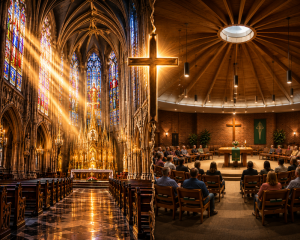
Churches reveal what people believe. For centuries, Christians designed churches to inspire awe and direct the soul toward God. Architects drew the eye upward with towers, spires, and domes. Sunlight filtered through stained-glass windows. Sacred images adorned the walls, and high altars dominated the sanctuary.
Now compare those churches with many built during the 1970s and 1980s. Fan-shaped seating, circular layouts, low ceilings, and minimal ornamentation created a more pragmatic, auditorium-like aesthetic. Rather than emphasizing transcendence, these designs often emphasized accessibility, participation, and community.
The same theological instincts that shaped contemporary hymnody seem to have shaped contemporary architecture as well—or perhaps the influence flowed in the opposite direction. Either way, the result was the same. The focus shifted subtly but significantly from “God is here” to “we are gathered here.”
That shift matters. A church building teaches long before a priest preaches a homily. It forms expectations about what worship is and whom worship is for. The architecture of a cathedral lifts the mind toward heaven. The architecture of an auditorium keeps the focus on the assembly.
Why Beauty Matters
Why do Christians build cathedrals or compose masterpieces such as Mozart’s Requiem? Cathedrals such as Chartres Cathedral, Notre-Dame de Paris, and St. Peter’s Basilica were neither practical nor efficient. They were acts of worship. In many cases, generations of craftsmen devoted their lives to these projects because they sought to glorify God through beauty.
The same principle guided the creation of other masterpieces. Christians did not ask how to maximize accessibility or community participation. They asked how they could offer God their very best.
Beauty teaches. Beauty elevates. It draws the soul beyond the ordinary and toward the transcendent. It reminds us that we were made for more than comfort, utility, or material prosperity. We were made for God.
That is why beauty matters. It does not distract from worship; it flows from worship. A civilization centered on God naturally produces cathedrals, sacred art, and great sacred music because worship inspires men to create things worthy of the One they adore.
Final Thoughts: Why I Am Not a Progressive Catholic
The issue I have addressed in this essay concerns orientation, not politics. Progressive Catholicism often begins with man and moves from there toward God. Historic Catholicism begins with God and, in light of that reality, understands the human person correctly.
That orientation shaped Christian civilization. It inspired Christians to build cathedrals, compose requiems, and create sacred art. It led craftsmen to devote decades of their lives to works they would never see completed. It led artists to create masterpieces not for their own glory, but for God’s.
This is one reason progressive Catholicism does not appeal to me. Not because I care too little about the world, but because I believe the Church exists for something greater than the world. Christ founded the Church to worship God and lead souls to eternal life.
Beauty serves that mission. A cathedral lifts the eyes toward heaven. Sacred music stirs the soul toward God. Great religious art reminds us that we were made for more than comfort, utility, and material concerns.
The Church’s highest purpose is not to help us feel at home in this world. It is to prepare us for the next. One of the ways she accomplishes that task is through beauty.
Thank you!
Read The Latin Right’s other writing here.
Please visit my Facebook page and IM your questions (and follow my page) or topics for articles you would like covered.









 Ad-Free & Subscriber Log-In