

The Beat Zen movement was one of the more unlikely developments in all of Western cultural history. It began in the U.S. in the late 1940s and early 1950s. Americans were still recovering, physically and emotionally, from a long and brutal war with Japan. At the same time the Cold War was becoming tangible. Americans were called to rally around Christianity (with an occasional nod to Judaism) to stand against “godless Communism.” American popular culture retreated into comfortable “Ozzie and Harriet” conformity.
Yet, somehow, by the 1950s a remarkable thing had happened. Zen, a centuries-old, mostly monastic Buddhist sect associated with Japan, became cool.
About the Beats
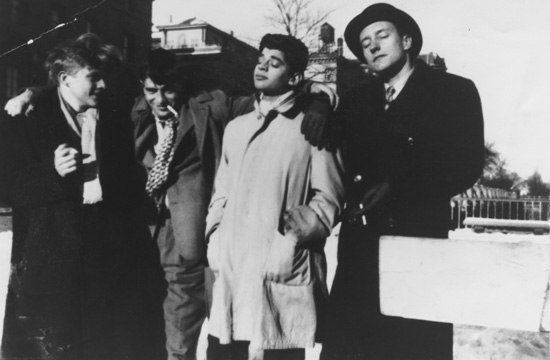
Before Beat Zen, there was Beat. Beat was a youth and literary movement that first emerged in post–World War II New York City. Many of the original Beats, including Allen Ginsberg (1926–1997) and Jack Kerouac (1922–1969), met each other as students at Columbia University in Manhattan in the 1940s. They were soon joined by William S. Burroughs (1914–1997), who was not a student but living in New York. Much of New York’s early Beat culture centered on the Greenwich Village section of Manhattan. Known for its jazz clubs and coffee shops, it was an epicenter for all manner of art — graphic, music, poetry.
In many ways Beat was a backlash to the regimentation of the World War II years and the conformist, gray-flannel-suit mainstream culture of postwar America. Beats reveled in being provocative and unconventional. The Beats are remembered for their poetry – the best-known example is Ginsburg’s Howl (1955) – and novels such as Burroughs’s Naked Lunch (1959) and Kerouac’s On the Road (1957). Beat literature tended to be unstructured, experimental, sometimes raw. They were called “Beatniks” by the “squares,” or conventional people, but the proper name was just “Beats” or “Beat Generation.”
About Zen
Zen is a school of Mahayana Buddhism that originated in China, where it is called Chan. (For a brief explanation of the taxonomy of Buddhist schools, see “The Quest for Original Buddhism.”) The traditional story is that Chan was transmitted from India to China by a monk named Bodhidharma about 500 CE, give or take. It’s more likely that it first emerged in China as a distinct school from a group of Buddhist meditation masters during the Tang Dynasty (618–907 CE). The name Chan came from the Sanskrit word dhyana, “meditation” or “concentration.” From China the school spread to Korea, where it is called Sôn or Seon, and to Vietnam, where it is called Thiên. It was transmitted to Japan in the 11th and 12th centuries and became Zen.
Buddhism had reached Japan in the 6th century, and by the time Zen came along other Buddhist sects were far better established. Zen, which has been primarily monastic for most of its history, was never the most popular Buddhist school in Japan. But it had a deep impact on Japanese culture. If you’d like to learn more about where Zen came from and how it developed, please read my book The Circle of the Way: A Concise History of Zen from the Buddha to the Modern World, published by Shambhala. (For the record, I have been a formal Zen student since 1988.)
Along with meditation Zen is possibly best known for its koans. Koans are cryptic and paradoxical questions often wrapped in a brief anecdote. The koan is not a riddle but a presentation of reality. They are a means for a student and teacher to work together in an intuitive, non-conceptual way. See also James Ford, “An Introduction to the Zen Koan.” James has written several good books about Zen, including Introduction to Zen Koans: Learning the Language of Dragons and
When Beat Met Zen
By the 1950s the center of the Beat movement had shifted to San Francisco, where Ginsberg and Kerouac met the poets Gary Snyder (b. 1930) and Philip Whalen (1923–2002). And this is where Beat met Zen. Like many westerners of the time they were introduced to Zen through the writing of D.T. Suzuki (1870–1966), the Japanese Zen scholar whose English-language books and lectures introduced Zen to the West. Snyder and Whalen would eventually become formal students.
And in San Francisco the Beats met Alan Watts (1915-1973). who had moved there in 1951 to teach Buddhism at the American Academy of Asian Studies. Watts was never one of the Beats himself but more of a close observer. Watts also had absorbed D.T. Suzuki’s work and had become besotted with Zen. Watts was a compelling writer with a keen intellect. He was a sharp critic of the unnaturalness of conventional modern life, and he also left us some lovely insights into spirituality. However, for all his interest in Zen he never practiced it formally, which limited his understanding of it. But his writings made Zen sound very cool. He brought a lot of people into Zen, and some of them stuck. My first Zen teacher, the late John Daido Loori, called Watts a dilettante but also said Watts’s books inspired him to seek the path of Zen.
Beat Gets Noticed, and So Does Zen
The Six Gallery was an art gallery on Fillmore Street in San Francisco that sometimes sponsored poetry readings. And in the evening of October 7, 1955, at Six Gallery, Alan Ginsberg gave the first public reading of the yet unpublished, and unfinished, Howl. Philip Whalen and Gary Snyder also read some of their work, as did two other Beat poets, Michael McClure and Philip Lamantia. The participants were introduced by Kenneth Rexroth. Lawrence Ferlinghetti — a poet, playwright, and publisher –was in the audience, as was an intoxicated Jack Kerouac, who cheered the other poets with shouts of “yeah!” and “go!”
The event created a huge amount of buzz that brought the Beats to national attention. Ferlinghetti contacted Ginsberg the next day and asked to publish Howl. The volume, Howl and Other Poems, had to be printed and bound in the UK, as US printers wouldn’t touch it. It came out in 1957 to mostly positive reviews. And then U.S. Customs agents seized a shipment of new books arriving from the British printer, calling it obscene. The resulting trial drew national news coverage and more attention to Ginsberg and the Beat poets. (The obscenity charges were dismissed; you can read more about the trial here.)
Also in 1957, Kerouac’s novel On the Road was published, to mostly critical acclaim. It was a best-seller and a literary sensation. There was nothing explicitly Zennish about On the Road, but Kerouac followed it up in 1958 with The Dharma Bums. In Dharma Bums, Kerouac sprinkled the word Zen and his understanding of Buddhism throughout the narrative. And in the late 1950s anyone who aspired to be hip and cool was reading Kerouac.
Beat Zen: Cool, and Chic Too?
Alan Watts’s best-selling book The Way of Zen was published in 1957. Watts’s essay “Beat Zen, Square Zen, and Zen” followed in the spring, 1958 issue of Chicago Review. The issue contained nine articles on Zen Buddhism plus an excerpt from Kerouac’s forthcoming Dharma Bums. After the Chicago Review issue, an article in Time magazine gushed, “Zen Buddhism is growing more chic by the minute” (“Zen: Beat & Square,” Time, July 21, 1958). First cool, and now chic? I’m not sure if the old Asian masters would have been amused at this, or just baffled. (A few years ago I wrote a critique of Watts’s Chicago Review essay that is archived here, if you are interested.)
Thus it was that Zen entered American popular culture, vaguely understood as something both modern and ancient, both enigmatic and revelatory. And very cool, whatever it was. Mostly thanks to D.T. Suzuki, the word Zen had become an entry in most English-language dictionaries by 1930 or so. But the Beat Movement redefined it. The word Zen now connotes all manner of things — something mystical, exotic, even commercial. The name Zen has been added to all manner of products, from soap to technology. And then there’s the “moment of Zen” that often points to something absurd.
Beat Zen: Postscripts
Beginning in the late 1950s, a period still called the “Zen Boom” began and continued into the 1980s. Americans, mostly young, began flocking into the few Zen temples in North America established to serve Japanese communities, to find Zen. The heads of Zen schools in Japan took notice and began sending more master teachers to North America to establish more Zen centers and temples. At this point Zen Buddhism, along with Chan, Soen, and Thiên, is practiced around the globe
In the 1960s the Beat movement faded into what would become the Sixties Counterculture. By 1970, as I remember, college students had traded Kerouac for Kahlil Gibran and Hermann Hesse. But the Beat influence lingers on.
Speaking of books — I still see Watts’s The Way of Zen on lists of “recommended books about Zen Buddhism.” As I said, Watts never practiced formally. He actually had no direct, personal experience with Zen training and practice, and there was a lot about it he misunderstood. There have been oceans of books published since that are much better. But there’s only so much you can learn about Zen from books, anyway. Trying to teacher yourself Zen from reaching books is like teaching yourself to swim by reading books. The real learning takes place in the water, or the zendo.
Jack Kerouac died in 1969, at age forty-seven, from liver damage due to heavy drinking. After the 1950s Allen Ginsberg’s spiritual journey led him to Hare Krishna and eventually to Tibetan Vajrayana Buddhism. Philip Whalen became a formal student of Zen and was recognized as a master teacher in 1987. From 1991 to 1996 he was abbot of the Hartford Street Zen Center, a refuge and hospice for AIDS patients in San Francisco. Gary Snyder spent a large part of the late 1950s and 1960s as a formal Zen student in Japan. He has a home in the Sierra Nevada mountains and, last I heard, is still writing.









 Ad-Free & Subscriber Log-In