

The Feminist Goddess of the Vimalakirti Sutra
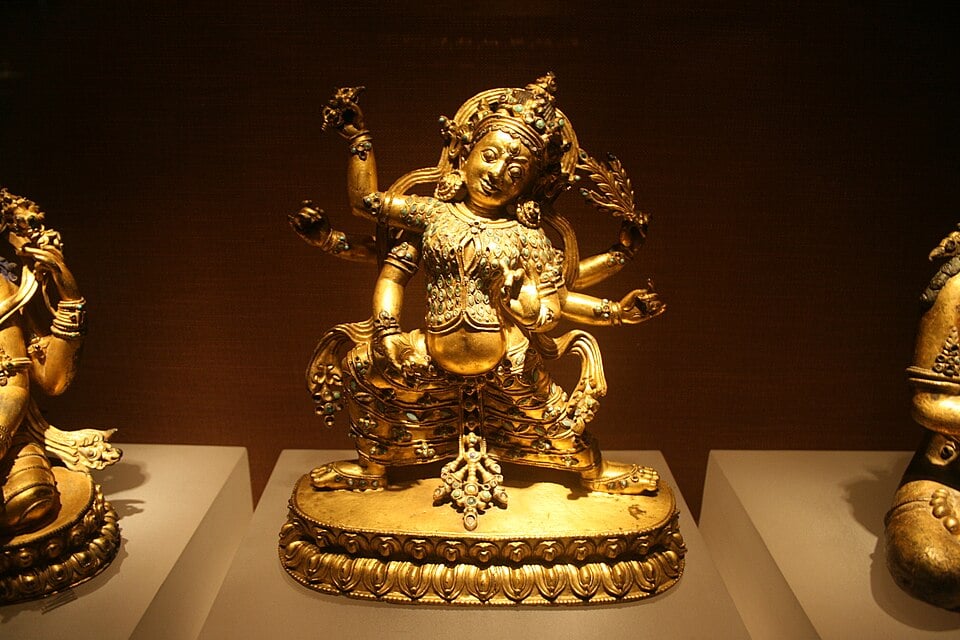
The goddess appears about halfway through the Vimalakirti Sutra, a Buddhist scripture. Her story seems simple but does a lot of doctrinal heavy lifting. Among other things, she tells us that male and female are empty designations that are not as real as we think they are. The goddess demonstrates this by causing a disciple of the Buddha to appear in her shape, while she assumes his male body. “The Buddha teaches that all phenomena are neither male nor female,” the goddess says.
If you are familiar with the Virginia Wolff novel Orlando, published in 1928, or the 1992 film of the same name starring Tilda Swinton, you might remember a similar scene in which a young man wakes up as a woman and realizes it makes no difference. But the goddess story is believed to have been written in about 100 CE, nearly two thousand years ago.
About the Vimalakirti Sutra and Other Buddhist Scriptures
To help you better appreciate what’s going on in the story I first need to provide some nerdy context about Buddhist scriptures, including sutras. First, the Sanskrit word sutra, which means “thread,” is used in Buddhism to designate a major discourse or sermon, often by the Buddha or a major disciple.
Buddhism has no single scripture that is the equivalent of the Bible or the Quran. Instead, there are three major canons of Buddhist scripture, each called by the language in which they were recorded — the Pali Canon, the Chinese Canon, and the Tibetan Canon. These correspond to the three major divisions of Buddhism. (For more about these divisions and how they happened, please see an earlier post, The Quest for Original Buddhism.) Each canon contains hundreds of scriptures of many sorts — sutras, commentaries, rules for the monastic orders, poetry. All three contain versions of several of the same texts, but there are many revered Buddhist scriptures that are missing from one or two of them.
The Vimalakirti Sutra is found in the Tibetan and Chinese canon, but not the Pali. It is one of the Mahayana sutras. Mahayana is a designation for a body of teachings accepted by Buddhist schools throughout east Asia and Tibet, but not so much in the Theravada school that dominates southeast Asia. Most of the Mahayana sutras are believed to have been written in India between the 1st century BCE and the 5th century CE, although some were written later. Their authors are unknown. Many of them present their teachings through stories and parables.
Please note that Buddhism has a different relationship with its scriptures than many other religions. In one of the most famous sermons of the historical Buddha preserved in the Pali Canon, the Kalama Sutta, the Buddha advised us not to believe things just because they are written in a scripture. Buddhist scriptures present pointers to truth, not truth in itself. They are guides on a path, teachings to be reflected upon and tested, not accepted uncritically. And for the most part the stories in the Mahayana sutras are not meant to be taken literally. If a goddess appears, it’s fine to understand her as a literary device. What’s important is what she is teaching.
The Goddess Scatters Heavenly Flowers
The Vimalakirti Sutra is a long narrative that centers on an enlightened layman and disciple of the Buddha named Vimalakirti. And for the record, Vimalakirti is not considered to be a historical person but is more of a literary invention. Most of the teachings of the sutra are presented in the form of dialogue between Vimalakirti and elite bodhisattvas, enlightened beings, notably Manjusri (also spelled Manjushri. Manjusri is an iconic figure who represents wisdom, in particular the perceptive of the true nature of existence. Most of the narrative takes place in Vimlakirti’s home, and many great bodhisattvas and disciples of the Buddha are in attendance.
When the goddess, who is not given a name, appears, she interrupts an intense conversation between Vimalakirti and Manjusri. She scatters heavenly flowers over the bodhisattvas and disciples. One of the disciples is Shariputra (also spelled Śariputra), who is considered to be a historical person and a chief disciple of the historical Buddha. Here and in several other Mahayana sutras Shariputra represents the Theravada tradition and must have Mahayana teachings explained to him.
The flowers fall away from the bodhisattvas but stick to the disciples, who frantically try to brush them away. The goddess asked Shariputra, “Why try to brush off the flowers?”
“Such flowers are not in accordance with the Law,” he replied.
But the goddess dismissed this response. “The flowers make no such distinctions,” she said. “You and your thinking make up these distinctions.” The flowers fell away from the enlightened bodhisattvas because they see the truth of the nature of existence and have cut off all such distinctions.
No Male, No Female
After more conversation, Shariputra finally asks, “Shy don’t you change out of this female body?” In the Burton Watson translation of the Vimalakirti (Columbia University Press, 1997), Watson adds a footnote — “Shariputra assumes that any woman would naturally want to change into a man if she had the power to do so.”
But the goddess replied, “What is there to change?” She then asked Shariputra if he would ask the same question of a phantom woman. No, he said; phantoms have no fixed form. “All things are like that,” the goddess said. “They have no fixed form.” And suddenly Shariputra appeared in her body, and she appeared in his. Then the goddess asked, “Why don’t you change out of this female body?” Shariputra was perplexed.
The goddess said, “Shariputra, if you can change out of this female body, then all women can change likewise. Shariputra, who is not a woman, appears in a woman’s body. And the same is true of all women—though they appear in women’s bodies, they are not women. Therefore the Buddha teaches that all phenomena are neither male nor female.” [Burton Watson translation]
Nonduality in the Vimalakirti Sutra
If you are utterly puzzled, you are certainly not alone. The point the goddess is making seems counterintuitive and takes most of us time to realize for ourselves. The sutra touches on a lot of doctrines, but nonduality is a central one. I will take a stab at explaining this.
The Buddha taught that all phenomena are caused to come into existence by other phenomena. As described in the Pali Suttapitaka,
When this is, that is.
From the arising of this comes the arising of that.
When this isn’t, that isn’t.
From the cessation of this comes the cessation of that.
From this, Mahayana Buddhists proposed that all phenomena inter-exist. Nothing exists separately and independently from everything else. And a thing that has no independent existence cannot be said to exist in and of itself. All designations, including “male’ and “female” are determined only by a phenomenon’s relationship to other phenomena. When Shariputra tells the goddess “The form and shape of my female body does not exist, yet does not not exist,” he was expressing a common teaching in Mahayana literature, that individual phenomena may be “real” in a relative sense, but not in an absolute sense.
More About the Vimalakirti Sutra
The Vimalakirti has long been one of the most popular of the Mahayana sutras. It’s far more readable than most — frankly, as literature, many Buddhist scriptures can be a slog to read. For many centuries it was thought the original Sanskrit text of the Vimalakirti was lost. It was preserved in several Chinese translations, the most famous by Kumarajiva (344–413 CE). The Burton Watson translation I’ve been citing is from Kumarajiva. There also were two Tibetan translations. But in 2001 a Sanskrit manuscript was found in Potala Palace in Lhasa that scholars believe is the original Sanskrit.
One more note about the goddess — about the time (I think) the Vimalakirti was written, a belief had emerged in the Theravada school of Buddhism that claimed women had to be reborn as men to enter Nirvana. I do not know where it originated; the sermons of the historical Buddha say no such thing. The goddess’s teaching in the Vimalakirti appears to refute that idea without explicitly naming it. Even so, this idea about no women in Nirvana would spread through much of Buddhist Asia in the centuries to come. But it really makes no sense.













 Ad-Free & Subscriber Log-In