

There are some things in religious conversations that can seem taboo. The relationship between religion and science is one of those. Much of the reason for that is a bias we have inherited from early 20th-century evangelicalism and fundamentalism. When Darwinism began reshaping the cultural landscape, conservative Christian leaders perceived it not as an intellectual opportunity but as an existential threat. Their response was defensive and, in many ways, catastrophic for the long-term credibility of faith in the public square. Rather than asking what evolutionary biology might reveal about the God who ordered creation, they dug in. They lobbied school boards, rewrote curricula, and declared the whole enterprise spiritually dangerous. It worked — in the short term. But the cost was a generational suspicion between faith and science that we are still paying for today.
What is often missed in that history is the tragedy of a missed opportunity. Science, pursued honestly, has never been the enemy of a serious theology. The natural world — its structure, its patterns, its staggering complexity has always been one of the primary languages through which thoughtful people have encountered the divine. To wall theology off from scientific discovery is not to protect it. It is to slowly suffocate it.
With another hundred years or so under our belt, the picture has shifted considerably. Most people no longer experience science and faith as locked in a zero-sum war. The conversation has matured. Thinkers on both sides have done the difficult work of nuance, and a growing number of theologians, scientists, and practitioners have begun asking better questions — not whether God and science can coexist, but what they might actually illumine in each other when brought into honest dialogue.
Despite that shift, something has been missing. For all the progress in the conversation, you still have yet to see any major theological integration of cutting-edge science into mainstream theological belief systems. The popular church has largely been content to wave at science from a distance without doing the harder work of genuine integration.
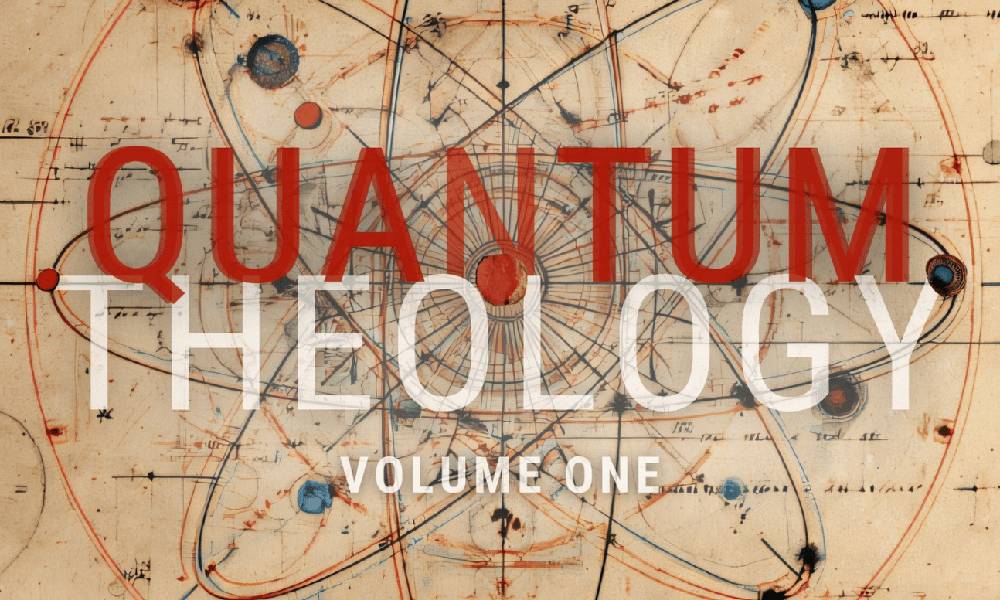
A new collection published by Quoir, Quantum Theology (2026), is trying to resolve that.
What Is Quantum Theology?
The book brings together a remarkable range of voices — theologians, scientists, mystics, and practitioners — all asking a version of the same question: what happens when the discoveries of quantum physics press themselves against our oldest convictions about God? What does it mean that reality, at its most fundamental level, is relational rather than mechanical? That particles behave differently when observed? That quantum entanglement connects distant objects in ways no classical physics can explain?
Quantum physics has dismantled the Newtonian universe piece by piece. What it has left in its place is not chaos but something far more interesting — a reality that is dynamic, relational, and irreducibly participatory. At the subatomic level, nothing exists in isolation. Everything is entangled with everything else. Observation shapes outcome. The observer is never truly separate from what is observed. These are not fringe ideas. They are the settled conclusions of the most rigorously tested field of science in human history.
The contributors to Quantum Theology don’t all arrive at the same destination. They represent genuinely different theological and scientific starting points. But the questions they are asking feel alive in a way that most Christian theological books do not. There is real intellectual risk in these pages, and that alone makes it worth your time.
A New Approach to the Doctrine of the Trinity
I had the privilege of lending my voice to Quantum Theology. My chapter is called The Psycho/Social Trinity, and it begins with a provocation.
For centuries, Christian theology has tried to understand the Trinity by starting with Jesus. What was his nature? How was he simultaneously divine and human? What was his ontological relationship to the Father? These are not bad questions — they produced some of the most sophisticated thinking in the history of Western philosophy. But they also produced councils drenched in political maneuvering, centuries of schism, and a doctrine that many people confess without ever really inhabiting.
The Council of Nicaea did not settle the question. It politically contained it. The Arian controversy did not end in 325 AD — it simply went underground, resurfacing in different forms across the following centuries. What was forged in those councils was as much a product of imperial politics as theological clarity. Constantine needed a unified church as much as the church needed an emperor’s protection, and the resulting theology bears the marks of that transaction.
That is not a cynical reading of church history. It is simply an honest one. And honesty requires us to ask: is the Trinitarian doctrine we inherited the clearest possible articulation of a genuine theological reality, or is it a historically conditioned approximation that we have been too afraid to revisit? My chapter argues for the latter — not to abandon the Trinity, but to find a more coherent way into it.
What if the doctrine of the Trinity made more sense if we started somewhere else entirely?
The Image of God and the Human Mind
Genesis tells us that humanity is made in the image of God — the imago dei. If that claim means anything, it means that humans carry something of a divine imprint. Not as metaphor or pious sentiment, but as a genuine structural reality. The text does not say we were made to think about God, or to worship God, or to obey God — though all of those follow. It says we were made in God’s image. Something of the divine architecture is replicated in us.
If that is true, then understanding the Trinity might run not through the councils of Nicaea but through a serious engagement with what human consciousness actually is and how it connects us to everything. The path to God may be shorter than we imagined — not because God is small, but because the image is closer than we think.
Augustine glimpsed this. Around 400 AD, in De Trinitate, he proposed that the unity of God resembles the unity of the human mind, and that the three persons of the Trinity could be understood through three interconnected mental faculties: Memory, Understanding, and Will. It was a genuinely original insight — and it was unfinished. He was constrained by the philosophical tools of his age, the Neo-Platonic categories he inherited, and the political pressures of a church still consolidating its authority. He saw the door but did not have the key to open it fully.
What Augustine could not have known is what we now understand about human consciousness, about quantum physics, and about the relational nature of reality itself. The cognitive sciences, depth psychology, and neuroscience have given us a far richer vocabulary for describing the structure of the human mind. And quantum physics has revealed a universe whose deepest feature is not matter but relationship. Both of these developments, I argue, have profound implications for how we understand the Trinitarian God.
Will, Word, and Consciousness: A Trinity That Makes Sense
My chapter argues that when these insights are taken seriously, the Trinity comes into focus in a way that is not only philosophically coherent but personally compelling. The Divine Mind — as Will, Word, and Consciousness — does not need to be defended as an abstract metaphysical formula. It can be recognized, at least in part, because its pattern is already echoed within us.
The Father, as Divine Will, is the originating movement within the divine life — not mere preference or desire, but the eternal orientation of God toward goodness, creation, and self-giving. Will, in the deepest sense, is what stands behind every act. It is the primal “yes” at the heart of reality. Everything that exists does so because a divine intentionality willed it into being and sustains it there. When Jesus speaks obsessively about doing the will of the Father, he is not performing submission — he is revealing what lies at the center of all things.
The Son, as Divine Word or Logos, is the eternal self-expression of that will. If the Father is the deep intention of God, the Son is how that intention becomes intelligible — articulate, personal, relational, and finally incarnate. The Logos is not an abstract principle. He is a person in whom the entire divine self-disclosure becomes flesh and takes up residence in human history. The incarnation is not a rescue mission tacked onto a plan that went wrong. It is the eternal “yes” of God spoken with human breath.
The Spirit, as Divine Consciousness, is the living awareness that unites Father and Son and breathes that communion into the world. Consciousness is not something the mind produces — it is the ground in which all mental activity occurs. The Spirit is the divine ground of awareness, the atmosphere in which the Father wills and the Son speaks, and the same presence that draws human consciousness into contact with the divine life. This is why the Spirit’s work is always described in relational terms — as advocate, comforter, guide, and unifier.
This is not a rejection of classical Trinitarian theology. It is, if anything, a more robust foundation for it — one that connects the best of the early Church Fathers to contemporary understandings of the mind, consciousness, and the relational fabric of the universe quantum physics keeps revealing. The early creeds were attempts to say something true about a reality that exceeded the philosophical tools available to say it. We have better tools now. We owe it to the tradition — and to the God it points toward — to use them.
There is much more to say about what that means, and why it matters not only for Christian theology but for the way we understand ourselves, our communities, and our calling. It has implications for how we practice prayer, how we understand the Church, and how we engage a world that is increasingly hungry for a faith that takes both God and reality seriously. But I will let the chapter make its case.
Read Quantum Theology
Quantum Theology is available now from Quoir. Whether you are a lifelong Christian, a skeptic, or somewhere in the restless middle, this book will press you to think more carefully — and more honestly — about the nature of God, the nature of reality, and why those two questions may not be as separate as we assumed.
You can view my UNenlightenment YouTube Channel HERE
You can view my UNenlightenment Podcast HERE
You can follow me on FaceBook HERE
Transform your life today by getting my book UNenlightenment HERE
Purchase my newest book The Kingdom of Man HERE













 Ad-Free & Subscriber Log-In