


It is perhaps the most clichéd idiom in all Christianity: “God loves you”. It can often be heard uttered to non-believers as part of a larger presentation of the Gospel and to believers as an encouraging platitude. Outside of these instances, how much is really known about the love of God?
To begin to understand this, we should ask a more generic question: How does someone know when they have been loved? Is it through language? Is it through gifts or sacrifice? All of these could very well be given to someone in a context outside of love. Are there any attributes that solely belong to love? After reflecting on my own experiences of when I have felt loved, it has been more about how I have received the gift of someone’s words or actions, more than the intention behind their expression.
These questions leave us with a more fundamental question: Does love have its own nature, or is it completely contingent upon how it is received? We might also ask: Does the intention of the giver have to be one of love, and with that, does it have to be received as love for it to manifest as such? All of these questions go to the essence of love.
These questions illustrate the many dimensions of love. Despite the fact that it is a predominant theme throughout the New Testament, very little has been written on the subject from a theological perspective.
How does God love?
If human love is this complicated, then certainly God’s love would be much more difficult to understand. Or is it? I think most Christians would say they believe God loves them. And, when asked how they know that, most would say it was because “the Bible tells me so”. But asked how often they felt loved by God, and many would find it difficult to answer. I am one of those people. I know God loves me from an intellectual perspective (the Bible tells me so), but there are not very many occasions where I can pinpoint moments I have felt loved by the Almighty. At least not in the same way that I have felt loved by others.
You might wonder how we judge such moments of God’s outpouring. Certainly, we all would point to the sacrifice of Jesus, the one and only Son, as a monumental moment of divine love. But, even then, that moment seems hollow apart from other things to accompany it (sin, selfishness, hell, etc.).
Even in the deepest moments of pain and despair, it has only been the company of friends and family that I have felt the most loved. This is why I have come to believe that God’s love is manifested through the willingness of others to love on his behalf.
God is not inept to love his creation directly, as was demonstrated through Jesus. Instead, he chose people to love others in his name. Just as Jesus demonstrated love to those around him in the name of the Father, so too are we to follow the same example by loving others in the name of God.
So much more could be said about this, and recently, something more has been said.
John Armstrong:
The Transforming Fire of Divine Love
Every now and then, I get sent a book to review. However, I am very picky about those I would be willing to endorse. I’m even more discerning about the books I would be willing to endorse on Patheos. I do this because I know my reader’s time is valuable and I’m sure many have hordes of other books waiting to be read. This is why I only share with my readers the best resources for building their faith.
Enter John Armstrong, A retired pastor, ministry leader, and author who has 50 years of ministry experience under his belt. Recently, Armstrong published a book called The Transforming Fire of Divine Love: My Long, Slow Journey into the Love of God.
Don’t let the poetic title fool you; this is far from an afternoon walk in the park. Armstrong’s book can be described as a theology of love. Writing from his cache of wisdom, we are given yet another example of the dangers of evangelical theology gone uninspected.
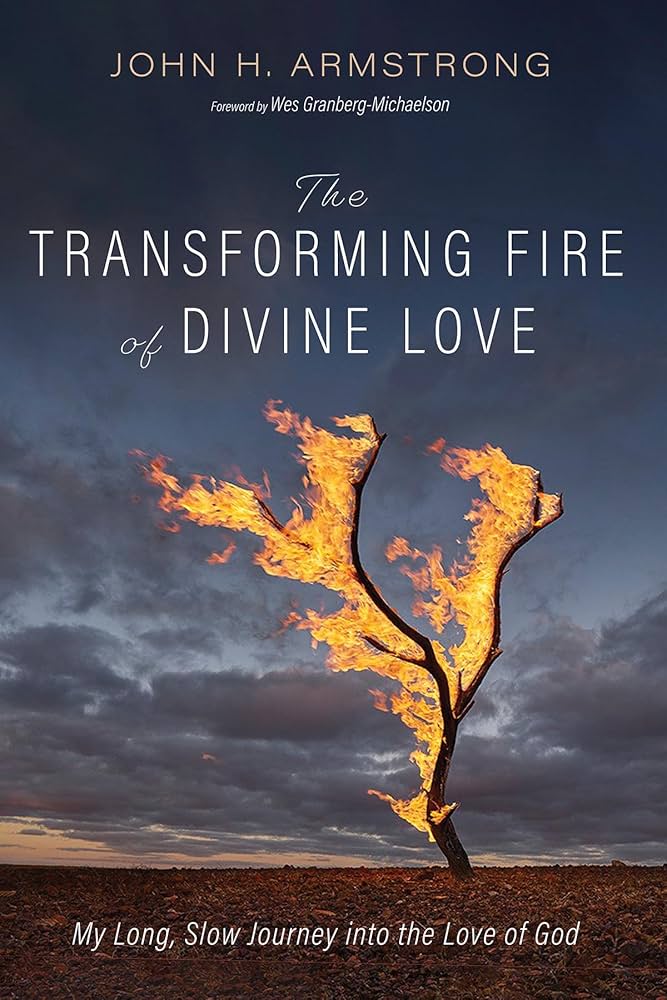
In a soft deconstruction surrounding the nature of God, readers will find Armstrong’s journey familiar, and his insights into the nature of God unique and challenging, yet practical. He provides the intellectual insights of a theologian with the heart of a pastor.
Although there are many things to like about Armstrong’s book, there are two things that stand out to me.
1. It’s about the journey.
Although Armstrong is bringing us through his intellectual journey of discovering God’s love, the book does not read like a fluffy narrative meant to tug at your heartstrings. Instead, we are given a before-and-after snapshot of the various theological themes related to God’s nature, comparing and contrasting his evangelical training in Calvinism to his current perspective and the rationale behind the change.
Anyone willing to re-evaluate their beliefs after ministering for so long deserves the highest form of recognition.
2. The truth
I have long believed that there is not a single perspective that has everything right. From the far right to the far left, God can use anyone to communicate with his people. We should all let truth be our guide, not ideology. This is the same perspective Armstrong brings, as demonstrated through his use of a wide range of thinkers. His book is a refreshing, unbiased presentation of a theme that has long been ignored by theologians.
In a time of extreme polarity, Armstrong provides us with the best of both worlds to help us better understand God’s nature and love. The Transforming Fire of Divine Love is a great reminder of why many of us set out to do ministry in the first place.
Readers will not agree with everything Armstrong has to say. And unless someone lives in an echo chamber, that should be our practice anyway. But most assuredly, readers will come back with practical, thought-provoking insights into the love of God that can not only impact your ministry but also transform your relationship with God in profound ways.
Final Thoughts
In the Gospels, we are told the story of when the religious leaders tried to trick Jesus by asking a question they knew would force him to “show his hand”. It was a question long debated by Jewish religious scholars: What is the greatest commandment?
Although they were trying to force Jesus to pick one commandment and thus ostracize a whole contingent of his followers, Jesus turned the tables by stating that all of the commandments could be summarized into a single axiom: love God and love your neighbor.
The religious leaders never understood that following God had nothing to do with right doctrine (Torah/Commandments). They were seeing God as too small. Instead, anytime Jesus was challenged intellectually, he responded with illustrations of love. He did this to illustrate that nothing is greater than loving God and loving others – not even doctrine.
Unfortunately, today, many still have the same view of God. However, with the help of religious leaders like John Armstrong, we are reminded that preaching the Gospel is not about spreading our theological opinions about God. Instead, it’s about testifying to the great love God has for his creation and the hope that accompanies it.
You can view my UNenlightenment YouTube Channel HERE
You can view my UNenlightenment Podcast HERE
You can follow me on FaceBook HERE
Transform your life today by getting my book UNenlightenment HERE
Purchase my newest book The Kingdom of Man HERE
















 Ad-Free & Subscriber Log-In