

I have been to enough funerals to know that the days after are the hardest. The service itself has a kind of structure that holds you. There are words to say, hands to shake, and a casserole someone brought that you will not remember eating. But when the mourners leave, and the silence settles in, you are left with the same question that has haunted human beings since the beginning: Is that it? Is that all there is?
Last December, I wrote a eulogy. Not for a person, but for a Church — or at least for a version of it I had given twenty years of my life to. I called it “A Eulogy for a Sleeping Church,” and I meant every word of it. I was done. Burned out, frustrated, and not at all sure I had anything left to say that had not already been said. I had poured myself into Evangelicalism for two decades — teaching, writing, preaching, arguing, hoping, and what I had to show for it was exhaustion and a growing suspicion that the institution had never wanted what I was offering in the first place.
For many in ministry, the calling was never complicated: find the hopeless and bring them hope. What exhausts them is not the work — it is the endless energy spent navigating a Christianity that has made exclusion its primary language. The tragedy is not just institutional. It is personal. There are people who will never encounter the love of Christ because the loudest voices claiming to represent him have already done irreversible damage.
But the thing about Christianity – the thing that makes it unique is in the type of hope that it offers. Not just for people outside of the Church, but even ministers within it.
This belief constantly reminds me that in the Christian tradition, the eulogy is never the final word.
What the Tradition Has Always Known About Death
Many of us look at Christianity as a religion built on immortality — that is something different, something Greek, the idea that the soul escapes the body and floats free of the mess of history. Instead, Christian identity is at its core about resurrection. Resurrection is not escape. It is a return. It is the claim that what died comes back — not unchanged, not unmarked, but genuinely, bodily, concretely alive again. The wounds are still there. The story is still true. But death does not get the last word.
The Apostle Paul understood that this is not merely a doctrine to be affirmed but a logic to be lived. In his first letter to the Corinthians, he stakes everything on it: if Christ has not been raised, your faith is worthless, you are still in your sins, and everyone who has died in hope has simply died. He is not hedging. He is saying that the resurrection is the load-bearing wall of the entire structure. Remove it, and everything falls.
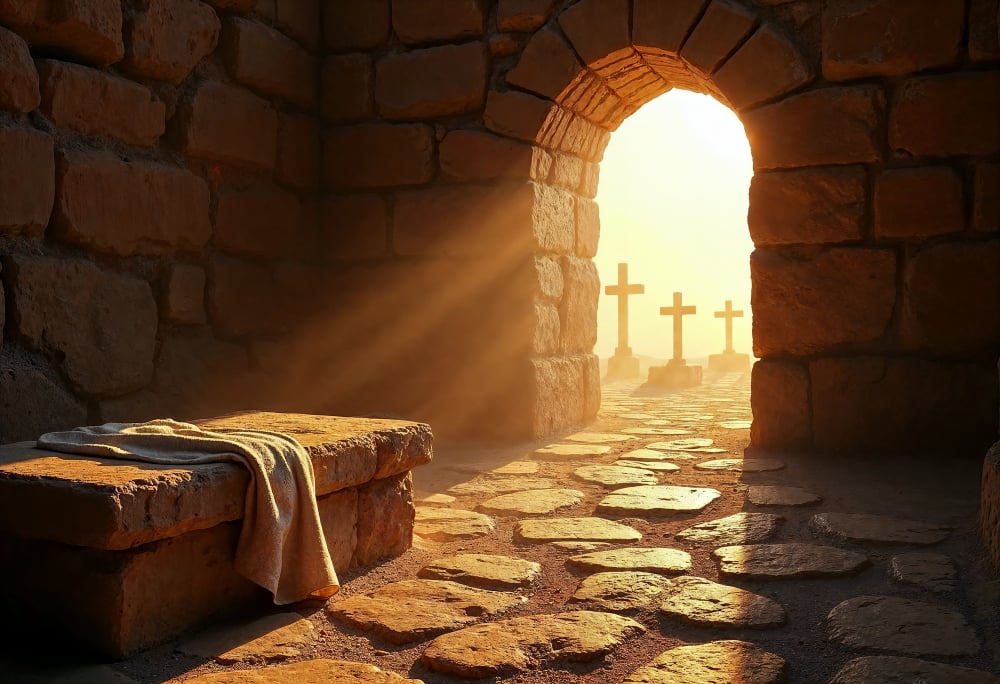
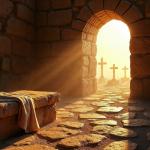
But Paul’s point cuts the other way too. If the resurrection is real, if death genuinely does not have the final word, then that changes everything about how we are permitted to read our own stories. It means the eulogy is never the last chapter. It means the silence after the service is not the silence of an ending. It is the silence of a Saturday — the day between the cross and the empty tomb, when no one yet knew what was coming.
Resurrection Is Not Resuscitation
Here is where I want to be careful, because resurrection is a word that gets softened into something manageable for our human brains. It becomes a metaphor for recovery. A way of saying things got better, you turned it around, the hero found their footing again. That reading is not just shallow — it is a different story entirely.
Resurrection in the New Testament is not the resuscitation of what was. Lazarus was resuscitated — he came back and eventually died again. The risen Christ is something else. He bears his wounds but is not bound by walls. He is recognized and then vanishes. He eats fish on a beach with his friends. He is the same person and he is not the same person. What the gospels are trying to describe is not a reversal of death but a transformation through it.
This matters enormously for anyone trying to rebuild after a season of genuine loss. The goal is not to get back to where you were. The institution you grieved may not deserve to be rebuilt. The certainties that dissolved may not have been worth keeping. The version of faith you practiced before the eulogy was spoken may have needed to die precisely so that something truer could take its place. Resurrection hope is not nostalgia. It is the insistence that what comes next can be more real, more honest, and more alive than what came before — because it has been through something.
Hope Does Not Belong Only to the Certain
One of the most damaging lies the institutional Church has told is that hope is a reward for the faithful — that it belongs to those who have their theology straight, their doubt managed, their attendance consistent. By that logic, the burned-out pastor has forfeited it. The disillusioned elder has disqualified herself. The person sitting in the parking lot, unable to walk through the doors again, has wandered beyond its reach.
But that is not the resurrection story. Mary Magdalene was not composed at the tomb. She was weeping. She did not recognize the risen Christ at first — she thought he was the gardener. The encounter came before the understanding. The hope arrived before she had worked out what to do with it. That sequence matters. Resurrection hope is not the destination you reach once you have rebuilt. It is what makes rebuilding possible in the first place.
There are believers and unbelievers inside the Church just as there are outside it. When Jesus speaks of the downtrodden, the mourning, the ones who hunger for something real, he is not describing the unconverted. He is describing a condition — one that does not stop at the sanctuary door. The burned-out pastor qualifies. The exhausted leader qualifies. The ostracized layperson qualifies.
What Comes After the Eulogy
I am not going to pretend I have arrived somewhere tidy. I have not. The grief in that December piece was real, and grief does not resolve on a schedule. But something has shifted. There are still people longing for something that is not performance, politics or institutional theater. These people remind me that the Gospel has always been most alive at the margins. It breathes freely outside the walls we build around it. Every time the Church has tried to contain it, brand it, or weaponize it, it has escaped and gone back to doing what it was always doing: finding the people no one else was looking for.
What comes after the eulogy is not a rebuilt institution. It may not be an institution at all. What I feel being called toward is something older and less managed: honest conversation, genuine formation, a faith practiced among the seekers and the wounded and the quietly faithful who never quite fit the mold they were handed. Not because they are a niche demographic but because they are, as best I can read the Gospels, exactly who Jesus kept walking toward.
The resurrection did not restore the Temple. It did not rehabilitate the Pharisees or recommission the disciples into the same work they had been doing before. It sent them out into something new, marked by what they had been through, carrying wounds that had become the very evidence of what was true. That is the pattern. That is what comes after the eulogy. And that is what we have forgotten.
Concluding Thoughts
If you read the December article and recognized yourself in it, this is what I want you to hear: the silence you are sitting in is not the silence of an ending. It is Saturday silence. The kind that feels final but is not. The kind that the whole tradition insists is one day away from something it does not yet have words for.
Grief is not the opposite of faith. It is often its most honest form. A faith that has never been asked to survive loss is a faith that has never been asked to do very much. What comes after the eulogy — what is already beginning for many of the people who reached out — is not a return to what was. It is something that could not have existed without the dying.
The tomb is not the last scene. Stay in the story long enough to find out what comes next.
You can view my UNenlightenment YouTube Channel HERE
You can view my UNenlightenment Podcast HERE
You can follow me on FaceBook HERE
Transform your life today by getting my book UNenlightenment HERE
Purchase my newest book The Kingdom of Man HERE











 Ad-Free & Subscriber Log-In