

Preachers can counter Christian Nationalist ideology this July 4th with a sermon series grounded in the biblical witness of freedom as responsibility, compassionate resistance, and courageous dissent.

Christian Nationalism and America’s 250th Anniversary
As the U.S. prepares to commemorate the 250th Anniversary of the country’s founding, Christian Nationalist messaging is on the rise.
Prominent public leaders claim that the founders established America as a white Christian nation. Efforts are ongoing to erase the history of chattel slavery in the U.S. And state-sponsored Christian gatherings such as the “Rededicate 250” prayer rally on the National Mall push Christian Nationalist propaganda under guise of “One Nation Under God.”
In response, Christian preachers must counter Christian Nationalism. Sermons during this time should be grounded in the biblical witness of freedom as responsibility and citizenship shaped by mercy and love of neighbor. Preachers can reclaim a love for country that is rooted in God’s call for justice, ethics, and compassion.
On June 9, the Clergy Emergency League and Wisconsin Council of Churches will host a webinar on “Preparing for July 4th Worship: A Workshop to Resist Christian Nationalism.” We will suggest hymn and liturgy options, prayers, reflection prompts, and denominational materials that invite congregations into faithful conversation about Christian identity differentiated from national power.
July 4th Sermon Series for Resisting Christian Nationalism
In my part of the workshop, I will offer sermon-series ideas for framing July 4th biblically, theologically, and ethically. Below are three simple, adaptable sermon arcs based on the Revised Common Lectionary and the Narrative Lectionary for June 28 and July 5, the Sundays before and after America’s 250th Anniversary.
Two Sermon Series for Readings in the Revised Common Lectionary, June 28 and July 5

SERIES TITLE: Freedom Restrained by Love — Inverting Power, Embracing Equality*
Texts: Romans 6:12-23 (June 28), Romans 7:15-25 (July 5)
Summary of the Texts
In Romans 6 and 7, Paul provides an ethical and theological framework for a diverse community living under the shadow of Roman militarism and systemic violence. Writing to both Jewish and Gentile believers who were all too familiar with a culture where the Empire enacted “peace” through force, Paul describes what it means to experience liberation through Christ.
In Chapter 6, Paul argues that true freedom is not the individualistic permission to do whatever one wants. Such a path leads to sin and death. Instead, he insists on a freedom restrained by love. This type of freedom directs us away from hatred and toward justice, inclusivity, and compassion for our neighbors.
Internal Struggle
In Chapter 7, however, Paul acknowledges the intense internal struggle inherent in this transformation. He describes the human dilemma of the law “at war” within himself, famously stating, “I do not understand my own actions. For I do not do what I want, but I do the very thing I hate.”
This conflict between the “law of the mind” that delights in God and the “law of sin” dwelling in the flesh creates a sense of captivity. Paul’s honesty about his own wretchedness leads to the question: “Who will rescue me from this body of death?”
The resolution to this struggle is found in the grace of Jesus Christ whose command to love sets people free. Amid the struggle between society’s norms and God’s values, believers are empowered to live in a way that inverts worldly power. We find true strength in vulnerability, while equity, compassion, and mercy replace status.
Lessons from Romans 6 and 7 for Resisting Christian Nationalism
In the lead-up to July 4th, when Christian Nationalist ideology often masks acts of hatred and retribution as personal freedom, Paul’s teachings in Romans 6 provide a critical corrective. Resisting nationalist distortions requires us to embrace a freedom restrained by love, which binds our hearts to Christ’s ways of justice, inclusivity, and active compassion.
We can refuse to “give sin a vote” (Romans 6:12-14, The Message) in how we conduct our lives, thus rejecting the old tyrannies of exclusion. Paul’s words remind us that our wellbeing is tied to the degree to which we enact compassion for the “other.”
In a pluralistic society, resisting Christian Nationalism requires us to acknowledge that while we are free to worship Christ, we must not impose our faith on our neighbors. This requires a commitment to interfaith dialogue and peace-building that intentionally breaks down walls of cultural purity. Instead, we can build bridges of love across borders and cultural lines of division. Christian love requires us to ensure that we preserve the freedoms of our neighbors, regardless of their faith or background.
Humility Counters Self-Righteousness
Furthermore, the “internal struggle” described in Romans 7 serves as a vital check against the self-righteousness and moral certainty of nationalist movements. Paul models a posture of humility and repentance that counters the distortions of a version of Christianity that prioritizes judgment and social hierarchies.
Recognizing our own “wretchedness” and need for rescue leads us away from the pursuit of national dominance and toward the grace of Jesus Christ. This grace empowers us to stand with the vulnerable and reject the use of faith for coercion or political purposes.
Ultimately, the lessons of Romans 6 and 7 call for an inversion of worldly power. While Christian Nationalism seeks status and exceptionalism, the Kingdom of God reveals that true strength is found in by standing for equality with our neighbors.
SERIES TITLE: A Cup of Cold Water and a Prophet’s Reward

Texts: Matthew 10:40-42 (June 28) and Matthew 11:16-30 (July 5)
Summary of the Texts
Matt. 10 and 11 are the teachings following Jesus’s Sermon on the Mount. In these chapters, Jesus sends his disciples into the surrounding towns to offer compassion, healing, and transformative love to those suffering under oppressive systems. A simple cup of water offered to one in need is enough to earn a “prophet’s reward.”
Yet when Jesus, John the Baptizer, and their respective disciples brought this message of compassion into communities hardened by hypocrisy and sin, many rejected them.
People criticized John for his abstinence and ascetic discipline while also criticizing Jesus for eating and drinking with social rejects. In other words, the “cancel culture” of their day found any reason for quashing the call to repentance, even if it meant contradicting themselves.
Reinsert Jesus’s Critique
The RCL cuts out vv. 20-24 in chapter 11, perhaps trying to soften Jesus’s harsh critique of cities that remained unrepentant. But the preacher may want to include these verses, reminding listeners that Jesus did not mince words when it came to calling out those who refused to change their treatment of the poor.
And it is to those in poverty whom Jesus speaks with tenderness. In 11:28-30, his words are like a cup of cold water in a parched desert of indifference. He promises accompaniment, shared burdens, gentleness, humility, and rest. Both the giver and receiver of compassion are gifted with the “yoke” of Christ.
Lessons from Matt. 10 and 11 for Resisting Christian Nationalism
In response to the onslaught of federal policies targeting vulnerable communities, communities of faith have been at the forefront of resistance. From high profile events of public witness to behind-the-scenes work of mutual aid, churches engaged in political action root their activism in long-standing religious commitments. Their efforts extend the “cup of cold water” to immigrants, transgender people, people of color, and others who are in need of advocacy and support.
But the “prophet’s reward” comes at a cost. Federal agents have assaulted many faith leaders with chemical weapons and pepper balls for protesting. Renee Macklin Good, described by her wife as a Christian motivated by her faith to help others, was murdered by an ICE agent in Minneapolis.
Federal forces may have assumed their violence would silence critiques and halt the protests. However, just the opposite occurred. Houses of worship and people of faith organized and worked together in even greater numbers to protect their communities.
The Prophet’s Reward
In this way, the prophet’s reward is being part of a force to be reckoned with. It is a force for goodness and fierce compassion that gets back up after it has been knocked aside and says: we will not back down from this ministry.
We are called to welcome the prophets, the righteous ones, and the ‘little ones’ – the vulnerable ones – who are in need of a cup of cold water to quench their thirst and wash the tear gas from their eyes.
This is the prophet’s reward. The persecution and the empowerment. The tear gas and the eye wash. The concussive grenades and the shouts of protest, laughter, and singing. The flagrant violation and the flagrant grace.
People are waking up. Eyes are opening. And Jesus stands with us as we carry this yoke of righteousness.
Sermon Series for the Narrative Lectionary, June 28 and July 5
SERIES TITLE: Practicing Community Courage “For Such a Time As This”

Texts: Esther 4:1-17 (June 28); Esther 7:1-6 (July 5)
Summary of the Texts
Esther and her uncle, Mordecai, lived under an oppressive regime intending to destroy their people through genocide. The patriarchal rule of a brutal dictator combined with the fragile ego of his highest administrator could tolerate no dissent or perceived disrespect.
When the decree announced the plan for destruction, there seemed to be no options, since neither of them had much power. Even Esther, who hid her Jewish identity and passed as royalty, would not survive.
Moral Courage and a Community’s Spiritual Discipline
But Mordecai called Esther to step into the courage of her people, exercise her voice, and use her position as the king’s wife to prevent the slaughter. She, in turn, called on her people to enter a period of spiritual discipline through fasting. This was a form of sustained nonviolent resistance in the face of seemingly insurmountable evil.
Esther then bravely requested an audience with the king, which he granted. After honoring him with two days of feasting, Esther revealed the reason for her petition – to prevent the destruction of her people. The king reversed the order and punished the evil administrator for his treachery.
To this day, Jews celebrate Esther’s bravery in the Feast of Purim.
Lessons from Esther for Resisting Christian Nationalism
Under the current U.S. regime, many groups have lived under oppression through ICE raids, unlawful detention in concentration camps, and forced deportation. The brutal nature of the administration, combined with fragile egos, has led to uncounted violations of human rights and deaths. Even those who thought themselves safe are learning that chaos and corruption are wreaking havoc across the country.
It may seem that there are few options for resisting. However, many are stepping into the courage required for this time. Demonstrations at detention centers have drawn attention to the inhumane conditions detainees endure. Protestors have taken to the streets to exercise their voice. And judges are using their positions to halt abuses against the rule of law.
Ancient Stories of Resistance Fuel Efforts for Justice
Sustained nonviolent resistance rooted efforts for civil rights and social change in our country’s history. Today, many Christians are rediscovering the spiritual discipline of collective dissent and community-building practices such as mutual aid societies. In a democracy, Christians can leverage ancient stories like Esther and Mordecai to fuel contemporary efforts for justice.
As we learn from the book of Esther, the spiritual discipline of faithful dissent can take many forms. From prayerful fasting to bold intervention, God sustains our faithful action to protect and support our communities.
Compassionate Resistance and Courageous Dissent
As we approach this milestone anniversary on July 4th, Christians have the opportunity to move beyond the distortions of nationalist ideology. They can reclaim a faith rooted in God’s love for all people.
We can practice the “freedom restrained by love” described by Paul. Or extend a “cup of cold water” to the vulnerable as Jesus commanded. Or engage in the “sacred dissent” modeled by Esther.
In all these ways, we can answer the call to a radical, expansive, courageous faith.
* Thanks to Rev. Leah Eubanks, one of my preaching students at Lexington Theological Seminary, for her sermon on Romans 6:12-23 which informed the Romans section of this piece.
Read also:
Preaching Immigration, Christian Nationalism, and Democracy
The Murder of Renee Good is an Apocalyptic Moment
Christian Clergy Speaking at Protests: Advice and Tips
Are you a clergy person looking to connect with other Christian leaders in the work of resisting and disrupting Christian nationalism? Check out the Clergy Emergency League.
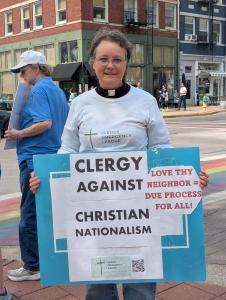
The Rev. Dr. Leah D. Schade is a seminary professor, ordained minister, and co-founder of the Clergy Emergency League. Her opinions are her own.
Leah is the author of Preaching and Social Issues: Tools and Tactics for Empowering Your Prophetic Voice (Rowman & Littlefield, 2024), Preaching in the Purple Zone: Ministry in the Red-Blue Divide (Rowman & Littlefield, 2019) and Creation-Crisis Preaching: Ecology, Theology, and the Pulpit (Chalice Press, 2015). She is the co-editor of Rooted and Rising: Voices of Courage in a Time of Climate Crisis (Rowman & Littlefield, 2019). Her book, Introduction to Preaching: Scripture, Theology, and Sermon Preparation, was co-authored with Jerry L. Sumney and Emily Askew (Rowman & Littlefield, 2023).















 Ad-Free & Subscriber Log-In