

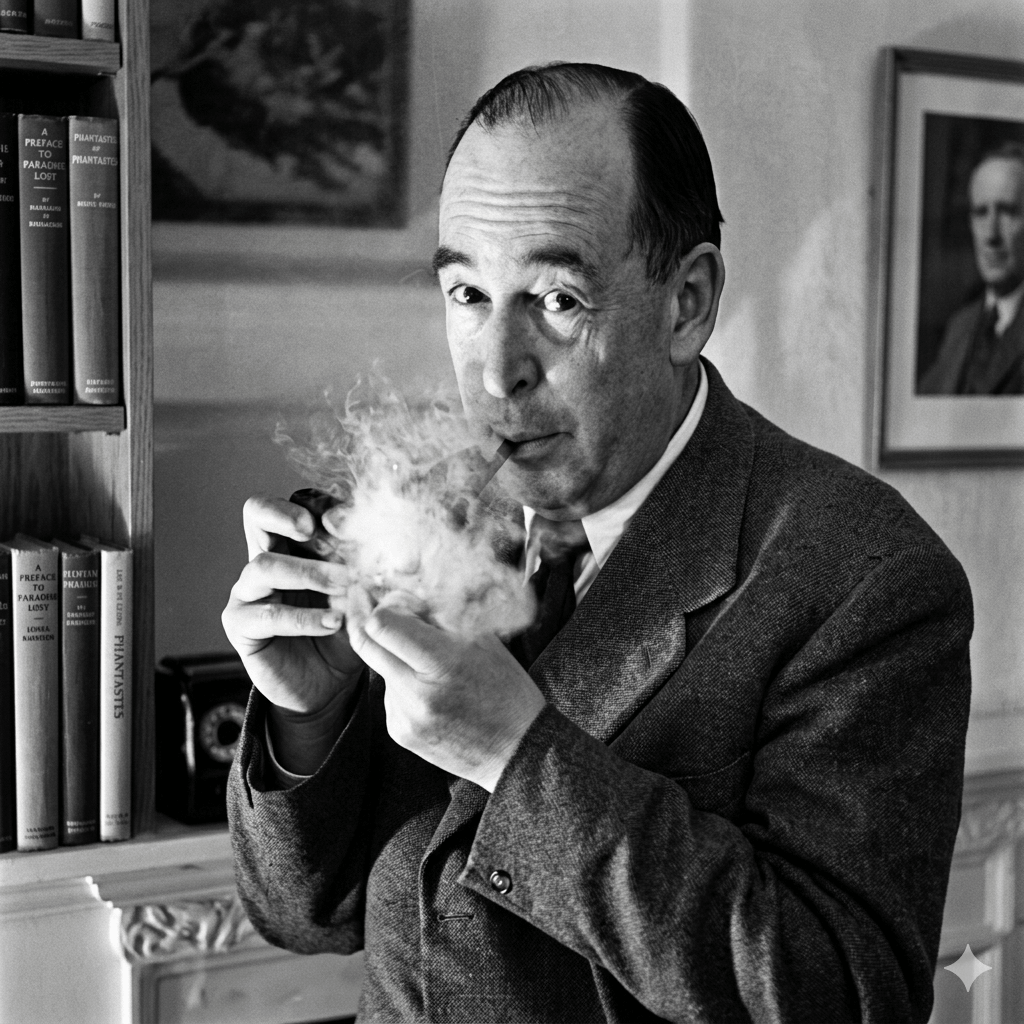
Finding wisdom and “humble disagreement” in the private letters of a Christian giant.
Are you familiar with the work of C.S. Lewis? He wrote The Chronicles of Narnia, a classic seven-book series and film franchise built on Christian themes and theology. And his book Mere Christianity is still a bestseller in Christian literature, recently holding the #1 position in that category on Amazon 75 years after its release.
Recently, several of the nearly forty books Lewis wrote during his lifetime were re-released. Having read little of his work before, I wanted to see what made the man tick and how his Christianity colored his view on life. So I picked up Letters on Living the Faith, a book that compiled his writings to fans and acquaintances.
Now you might think that writing a few dozen books would give Lewis little time for private correspondence. But between 1941 until his death in 1963, Lewis had written more than 3500 pages worth of letters. Letters on Living the Faith is comprised of what you might call his greatest bits, short excerpts that capture the main points he was trying to get across.
I found much to agree with. But by the same token, I found there were several statements from the renowned writer that had me scratching my head. Now, it’s important to note that C.S. Lewis did not position himself as the ultimate authority on Christian thought. He humbly ended more than one letter with the qualifier: “Remember, this is all only my guess.”
The words below are those of C.S. Lewis, lightly edited for length and clarity. My thoughts follow each of Lewis’s points in italics.
Five Points of Agreement with C.S. Lewis
- Belief is like someone rowing a boat. To thrust the boat forward, you have to face backward, so you can see what is behind you but not what lies ahead of you. Therefore, you must keep your eye on the helmsperson, as they are the ones steering the boat and the one who can see what lies ahead. This is a beautiful analogy of the role a divine source can play in our lives. When we can’t see the path ahead, why not seek guidance from a source that can possibly steer us in the right direction?
- Religious practices are the handrail not the staircase. It is not the thing you ascend by, but it is protection against falling off and a help-up the stairs. The handrail is a thing to lean but importantly we must ascend and descend the stairs using our own power.
- The happiest moments are those when we forget our precious selves…and think of God, our fellow humans, animals, the garden, and the sky instead. To me, “precious selves” equates to the ego. When we can keep it quiet, that’s when we open ourselves to being in the moment and enjoying the magic of everyday life.
- When in doubt what to do or say, do or say nothing. Sometimes the best thing you can do in life is wait. Time often reveals for the best possible response or path to for us to take.
- Can you love your enemies even if they are Nazis? It has nothing in the world to do with trying to pretend that the enemy is “not so bad” after all or that his sins don’t matter. It’s the old business about loving the sinner and hating the sin. Lewis wrote this not long after World War 2, which explains the “Nazis” reference. Loving your enemy may be the most difficult task we can undertake. I understand the concept but, living in the United States of early 2026, struggle with it daily.
Five Points of Humble Disagreement with C.S. Lewis
- I have not made-up my mind about mysticism, seeking direct experiences of the presence of God. If anyone tries to impose mysticism as the norm of Christian life I suggest he would be making the same mistake as the one who said we all become fishermen because some of the apostles were. Isn’t the direct experience of God something all believers should seek? At some point, we need to cut out the middleman and pursue a one-to-one relationship with the Divine. I believe it’s what God expects of us and patiently waits for.
- It is one of the evils of rapid diffusion of news that the sorrows of all the world come to us every morning. I think we’re meant to enjoy our Lord and in him our friends, our food, our sleep, our jokes, the bird’s song and the frosty sunrise. The thing about the news—you can shut it off. I make it a point to avoid all news and social media for the first two hours of each day in favor of tending to the needs of the soul. Consider spiritual reading, contemplation, meditation, prayer, before ever picking up your phone.
- I think advice is best kept till it is asked for. One must beware of meddling. As some readers know, I recently started playing pickleball. After a recent game, a more experienced player asked if he could give me advice. He recommended when playing near “the kitchen” (by the net), I loosen the grip on my paddle. I did and it has improved my game tremendously. The point: use your best judgement, but sometimes giving advice is merited and appreciated.
- Christmas cards in general and the whole vast commercial drive called “Xmas” are one of my pet abominations. I wish they could die away and leave the Christian feast unentangled. Bah humbug, C.S.? Christmas is also about the joy of giving and gathering with friends and loved ones. I say yes to Jesus and yes to Santa Claus, as well.
- It is our duty to do all we can to convert unbelievers. Should we really enforce our beliefs on others? Our primary focus should be on ourselves and our own personal spiritual path in life. Each person should discover and practice a religion of their own choosing.
Even when we disagree, I’m aware that Lewis himself said that his insights were often just “guesses.” He leaves space for us to find our own answers and direction. Lewis also reminds us that the most important thing we can do for our own spiritual growth is to be fully present in our own lives: knowing when to grab a sturdy handrail—and when to let go.
Get “Wake Up Call” delivered to your inbox once a week. Sign up for email.















 Ad-Free & Subscriber Log-In