

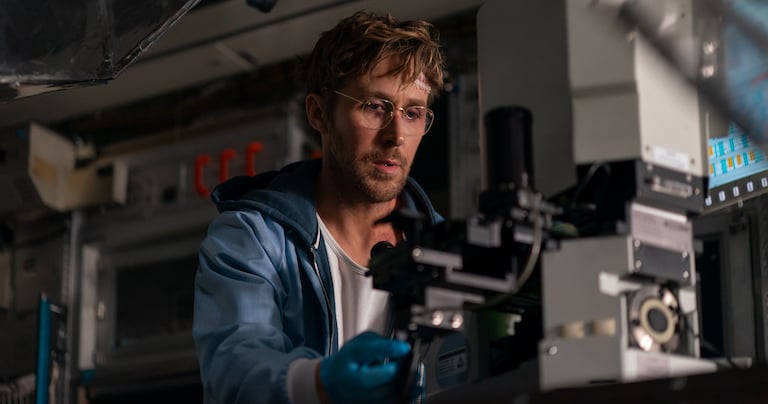
“Do you believe in God?” Ryland Grace asks his boss, Eva Stratt, in Project Hail Mary.
“Beats the alternative,” Stratt says.
And so it is, especially the age in which Grace and Stratt find themselves.
The sun has been afflicted by, essentially, an interstellar virus. Single-celled critters dubbed astrophage have invaded the system, attached themselves to the sun like a giant collective leech and are gobbling up its electromagnetic radiation, causing the sun to cool—and the earth, of course, along with it. Scientists say that in 30 years, half the planet’s population will be dead. And that’s the rosy scenario.
With catastrophe looming, the world’s governments decide to unite (a miracle in itself) and send its best scientists to work on figuring out a solution.
Well, the best scientists and one talented middle school teacher—Ryland Grace (played by Ryan Gosling)—who wrote a pretty impressive paper back in the day.
But it’ll take more than scientific smarts to solve this problem. It’ll need more—something intangible, something immeasurable. And perhaps, deep down, Stratt knows it. Perhaps everyone does. The project’s name—Hail Mary—doesn’t just point to an improbable, 50-yard, last-second football pass. It points to a belief in intercession, in the divine, in hope that goes beyond logic or reason and touches something beyond.
The movie, Project Hail Mary, isn’t a Christian film. It’s not even particularly spiritual. But underneath its scientific exterior, something else is at work, too. Let me point to a few examples. (And be warned: Toward the end there be spoilers.)
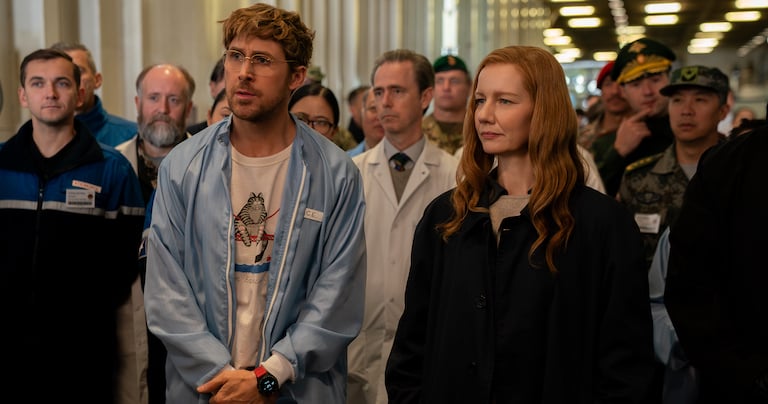
The Union of Science and Faith
Ever since Charles Darwin trotted out his theory of evolution, the worlds of science and faith have often felt at odds. And just like everything else in the world today, it seems, the battle lines between the two keep hardening. Those in the secular scientific camp often dismiss God as a myth and faith as superstition. Many Christians would flip that around: Scientists are the ones pushing unfounded dogma our way, they argue, and as a consequence often wave away everything from evolutionary theory to concerns about climate change.
In Project Hail Mary, climate change—the rapid cooling of the planet in this case, rather than the rapid heating of it—seems to be a concern of all. And while Grace’s surprise that Stratt believes in God hints that traditional science/faith divide hasn’t healed, Stratt’s response reminds us that this divide is one of our making. If God exists, He created and works through, the laws of physics. He designed our biology and created our chemistry. And even if Christians may feel threatened by scientific theories, God most assuredly is not.
Believing in God beats the alternative, Stratt says. Because if there is a God—a God who is interested in us—perhaps that prayer will be answered. The odds themselves are against this project, Stratt acknowledges; their chances are outlandishly slim. But if there’s Something at work outside the oven, it’s a chance worth taking.
The Three-Fold Cord
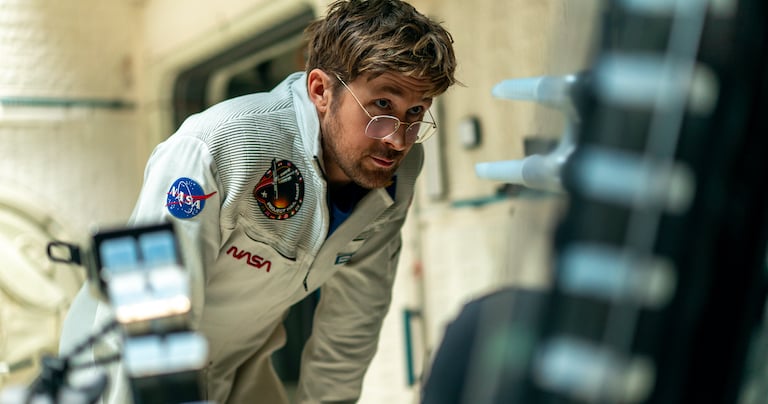
As mentioned, the threat of the astrophage unites the world in a way that, to our jaded eyes, might feel a little outlandish. Top scientists from around the globe work together to solve this pesky problem, apparently without ego. And their efforts are rewarded with the Hail Mary.
That ship is designed to fly–at practically the speed of light–to the one star in the region that doesn’t seem to be affected by the astrophage. If the astrophage is a cosmic virus of sorts, this mysterious star seems to have the necessary antibodies to stave off infection.
But it’s only after the Hail Mary slips past all earthbound help that Project Hail Mary’s core partnership truly begins. Grace—now alone on the craft after his two other shipmates died en route—meets an unlikely ally. His name is Rocky, and he comes from another, equally imperiled world. He too has come looking for ways to solve the astrophage problem. And he, like Grace, is alone.
Even the odds of them meeting out there feel literally astronomical: a lucky break, some might say. Divine providence, others might insist. But regardless, meet they do. And once they learn to talk to one another, they dive into the problem at hand: exploring that astrophage-resistant star and using that newfound knowledge to save their own stars, systems and planets.
If God created us, He created us for community. On our own, we’re pretty weak when you think about it: We’re not particularly strong or fast. But when we, like those scientists, put our big ol’ brains to work for a common cause, we can do remarkable things.
And it’s not just about the nuts-and-bolts of building a spaceship for figuring out how to get home, either. It’s about the emotional connection between Grace and Rocky in Project Hail Mary: The unlikely friendship they share and the lengths they’ll go for the other. Each sacrifices a great deal for the other—right up to the edge of death itself.
So many Bible verses talk about friendship, community and sacrificing for one another. But the one that perhaps best fits the vibe between Rocky and Grace would be Proverbs 17:17. A friend loves at all times, and a brother is born for adversity, we read in the ESV translation. And that’s apt for Project Hail Mary, even if the brothers in this case were born, literally, trillions of miles away.
Change is Possible
Project Hail Mary would be a fun, powerful, poignant film if those were the film’s primary emotional beats. But then the film takes us in a shocking (and for our purposes, spoilery) direction.
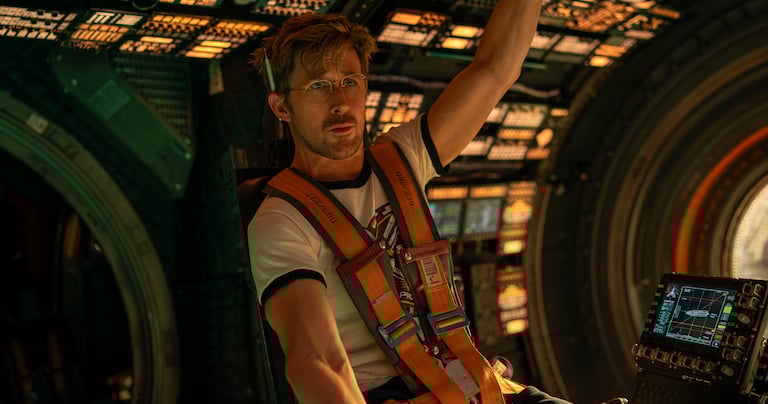
Throughout the film, we’re encouraged to think of Grace as a brilliant, kinda goofy and ultimately sacrificial guy. We know that the Hail Mary is designed for a one-way trip: There’s no way the ship has enough power to make it back to earth. The people who decided to board the ship knew that their trip also didn’t have a return ticket in place. The crew of the Hail Mary would die in space.
What a great guy Grace must be to sacrifice himself for the benefit of others, right?
Wrong. Because Grace announced that he absolutely, positively, would not go.
“If you don’t go, you die,” a desperate Stratt (played by Sandra Hüller) says. “With the rest of us.” And yet, Grace still refuses. He’s not brave enough, smart enough, resourceful enough. He admits, in as many words, that he’s a coward.
So Stratt does what she must: She drugs Grace and puts him on the ship anyway.
“You might think I’m betraying you,” she says. “I’m not. I’m believing in you.”
Stratt believes that Grace can become the hero that the world needs. But he just needs a little push to get him going. And by the film’s end, Grace discovers that he’s grateful for the push.
Sometimes, we all need that push to reach our potential. Like Grace, we’re so often filled with doubt and shame and fear. I think we’d all love to think we could be the hero. But how many of us could really fall on that grenade if we were called to do so? To take a bullet for somone else? To climb aboard a doomed spacecraft?
Maybe. One of Grace’s doomed crewmates, Yao, tells him the secret to bravery: “You just need to find someone to be brave for.” It’s a nice echo of another famous verse, this one found in John 15:13: Greater love has no one than this, that someone lay down his life for his friends.
Some folks insist that change is impossible. No matter how hard we try, we are who we are. We’re doomed to carry our weaknesses and sins all of our days, toting with them on our own lifelong journeys where none of us will return.
But that’s not the message of Project Hail Mary, and neither is it the message of the gospel. Change is hard, yes, but it’s not impossible. We can be different. We can be better. We can change. We just need help. That help comes through the grace of God and the work His Son did on the cross.
But even so, we can be reluctant. And sometimes, God gives us a harder push than we’d like.
Project Hail Mary isn’t just a rip-roaring sci-fi yarn. It’s the story of salvation. Of redemption. Of one man’s chance to change. A man named, fittingly enough, Grace.










 Ad-Free & Subscriber Log-In