

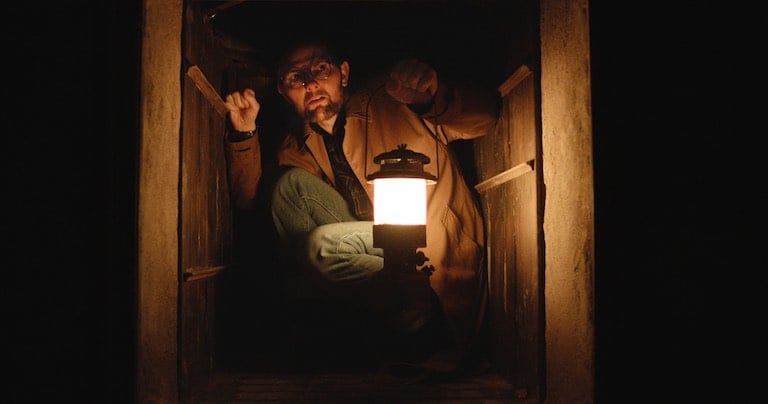
Hokum is a great little horror flick, one that runs heavy in atmospheric chills but light on gore. It’s about a writer who travels to Ireland to ostensibly spread his parents’ ashes. But he has more on his mind than closure—and the inn that he visits wants more from him, too.
So perhaps it’s not surprising that the film comes with its own hidden layers. Let’s unpeel a couple of them. But to do so, we’re going to need to jump to the very end of the film—and reveal a couple of spoilers along the way.
Endings Are the Hardest
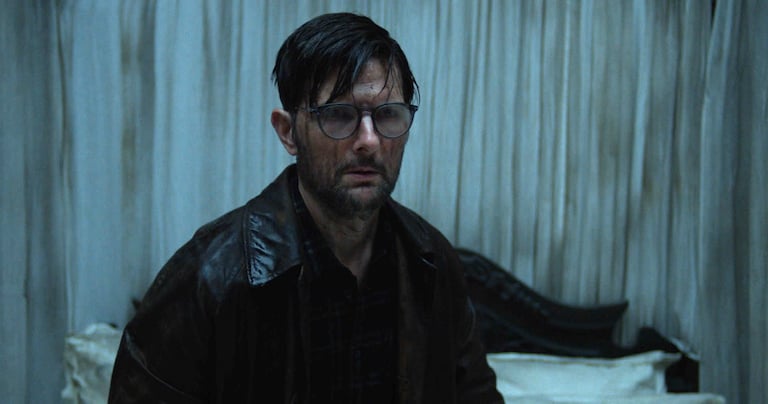
The writer’s name in Hokum is Ohm Bauman (played by Adam Scott). He shares his first name with the last letter of the Greek alphabet: “Ohm” is what the capitalized version of “omega” is called. Fitting, given that Ohm is struggling with his own ending.
For one thing, his latest book doesn’t quite have its ending yet. In Hokum’s story-within-a-story, we know where the climax is heading: into the middle of the desert. Ohm’s “hero,” a conquistador, is looking for something there. Treasure? Meaning? Perhaps, but in the end he may be simply looking for survival. It’s been a long trek into the sands: He and his young squire—a boy who’s perhaps 10 years old—have left behind everything to find this secret.
And indeed, they find that secret—or , at least, where that secret should be. It’s an incongruous circle in the middle of the sands (a circle neatly echoed by the condensation ring under Ohm’s whiskey glass as he writes). But how might they open that ring? Or solve its intrinsic puzzle? The answer is locked inside a bottle, sealed tight. The only way to access that roll of paper inside is to break the bottle. But there’s nothing hard for miles and miles. Nothing but … the boy’s head.
Irish Harm
In Ireland, Ohm, spills the end of the book to Fiona (Florence Ordesh), an apparently appreciative bartender. The conquistador kills the boy, Ohm says. The bottle doesn’t break. “In the end, he wanders into the desert to die.”
“Why would you write this?” Fiona asks. “It’s so bleak!”
Ohm describes the book as “challenging,” but there’s more to it than that. Perhaps unintentionally, he has written himself as the conquistador—a man who committed a grievous sin and deserves to die in the desert, alone.
Ohm may be one of the year’s most unlikable cinematic “heroes.” He’s a jerk: just a flat-out misery to be around. He snaps at everyone. He belittles a would-be writer. He’s alone and you can see why.
Admittedly, he had a rough home life. Ohm reveals to Fiona that his beloved mother was murdered—shot in the face when she came home from work. They never caught the killer, Ohm says. Ohm’s father, in his grief, “turned into a monster and drank himself into an early grave,” according to the writer.
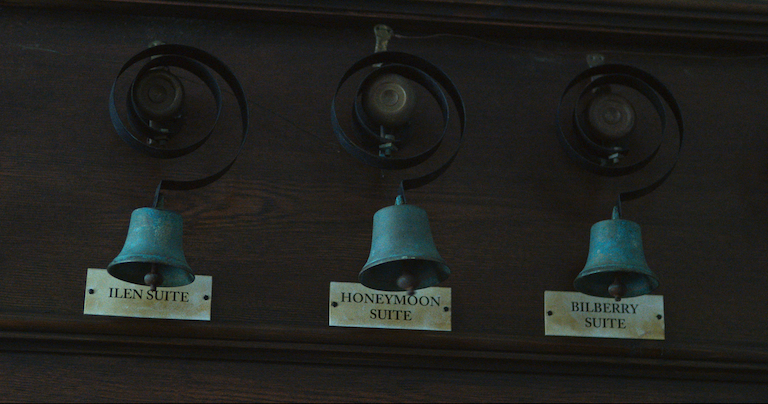
Ohm’s parents honeymooned at that Irish inn during happier times. What better place to let their ashes lie?
But Ohm isn’t telling the whole truth. When he was a little boy—perhaps not much older than the boy in his book—he was playing with his father’s gun. It went off, just as his mother came home from work.
“Should’ve f—ing hanged him,”Ohm tells Fiona about this “unknown” killer. But Ohm knows the killer all too well. Later that night, Fiona comes into Ohm’s room to find him, hanging, from the light fixture.
Ohm wasn’t just thinking about the book’s end. Perhaps he was plotting his own end, too.
The Cailleach
Fiona rescues Ohm in time. The writer spends several days in a local hospital and, when he comes to, he learns that Fiona’s missing. She simply disappeared on Halloween and hasn’t been seen since.
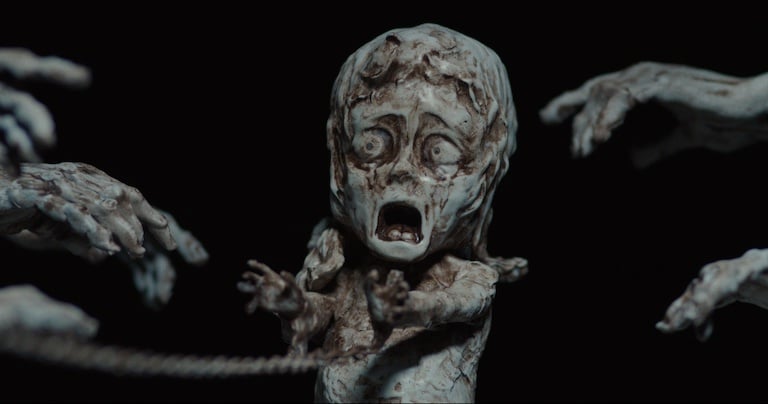
Oh, did I mention that the inn is supposedly haunted? By a witch?
Yes, the inn is supposedly haunted by a witch—one who lurks, interestingly enough, in the establishment’s honeymoon suite. According to the hotel’s owner, the witch (called “Cailleach” in the movie, and a word that has its own interesting wrinkles if you read my Plugged In review) leads the unsuspecting through a tour of the underworld, where they’re exposed to all of its horrors, and they may leave something important behind.
Ohm doesn’t know about witches (he thinks the whole story is “hokum”), but he is concerned about Fiona. So he finds a way up to the Honeymoon Suite and into his darkest shame and fears.
Irish Scream
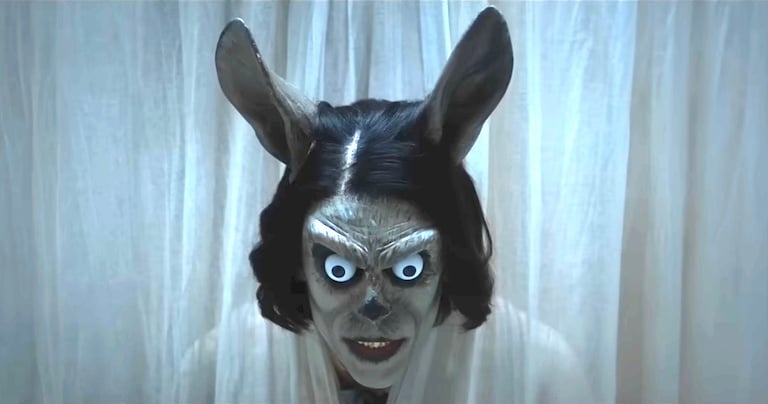
Most horror films satisfy themselves with one monster. Hokum gives us several: There’s the witch, of course. Ohm is haunted by another—the truly terrifying rabbit-man you see in the trailers, and perhaps a manifestation of Ohm’s own guilt.
And let us not forget about Ohm himself. In Ohm’s own story, he would be the villain—the boy who stole his mother’s life, the man for whom a hanging would be just. His psychic calculus is strict and without mercy. He was the cause of his mother’s death. His mother didn’t deserve to die. Therefore, he deserves to die, too.
But the movie has yet another monster—perhaps the most monstrous because he denies what he is. He is consumed with the sin of self, the belief that any evil is justified if it helps him escape.
Against all these monsters we see just one angel: Fiona, the woman who cut Ohm from the rope. Fiona, who gives Ohm the tools to escape his terrible night with the witch. It’s her gifts that lend Hokum a near-mythic element. Just as Theseus found his way out of the labyrinth with a roll of string, so Ohm escapes the witch through a shard of chalk, a few words from beyond the grave and a tiny knife.
The same knife that cut him loose.
And that comes with some nicely Christian connotations.
Finding Grace
Fiona serves as a symbol of grace, saving Ohm when Ohm himself thought he had no business being saved. Ohm knew he was a sinner, beyond any reasonable hope of redemption. And yet he was redeemed.
And the other monster? He never confessed. He did whatever he could to get away. The man who tried so hard to escape was the man who couldn’t.
“There is no true prayer without confession,” wrote the famous evangelist Dwight L. Moody. “As long as we have unconfessed sin in our soul, we are not going to have power with God in prayer. He says if we regard iniquity in our hearts, He will not hear us, much less answer.”
But when we acknowledge what we’ve done, and when we accept and grieve over it, it opens the door for grace to work. To heal. To save.
The Payoff
The film ends where it began: With Ohm’s book.
The Conquistador, so ready to kill his child squire for his own salvation, thinks better and gives the bottle to the boy. “You don’t stop for blood, you don’t stop for bone,” the Conquistador says. “You don’t stop hitting until it breaks. It’s nothing I don’t deserve.”
The boy, conspicuously wearing a cross around his neck, takes the bottle and … flings it away. He refuses to take the Conquistador’s life, even if the Conquistador deserves it. Even if it means that both of them will die in the desert.
And then, where the bottle lays, the wind begins to blow and exposes … a ram’s skull. Something hard enough to break the bottle and save both of their lives.
I love this end. And to me, it feels like a callback to another would-be sacrifice.
In Old Testament times, sacrifices were the only way to breech the gulf between man and God. Our sins deserved death. But in Genesis 22, the sacrifice God asked of Abraham was horrific indeed: He asked the guy to sacrifice his son. “Your only son,” God tells him.
But Abraham knew the wages of sin. If God asked for it, what could he do? So he led his son up a mountain and prepared an altar for a sacrifice. Isaac, unknowing, asked where the sacrifice was.
“God Himself will provide the lamb of the burnt offering, my son,” Abraham said—knowing it was to be Isaac himself.
But just as the knife was about to fall, God stays Abraham’s hand. And in a thicket, Abraham spies a ram—a substitute offering.
The whole biblical story presages God’s own sacrifice of His son, His only son, for us. A sacrifice that allowed grace, not the exacting calculus of sin and sacrifice, set the course for our lives. God’s grace saved Isaac that day—and saved Abraham, too. Miraculous grace saved the Conquistador and his own surrogate son in Ohm’s story, a grace that wouldn’t have been possible without confession and submission.
And grace saved Ohm, too. The writer could never pay for what happened to his mother. But ultimately, he learned to forgive himself. To move on. And that’s a great message for us all.












 Ad-Free & Subscriber Log-In