

Do we create our gods, or do our gods create us?
In The Way, I write that most traditions recognize that there are two (not three) aspects of God. And these aspects correspond to the immanent and the transcendent. Thus, Swami Abhayananda, a Hindu sage, realized that there is a binitarian concept of God that is common to most religions.
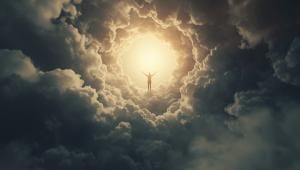
Immanent and Transcendent
So, first, there is an absolute or transcendent aspect of God, beyond space and time. And Ramakrishna, a Hindu mystic, said that this is God without name or form. Philosopher Paul Tillich calls this the “God above gods” or the “ground of being.” Similarly, Christian mystic Meister Eckhart calls this the “Godhead.” Here, God is “a part of us.”
Thus, God as the ground of being is NOT personal. And the late Thich Nhat Hanh, a Buddhist monk, might say that we can NOT have a relationship with this God, just like we cannot have a relationship with the sea or the sun. So, descriptions can NOT contain God as the ground of being. In the East, they say “Neti Neti,” which means “Not this, not that.”
So, second, there is a relative or immanent aspect of God, within space and time. And Ramakrishna said that this is God with name and form. Eckhart and Tillich might say that we invent these gods as intermediaries to approach the God above gods or the Godhead more easily. Here, God is “apart from us.”
Thus, Gods with name and form are personal. And Thich Nhat Hanh might say that we can have a relationship with this God. (As some Christians believe they have a relationship with Jesus.) So, descriptions can (in part) contain God with name and form, although it is NOT easy to describe the Indescribable.
Analytical (Left Brain) and Intuitive (Right Brain)
I have been reading about the hemispheres of the brain and noticing the parallels between how our brains process sensory input and how we perceive the nature of God or Ultimate Reality.
I wrote about Julian Jaynes’ The Origin of Consciousness in the Breakdown of the Bicameral Mind here. Jaynes believed that introspection developed only in the last 5,000 years. Before that, humans originated thoughts in their creative and intuitive right brains and transmitted them as voices to their analytical and logical left brains. They interpreted these voices as the voices of gods.
I wrote about Iain McGilchrist’s The Master and His Emmisary here. McGilchrist challenges the notion that our analytical and logical left brains dominate our creative and intuitive right brains. He suggests that, without the right brain, our world would seem dull, flat and mechanistic. So, he contends that our right brains, which see the big picture, are the “masters” of our left brains.
I wrote about bad theology and the metacrisis here. Paul Kingsnorth‘s Against the Machine says that a crisis in culture is a crisis in spirit. To him, Western civilization used to center on the four Ps— People, Places, Prayer, Past. Whereas, now it centers on the four Ss—Sex, Science, Screen, Self. And Kingsnorth, who converted to Orthodox Christianity, blames Protestantism, in large part.
Kingsnorth writes, “By basing their new version of the faith on the notion of sola scriptura—that there should be no authority but the Bible—they (Protestants) unleashed the radical individualism on which the modern world would be built. With tradition and authority demolished (Catholicism), reason would become the only ‘basis for argument about God, creation and morality’.”
Kingsnorth recognizes the failings of Christendom. Christendom is the actual, contemporary Christian culture, as opposed to Christianity, which is the historical, idealistic teachings of Jesus. So, he asserts that Christendom is dead and that Christianity has lost its way. Christianity, which used to be the guiding principle of Western civilization, fell to the capitalistic, individualistic Machine.
Truth with a Capital T
Jaynes, McGilchrist, and Kingsnorth all realize that we increasingly live in an analytical, immanent, left-brained world, which has overshadowed the intuitive, transcendent, right-brained world.
To Kingsnorth, Christianity is the most immanent tradition. He writes, “Western Christianity progressively abandoned its commitment to transcendence and was ‘resolved into philosophy’, allowing itself to be brought down to Earth, into the realm of social activism, politics and ideas.” We agree that society has lost its respect for the sacred and its sense of transcendence.
Here, Kingsworth and I part ways. He seems to believe that we should return to an old spiritual narrative that delineates the sacred from the secular and recognizes a supernatural Supreme Being. In contrast, I believe that we should reinvent a new spiritual narrative that integrates the sacred and the secular and emphasizes an impersonal, interconnected, nontheistic Universe.
Unlike Kingsnorth, I do NOT embrace religion. In The Way, I wrote that Christianity should acknowledge mysticism, embrace mystery, and recognize advances in history, philosophy and science, to become relevant again. Often, I write that Christianity should reevaluate its speculative beliefs, supernatural claims and unkind practices. None of that is happening on a wide-scale basis.
To me, the “Truth with a capital T” that Kingsnorth eventually found in Christianity can also be found in any number of sacred and secular traditions. When Jaynes, McGilchrist and Kingsnorth focus on the intuitive, transcendent, right-brained world, they all recognize the essential Truth of our interconnectedness. “Everyone is related, and everything is connected,” as I often say.
Do We Create Our Gods, or Do Our Gods Create Us?
Our right brain and left brain ways of seeing things correspond, respectively, to the transcendent and immanent things that we see. Are transcendence and immanence objective aspects of reality, or are they subjective products of the right and left hemispheres with which we perceive reality? In other words, do we create our gods, or do our gods create us?
If the singular Truth with a Capital T is that everyone is related and everything is connected, how do we recover our sense of transcendence? And how do we rely more on our intuitive right brains? How do we relinquish the hold of Kingsnorth’s Machine? And how do we restore our respect for our common heritage, our entangled destinies, and our essential Oneness?
I wrote that our politics shapes our spirituality here. Kingsnorth has written that “civilizational spirituality” puts civilization before spirituality. So, how could our spirituality shape our politics? Similarly, Kingsnorth might ask, “How could a ‘spiritual civilization’ put spirituality before civilization?” So, how do we proclaim the essential Truth of our interconnectedness?












 Ad-Free & Subscriber Log-In