Patheos Watermark

Confucianism

Confucianism Quick Facts

Formed 500 BCE
Origin China
Followers 5,000,000
Deity None / various gods and ancestors
Sacred Texts Analects, the Five Classics, the Four Books
Headquarters None

Confucianism

Confucianism Overview

Learn More

Some say Confucianism is not a religion, since there are no Confucian deities and no teachings about the afterlife. Confucius himself was a staunch supporter of ritual, however, and for many centuries there were state rituals associated with Confucianism. Most importantly, the Confucian tradition was instrumental in shaping Chinese social relationships and moral thought. Thus even without deities and a vision of salvation, Confucianism plays much the same role as religion does in other cultural contexts. The founder of Confucianism was Kong Qiu (K'ung Ch'iu), who was born around 552 B.C.E. in the small state of Lu and died in 479 B.C.E. The Latinized name Confucius, based on the honorific title Kong Fuzi (K'ung Fu-tzu), was created by sixteenth century Jesuit missionaries in China. Confucius was a teacher to sons of the nobility at a time when formal education was just beginning in China. He traveled from region to region with a small group of disciples, a number of whom would become important government officials. Confucius was not particularly famous during his lifetime, and even considered himself to be a failure. He longed to be the advisor to a powerful ruler, and he believed that such a ruler, with the right advice, could bring about an ideal world. Confucius said heaven and the afterlife were beyond human capacity to understand, and one should therefore concentrate instead on doing the right thing in this life. The earliest records from his students indicate that he did not provide many moral precepts; rather he taught an attitude towards one's fellow humans of respect, particularly respect for one's parents, teachers, and elders. He also encouraged his students to learn from everyone they encountered and to honor others' cultural norms. Later, his teachings would be translated by authoritarian political philosophers into strict guidelines, and for much of Chinese history Confucianism would be associated with an immutable hierarchy of authority and unquestioning obedience.


Contributors

Confucianism Origins

Confucianism Origins -- Confucianism Beginnings

Details

Confucius's ideas became well-known only after his death. The 4th-century philosopher Mencius, 3rd-century thinkers Xunzi and Han Feizi, and many others joined the debate about Confucian thought, adding their own ideas about human nature and morality, and considering practical applications, particularly to political rule and government.

Confucianism Origins -- Confucianism Influences

Details

Confucius attributed his teachings to the Duke of Zhou, a heroic figure from his home state of Lu who was regarded as the founder of that state. He was also inspired by the rituals and institutions of the Zhou dynasty, founded several hundred years before his birth; by the classic literature of his time; and by legends of the early sage kings.

Confucianism Origins -- Chinese Religion Founders

Details

Confucius, whose Chinese name was Kong Qiu (K'ung Ch'iu), was born around 552 B.C.E. and died in 479 B.C.E. He traveled from state to state teaching the sons of the nobility about leadership and morality. He was not famous during his lifetime, and never achieved the high position he aspired to as an advisor to a great ruler.

Confucianism Origins -- Confucianism Scriptures

Details

Confucius left no writings, although the "Five Classics" of Chinese literature are traditionally attributed to him as writer or editor. The "Analects" is a collection of aphorisms put together by Confucius's students after his death. The "Liji," or "Record of Rites," also contains dialogs, discourses, anecdotes, and narratives about Confucius and his teachings.

Confucianism Origins -- Confusianism Historical Perspectives

Details

Some Western scholars have argued that "Confucianism" was manufactured or invented by Asian and Western scholars as an alternative to Western individualism. Scholars have also examined the little-known impact of Confucian studies on Western institutions, including civil service and the examination system.

Confucianism History

Confucianism History -- Confucianism Early Developments

Details

Confucianism as an institution was not established until long after the death of its founder. During the 4th and 3rd centuries B.C.E., a diverse collection of writings circulated concerning his life and teachings, with little internal cohesion. It was not until the 2nd and 1st centuries B.C.E. that a cohesive portrait of a "Confucian" tradition emerged.

Confucianism History -- Confucianism Schisms, Sects

Details

While there were differing interpretations of Confucianism and disagreements about its meaning, enduring sects with independent organizational structures never formed in the case of Confucianism. At times there were official Confucian rituals, and temples that were modeled after the establishments of the Buddhists and Daoists.

Confucianism History -- Confucianism Exploration, Conquest, Empire (incl. violence, persecution)

Details

Han Feizi's philosophy was of profound importance to the Qin emperor who first unified China in 221 B.C.E. His "Confucianism," which emphasized strict regulations and obedience to authority, was appropriated by the imperial government. The first model of the Imperial Academy was established less than a century later. Here the classics were taught and students were evaluated for positions with the government.

Confucianism History -- Confucianism Missions, Spread, Changes, Regional Adaptations

Details

There were few regional differences in Confucianism, but specific interpretations changed periodically. Zhu Xi (1130-1200), known as the creator of "Neo-Confucianism," developed an interpretation that unified human nature with cosmic principles. Wang Yangming (1472-1529) introduced the idea of "true knowing" -- an intuitive awareness of moral principles attained through self-cultivation.

Confucianism History -- Confucianism Modern Age

Details

Confucianism has been both lauded and condemned in the modern age. Confucianism, along with Daoism and Buddhism, has been blamed for China's inability to compete with the West during the 19th and 20th centuries. Confucianism has also been praised as the key to China's unique cultural heritage and strong social order.

Confucianism Beliefs

Confucianism Beliefs -- Confucianism Sacred Narratives

Details

The idea of learning from the past is fundamental to Confucian thinking, and the early histories and biographies are the closest thing to sacred narratives in Confucianism. Among the "classics" are many stories that contain a moral component or exemplify an effort to understand why things happened as they did.

Confucianism Beliefs -- Confucianism Ultimate Reality and Divine Beings

Details

Confucius did not deny the existence of a reality beyond the human world, but he said that the nature of ultimate reality and the intentions and expectations of divinities are beyond human capacity to know or understand. Human morals should therefore be based on human relationships, without reference to some higher order.

Confucianism Beliefs -- Confucianism Human Nature and the Purpose of Existence

Details

Confucian scholars have long debated essential human nature without reaching agreement as to its fundamental characteristics. Most agree, however, that the purpose of existence is to reach one's highest potential as a human being. Through a rigorous process of self-cultivation that lasts a lifetime, one may eventually become a "perfected person."

Confucianism Beliefs -- Confucianism Suffering and the Problem of Evil

Details

According to some interpretations of Confucianism, suffering and evil are inevitable in human life, and can promote learning and growth. A mistake is not a "sin," but an opportunity to learn and do better next time. Empathy for the suffering of others also provides motivation to grow morally, but not all humans are capable of empathy.

Confucianism Beliefs -- Confucianism Afterlife and Salvation

Details

Confucius stated that the afterlife was beyond human comprehension. Humans should live and behave in such a way as to promote ideal social relations, rather than to act based on the expectations of rewards or punishments after death.

Confucianism Ritual, Worship, Devotion, Symbolism

Confucianism Ritual, Worship, Devotion, Symbolism -- Confucianism Sacred Time

Details

As Confucius stated that ultimate reality is beyond human comprehension, there is no sense of sacred time outside of ordinary time. Confucius was a great supporter of ritual, as he felt that ritual solidified human social bonds; thus, in a sense, ritual sacralized ordinary time and daily life.

Confucianism Ritual, Worship, Devotion, Symbolism -- Confucianism Sacred Space

Details

Confucius stated that divine realms are beyond human comprehension, so there is no Confucian concept of a sacred space outside of the realm of life on earth. The focus of Confucianism is ordinary human interactions, and thus, in a sense, the ordinary space of daily life becomes sacred space.

Confucianism Ritual, Worship, Devotion, Symbolism -- Confucianism Rites and Ceremonies

Details

Despite his disinterest in ultimate questions, Confucius was a strong advocate for ritual. He believed that participation in ritual served to unite people and strengthen the human community.

Confucianism Ritual, Worship, Devotion, Symbolism -- Confucianism Worship and Devotion in Daily Life

Details

To live one's life as the best person one can be, to constantly strive to cultivate one's character, and to act according to one's proper role within the human community - these are the daily devotional activities of one who is trained under the Confucian system.

Confucianism Ritual, Worship, Devotion, Symbolism -- Confucianism Symbolism

Details

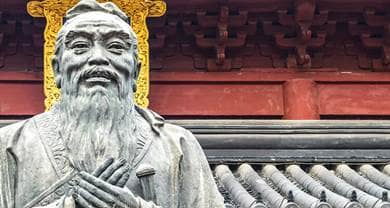
Symbols specific to Confucianism are relatively rare, and almost always pertain to scholarship. Stylized images of Confucius attired as a scholar are often seen, and sometimes images of his scholar-disciples are also portrayed in paintings or statues. Motifs such as the "six arts" of the scholar are sometimes seen in works of art.

Confucianism Ethics, Morality, Community

Confucianism Ethics, Morality, Community -- Confucianism Leadership/Clergy

Details

The model Confucian leader was the scholar-official. Years of education in the classic texts culminated in a rigorous series of examinations. Positions within the government were assigned based on the results. Subsequent positions would be based on performance and on one's status with respect to the ruling powers.

Confucianism Ethics, Morality, Community -- Confucianism Community Organization and Structure

Details

In traditional China, Confucianism prevailed within the courts of the nobility and in every arm of the government. The ruler assigned officials to govern at every level, including the local community, and the judiciary was also run by the central government.

Confucianism Ethics, Morality, Community -- Confucianism Principles of Moral Thought and Action

Details

Confucius provided few specific moral principles. One should obey one's elders and superiors and treat rulers, parents, and even those who were not one's social equals with respect. One should also respect ritual, cultivate wisdom, be trustworthy, and strive to do the right thing in any situation.

Confucianism Ethics, Morality, Community -- Confucianism Vision for Society

Details

Confucius envisioned a society in which all lived in harmony, content with their place within the social hierarchy. He believed that if a ruler's moral character was exemplary, this would influence his people to behave morally as well.

Confucianism Ethics, Morality, Community -- Confucianism Gender and Sexuality

Details

Women were at the bottom of the Confucian hierarchy. Of them was expected exemplary behavior and uncomplaining obedience. By custom, aristocratic men and women lived separately. Men had multiple wives and concubines, but women were not allowed to see men other than their close relatives, husbands or masters, or the palace eunuchs. Homosexuality was discouraged, but not specifically condemned as "sinful." Abortion was also discouraged, except in cases where the mother's health was endangered.

Recommended Confucianism Products

Shop More