Special Offers
Buddhist
Catholic
Contemplative
Evangelical
General Christian
Hindu
Jewish
Latter-day Saint
Muslim
New Visions
Progressive Christian
Beliefs
Buddhist
Catholic
Contemplative
Evangelical
General Christian
Hindu
Jewish
Latter-day Saint
More Voices
Muslim
New Visions
Pagan
Progressive Christian
Topics
Religion News
Food and Religion
Sports and Religion
Religious Art
Religious Music and Entertainment
Religious Events
History and Religion
Style and Religion
Politics and Religion
Women in Religion
Recreation Outdoors and Religion
Business Finance and Religion
Careers Workplace and Religion
Education and Religion
Family Parenting and Religion
Health Fitness and Religion
Home and Religion
Relationships and Religion
Technology and Religion
Travel and Religion
Columnists
Buddhist Columnists
Business Finance and Religion Columnists
Careers Workplace and Religion Columnists
Catholic Columnists
Contemplative Columnists
Education and Religion Columnists
Evangelists Columnists
Family Parenting and Religion Columnists
General Christian Columnists
Health Fitness and Religion Columnists
Hindu Columnists
History and Religion Columnists
Home and Religion Columnists
Jewish Columnists
More Voices Columnists
Latter Day Columnists
Muslim Columnists
New Visions Columnists
Nonreligious Columnists
Pagan Columnists
Politics and Religion Columnists
Progressive Columnists
Recreation Outdoors and Religion Columnists
Relationships and Religion Columnists
Religion News Columnists
Religious Art Columnists
Religious Events Columnists
Religious Music and Entertainment Columnists
Sports and Religion Columnists
Style and Religion Columnists
Technology and Religion Columnists
Travel and Religion Columnists
Women in Religion Columnists
Resource Library
2026 Calendar
Library of World Religions
The 100 Most Holy Places on Earth
Patheos Answers
Podcasts
Videos
Faith Leaders Database
Anglican Episcopalian
Bahai
Baptist
Buddhism
Christianity
Confucianism
Eastern Orthodoxy
Hinduism
Holiness and Pentecostal
ISKCON
Islam
Judaism
Lutheran
Methodist
The Church of Jesus Christ of Latter-day Saints
New Age
Paganism
Presbytarian and Reformed
Protestantism
Religion Behind the Scenes
Roman Catholic
Scientology
Shia Islam
Sikhism
Sufism
Sunni Islam
Taoism
Zen
See all religions
Research Tools
Comparison Lens
Preacher Resources
Teacher Resources
Video
Podcasts
Thought Readers
Faith In Media Tracker
E-Books and Other Special Offers
God's Cheat Sheet to Finances
Books of the Bible Study series
History of the Bible
7 Day Prayer Challenge for Spouses
A Different Kind of Christian
Jesus is Love
Prayer Devotional
The Saints We Love
FaithChatter Conversation Cards
Newsletters
Special Offers
Ad-Free & Subscriber Log-In
Subscription Support
Trending:
Forgiveness
|
Marriage
|
Afterlife
|
Trump
|
Pentecost
|
Deconstruction
RELIGION LIBRARY
Confucianism
Toggle navigation
Overview
Origins
History
Beliefs
Rituals and Worship
Ethics and Community
Beginnings
Confucius's ideas became well known only after his death. The 4th-century B.C.E. philosopher Mencius, 3rd-century B.C.E. thinkers Xunzi and Han Feizi, and many others joined the debate about Confucian thought, adding their own ideas about human nature and morality, and considering practical applications, particularly to political rule and government.
read more
Influences
Confucius attributed his teachings to the Duke of Zhou, a heroic figure from his home state of Lu who was regarded as the founder of that state. He was also inspired by the rituals and institutions of the Zhou dynasty, founded several hundred years before his birth; by the classic literature of his time; and by legends of the early sage kings.
read more
Founders
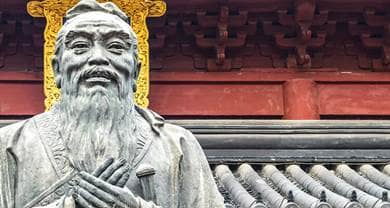
Confucius, whose Chinese name was Kong Qiu (K'ung Ch'iu), was born around 552 B.C.E. and died in 479 B.C.E. He traveled from state to state teaching the sons of the nobility, though he was not famous during his lifetime, and never achieved the high position he aspired to as an advisor to a great ruler.
read more
Sacred Texts
Confucius left no writings, although the "Five Classics" of Chinese literature are traditionally attributed to him as writer or editor. The "Analects" is a collection of aphorisms put together by Confucius's students after his death. The "Liji," or "Record of Rites," also contains dialogs, discourses, anecdotes, and narratives about Confucius and his teachings.
read more
Historical Perspectives
Some Western scholars have argued that "Confucianism" was manufactured or invented by Asian and Western scholars as an alternative to Western individualism. Scholars have also examined the little-known impact of Confucian studies on Western institutions, including civil service and the examination system.
read more
Overview
History
Back to religion Library
editors picks
View All Columns
Evangelical
Before You Unplug or Sign Out for Good
Guest Contributor
Evangelical
What Is the Purpose of Spiritual Gifts, and How Do You Discover Yours?
Randy Alcorn
New Visions
5 Ways to Hear What God is Telling You
Tom Rapsas
Muslim
How Awake Are We? When Waking Up is Falling Asleep
Daniel Thomas Dyer
Latter-day Saint
"The Church supports the use of vaccinations"
Dan Peterson
Evangelical
Luther and the Beauty of Christ
Guest Contributor
Patheos
The Soul of Gospel Music Explored in New Netflix Series "Voices of Fire"
DeWayne Hamby
Patheos
Seven Ways to Think About Christian Mysticism
Carl McColman
Evangelical
Cancelling Alice Walker?
Philip Jenkins
Evangelical
Does God Have His Own Logic?
Roger E. Olson
Muslim
Imam Ali’s letter to the Governor- Everlasting Example of Good...
Ejaz Naqvi MD
Progressive Christian
Why Did Jesus Have To Die?
Keith Giles
Patheos
Explore the world's faith through different perspectives on religion and spirituality! Patheos has the views of the prevalent religions and spiritualities of the world.











 Ad-Free & Subscriber Log-In