Patheos Watermark

Disciples of Christ

Disciples of Christ Quick Facts

Formed1832 CE
OriginUnited States
Followers700,000
DeityGod (Trinity)
Sacred TextsBible
HeadquartersIndianapolis, IN USA

Disciples of Christ

Disciples of Christ Overview

The Christian Church (Disciples of Christ), as it is formally recognized, is a mainline Protestant denomination originating from the American revival movements in the early 19th century. Also known as the Stone-Campbell Movement, or the Restoration Movement, the early history of the Disciples of Christ is also shared with two other branches of the movement, the Churches of Christ and the independent Christian Churches/Churches of Christ. In 1832, two separate revival groups, one led by Barton Stone and another by Thomas and Alexander Campbell united to form The Christian Church. As a "restoration" movement, they wanted to lose all of the baggage associated with denominationalism (such as creeds and ecclesial hierarchy) and return to the original order of the church found in the 1st century Church as described in the New Testament. Their ultimate goal to unite all churches based on New Testament faith and practice. Even though the new denomination spread rapidly throughout the American frontier, it made little impact in unifying the various denominations. In 1906, The Christian Church divided into two branches over disagreements around the use of instrumental music in worship. The a cappella churches were labeled "Church of Christ." In 1927, another split occurred and the more conservative Independent Christian Churches/Church of Christ branch was formed. Like other Free Church Protestant denominations, The Christian Church (Disciples of Christ) maintains autonomous local churches that are congregationally governed. Most Disciples of Christ worship services consist of singing, prayer, a sermon, and weekly observance of the Lord's Supper.


The origins of the Christian Church (Disciples of Christ) lie in the United States' Second Great Awakening of the early 19th century, when reformers from Kentucky, Virginia, and Pennsylvania began actively working for the union of the Christian churches.

Inspired by American revolutionary ideals of egalitarianism and religious freedom, the Restoration Movement emerged from the revival activities of Presbyterian Thomas Campbell (1763-1854), his son Alexander (1788-1866), Methodist James O'Kelly (1757-1826), Baptist Abner Jones (1772-1841), and Presbyterian Barton Stone (1772-1844).

The Christian Church (Disciples of Christ) was founded in 1832 through a merger of Restorationist groups led by Alexander Campbell and Barton Stone. Unable to choose between the names "Christians" and "Disciples of Christ," they adopted both names.

The Disciples teach that only the New Testament scriptures lead to salvation. An early source of agreement among the Restorationists was the belief that the Bible alone should be the basis for Christian faith and practice.

Scholarship concerning the Disciples has been interested in church's role in history and in the insight that its key documents can shed on 19th-century America. Recent scholarship has been concerned with the question of interfaith dialogue.

The Christian Church (Disciples of Christ) grew rapidly in the American midwest during the 19th century. State conventions began meeting in 1839, and the first national convention was organized in 1849.

The Disciples suffered two schisms, in 1906 and 1920. The first resulted from disagreements over the introduction of instrumental music in churches and the organization of a missionary society, while tensions between liberal and conservative tendencies produced the second.

The founders of the Disciples were pacifists, but not abolitionists. Disciples fought on both sides of the civil war. More recently, the church has pledged itself to an agenda that promotes reconciliation while opposing racism.

The Disciples markedly altered the church's early Congregationalist structure in 1849 and again in 1968. The American Christian Missionary Society was organized in 1849, and a new form of church government was introduced in 1968.

Disciples founded the influential magazine The Christian Century, and have built many American colleges and universities. In 1995, the Disciples partnered with the United Church to found the Common Global Ministries Board.

Early Restorationists believed that the Christian church had gradually deteriorated from the ideal state of the original apostolic faith. The term "Restorationist" refers to the commitment to restore the church to its original, or primitive, form.

Generally Disciples do not engage in speculative theology, including speculation about the Trinity or the ultimate nature of a triune God. Creeds and doctrines are seen as divisive, especially when used as tests of faith.

Disciples believe in the immortality of the soul. They reject the doctrine of original sin, but teach that all people have a sinful nature that is redeemed by Christ's sacrifice.

Rooted in the early American Restorationist cause of reuniting the Christian churches, present-day Disciples teach that finding common ground will help end suffering and injustice.

Disciples promote an ideal of liberty and freedom in biblical interpretation and Christian belief. A personal faith in Christ as Lord is the only requirement for salvation.

Disciples meet weekly for the Lord's Supper, and believe that it is in these congregational gatherings that God can be found and known. Yearly celebrations commemorate significant moments in the life of Jesus, particularly his birth, death, and resurrection.

Disciples meet in church buildings, but are careful to emphasize that Christianity is a deep personal commitment and a way of life. They resist the idea that a building anchors a community, focusing instead on the community itself.

The heart of the shared life of the Disciples is the weekly celebration of the Lord's Supper. All are welcome, and there is no set order of worship. Baptism is by immersion, for adults only.

Many Disciples engage in daily Bible study and prayer, alone or in groups. Frequently the local pastor or fellow congregants assist in preparing daily devotionals for individual and family use.

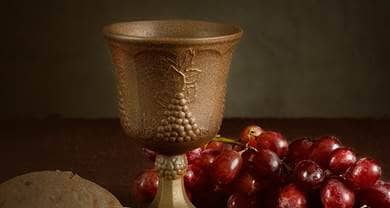
The official symbol of the Disciples is a red chalice with a white St. Andrew's cross. It represents the central place the Lord's Supper occupies in the church's life and recalls the Scottish ancestry of Thomas and Alexander Campbell.

Along with many other Protestant churches, the Disciples believe in the priesthood of all believers. Lay elders preside over communion, and the church also ordains ministers to provide spiritual care for its members.

The basic unit of the church is the independent local congregation, and the church as a whole is organized under a representative government called the "three manifestations," local, regional, and general.

The most powerful guiding principles for the Disciples include a desire for Christian unity, a return to the original apostolic faith and life as seen in the New Testament, and a rejection of creeds or doctrines as tests of faith.

The original and ongoing hope of the Disciples is the restoration of wholeness to the community and to the world, and this informs the passion of the church for social and economic justice.

The Disciples were early to promote women to leadership roles, ordaining their first female pastor in 1888. Recently Disciples have begun adopting an open and affirming stance regarding sexuality, with some speaking in favor of gay marriage.

Recommended Disciples of Christ Products

Shop More


Most Popular on Facebook