
- Trending:
- Pope Leo Xiv
- |
- Israel
- |
- Trump
- |
- Social Justice
- |
- Peace
- |
- Love
RELIGION LIBRARY
Eastern Orthodoxy
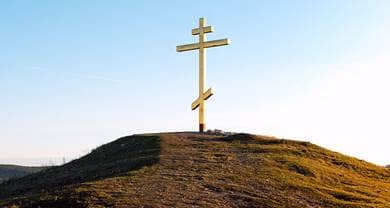
The Eastern Orthodox Church, a branch of Christianity also known as Eastern Orthodoxy, Orthodox Christianity, or the Orthodox Church, identifies its roots in the early Church, particularly as it developed within the Greek-speaking eastern branch of the Roman Empire. The Eastern Orthodox Church accepts the first seven Ecumenical Councils (which were held between 325 and 787 C.E.), and regards itself as the True Church. The Eastern Orthodox Church is organized with an episcopal structure including the Four Patriarchs of Alexandria, Antioch, Constantinople, and Jerusalem (the Patriarch of Constantinople is the first of equals) and consecrated bishops (whose lineage is believed to be traced back to Jesus' apostles). Their worship is highly liturgical and extremely iconographic, both of which are central to the Church's life, history, and practice. Their icons, which include depictions of Jesus, the Virgin Mary, biblical scenes, or saints, are believed to create a sense of the presence of God. Eastern Orthodoxy is strongly doctrinal and places great authority in the Bible, the Creeds (Apostles' and Nicene), and the seven ecumenical councils. Like all other Christians, Orthodoxy is Trinitarian, believing that God exists in three persons (Father, Son, and Holy Spirit).
Quick Fact Details:
- Formed: The exact date of the beginning of the Eastern Orthodox Church is indeterminable. While the belief system recognized as Christianity is in place by the first century, institutional structures developed over time. Nor is it possible to distinguish Orthodoxy as a separate tradition until it can be differentiated from other Christian traditions (most notably, Roman Catholicism and Protestantism). Scholars recognize a variety of significant institutional, theological, and cultural markers in the development of Orthodoxy:
- 325—Council of Nicea. The first post-apostolic ecumenical council of the Christian community at which Church leaders formed a creedal statement of belief recognized universally.
- 380—Edict of Thessalonica. The Emperor Theodosius I mandates "catholic" (universal, in contrast to the heresies of the time) Christianity to be the legal religion of the Empire.
- 381—First Council of Constantinople. This council amended and ratified the Nicene Creed, resulting in the version used by Christian churches around the world.
- 451—The Council of Chalcedon. The first division within Christianity triggered by the split between those who adhered to the conclusions of the Council and those who did not (referred to as Oriental Orthodox).
- 787—The Second Council of Nicea, often called "The Triumph of Orthodoxy." After many decades of iconoclasm (the rejection and destruction of icons), this council ratified the veneration and use of icons in worship and in private devotion—a uniquely Orthodox practice.
- 1054—The Great Schism. Though the Eastern and Western branches of the Church had long been divided over theological, cultural, linguistic, and ecclesiological disputes, the separation was formalized in 1054, thus creating the first large-scale division within Christendom.
- Sacred Texts: Eastern Orthodoxy uses the Septuagint version of the Old Testament, which includes the deuterocanonical books that Protestants rejected. Their New Testaments are identical to those of all Christians.
- Headquarters: The nature of the Eastern Orthodox Church is conciliar rather than monarchical. That is, the patriarchs all hold equal authority in the Church and there is no centralized headquarters from which jurisdiction is maintained. Because the Ecumenical Patriarch—believed to be the first in honor among Orthodox patriarchs—is the Patriarch of Constantinople, Istanbul may be considered the spiritual center of the Orthodox communities.
Quick Fact Sources include www.adherents.com, www.bbc.co.uk/religion, The Oxford Handbook of Global Religions (2006), The Encyclopedia of Religion (2005), the Religious Movements Page at the University of Virginia, The Cambridge Illustrated History of Religions (2002), and the Encyclopedia of World Religions (1999).
Quick Facts
| Formed | c. 1st - 5th centuries C.E. |
| Adherents | 200,000,000 |
| Deity | God (Trinity) |
| Sacred Text | Bible |
| Origin | Roman-Byzantine Empire |
| Headquarters | Constantinople (Istanbul) |








 Ad-Free & Subscriber Log-In