
- Trending:
- Pope Leo Xiv
- |
- Israel
- |
- Trump
- |
- Social Justice
- |
- Peace
- |
- Love
RELIGION LIBRARY
Hinduism
Human Nature and the Purpose of Existence
| PATHS (MARGAS) | ||
| Karma marga | Path of action (especially ritual action) |
Vedas |
| Jnana marga | Path of knowledge (meditation and analysis) |
Upanishads |
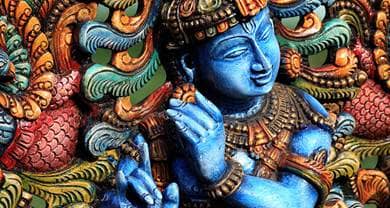
| Bhakti marga | Path of devotion (especially towards Krishna) |
Bhagavadgita |
Hinduism articulates several different, overlapping paths, or margas for humans to follow. Although these paths may seem to be inconsistent, and even contradictory, fully developed Hinduism holds that they are in fact three different, and sometimes overlapping, means to fulfill the same religious goal.
In the earliest layer of Hinduism, the purpose of life is quite straightforward: humans are to perform the proper sacrifices to the gods. The Vedas emphasize that the life of the householder is the most exemplary model for humans. One should do one's societal duty (which later becomes worked out as the caste system), bear children (especially sons), and, essentially, live a proper life. This is known as the karma marga, the path of action, particularly ritual action.
| VEDAS | UPANISHADS |
| Emphasize one's duty as householder | Emphasize asceticism (disregard material world) |
The Upanishads significantly challenge this worldview. The sages responsible for these texts reject the Veda emphasis on the life of the householder and the primacy of sacrifice to the gods. They argue, instead, that there is a higher reality beyond the human realm, Brahman. Human beings can ultimately become one with this higher reality, but only if they change how they see and behave in the world. Specifically, the Upanishads hold that people must renounce the trappings of the world and embark on a life of asceticism.
 In this way, they can train themselves to disregard the things of the material world, which only lead to grasping and attachments, and thus the creation of karma. If one meditates on the true nature of the self (the atman), one can realize that everything that one thinks of as the self, as "I," is in fact no different than Brahman. One can thus learn to be in the world in such a way that one is not attached, and thereby not creating karma (although still acting). When one dies, one is free of karma, and thus not reborn; instead, this person is release from samsara. This is moksha, which literally means "release," but which really refers to ultimate salvation, union with Brahman.
To attain this state of karma-less being, one must, through meditation and intense philosophical analysis, develop the proper knowledge of the true nature of the self. This path, as most clearly laid out in the Upanishads, is known as the jnana marga, the path of knowledge.
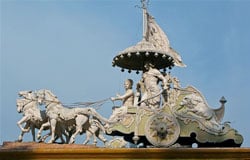 The third path is the bhakti marga, the path of devotion. This is perhaps first described in the Bhagavad Gita, one of the most important sacred texts in all of Hinduism. In the Bhagavad Gita, the god Krishna explains to the warrior Arjuna that the highest and most effective form of religious activity is absolute devotion (in the Bhagavad Gita, it is specifically absolute devotion to Krishna). The logic of the Bhagavad Gita's advocacy of the bhakti marga is complex, but essentially Krishna says that since he, Krishna, is the highest manifestation of Brahman, all beings, including all of the other gods, are contained within him. Thus there can be no action that is not, in the end, part of Krishna: ultimately all sacrifice is to Krishna, all worship, all good and bad actions on earth. So the highest form of action is selfless, loving devotion to Krishna, which is bhakti.
The message of the Bhagavad Gita is considerably more complex than this. Krishna actually builds a very convincing case against the Upanishadic notion of renouncing the world to attain the highest religious goal, moksha. Krishna tells Arjuna that he must, in fact, continue to follow the path of action, to do his duty, dharma, as defined by his caste. Arjuna is a kshatriyan, and so he must fight. However, and this is one of the reasons the Bhagavad Gita became so important in Hinduism, Krishna says that Arjuna can both fulfill his duty (the point of the karma marga) and at the same time be free of karma (the point of the jnana marga). He must do his duty but renounce the fruits–the karmic effects–of his actions. How can he do this? By devoting all of his attention, all of his thoughts, on Krishna (and this is the bhakti marga).
| THE FOUR ASHRAMAS | |
| Ashrama (station in life) | Duties |
| Student | Learn duties of his caste |
| Householder | Raise a family |
| Forest dweller | Study sacred texts |
| Renouncer | Meditate |
An important part of Krishna's message to Arjuna is the concept of Ashrama (or Ashram). Krishna tells Arjuna that he must act according to his caste (varna) and his particular station in life (ashrama); this is related to the concept of varna-ashrama-dharma. One is born into a particular caste as a result of past karma, and one's caste determines what sort of life one will live, what sort of work one will do. As one progresses through life, one is also governed by the concept of ashrama. There are four ashramas: student, householder, forest dweller, and renouncer. At each stage, there are certain duties that one must attend to, certain obligations: a student should focus on learning the appropriate duties of his caste; a householder should raise a family; a forest dweller should focus on study of the sacred texts; and a renouncer should leave the trappings of the world behind to meditate.
What this system does is put everything in its proper place. It is a model of the overarching Hindu concept of dharma, of order. It provides a structure so that at each stage of one's life, one has certain duties and obligations, defined by that stage and one's caste. The Bhagavad Gita adds the concept of bhakti to this, thereby introducing the idea that no matter what one's caste is, from the highest Brahmin to the lowest Shudra, and no matter what one's age, if one performs the appropriate duties with the appropriate devotion, one is engaged in the highest religious acts.
Study Questions:
1. How has the Hindu purpose of life changed throughout history?
2. How do the three paths differ from one another? What are their similarities?
3. What is bhakti, and why is it important?









 Ad-Free & Subscriber Log-In