
- Trending:
- Forgiveness
- |
- Marriage
- |
- Afterlife
- |
- Trump
- |
- Pentecost
- |
- Deconstruction
RELIGION LIBRARY
Hinduism
Missions and Expansion
Hinduism was not originally a unified religious tradition. Rather, it consisted of a wide range of practices and beliefs that were only loosely linked. There was from the beginning wide regional variation. Local traditions existed almost independently, linked by some basic principles—karma, say, or samsara—or a basic understanding of the power of the divine. 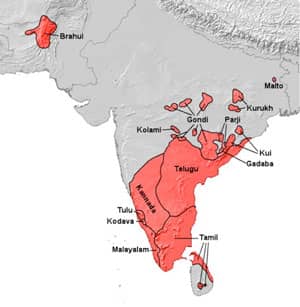 But the Indian subcontinent is a huge and diverse landmass, and the people who inhabit India differ sometimes quite radically depending on where they live. There are hundreds of languages, and thousands of local cults and local traditions that may be unknown outside of a particular region or even a particular village.
Early western scholars posited a geographical and ideological divide in Hinduism, one that was characterized as a split between the north and the south. The north, these orientalist scholars argued, was characterized by the religious ideas of the Vedas, which were brought from outside of India by ancient Europeans, the Aryans. These outsiders invaded northern India and pushed the indigenous peoples to the south. The northerners spoke variations of Sanskrit. The southerners, this theory held, were known as Dravidians, and spoke variations of Tamil. The southerners were said to be darker than their light-skinned Aryan neighbors, and were also less educated, less pure, and their religious traditions less evolved.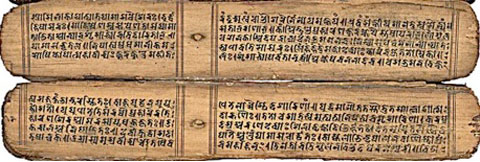
| VEDIC TEXTS |
|
This is a typically slanted and perniciously biased colonialist history. In fact, pre-Vedic religious traditions mixed with Vedic ideas and practices from the beginning, and what emerged as "classical" Hinduism is a complex intermingling of a whole range of local and pan-Indian traditions. Some aspects of Hinduism are truly pan-Indian: the Vedas, for instance, are the basic underlying foundation for virtually all forms of Hinduism; the great epics, the Mahabharata and Ramayana, are mostly pan-Indian, although even they—particularly the Ramayana—have regional variations. The great gods and goddesses—Shiva, Vishnu, Devi—are worshipped everywhere, but regional variations are the norm rather than the exception.
Hinduism has historically been a non-missionizing religious tradition. This is specifically linked to the fundamental theological worldview that all schools of Hinduism share. Human beings are reborn into the world according to their past deeds in prior lifetimes. This is the basic law of karma. Thus being a Hindu is not a matter of choice or cultural circumstance; it is a reflection of the workings of the cosmos. Thus many (although not all) Hindus have held that one cannot convert to Hinduism. You are either born a Hindu, or you are not. As a result, to be Hindu has traditionally meant to be a Hindu in India.
 Hinduism has, however, spread to other parts of the world. It has spread as a result of Hindu kings conquering non-Hindu lands; it has spread as a result of colonization and then globalization; and in the modern period it has spread as a result of westerners adopting, and converting to, Hindu practices and beliefs. Hindu kings began to make forays into Sri Lanka and parts of southeast Asia as early as the 7th century C.E. Hinduism was a major cultural force in much of Southeast Asia, as evidenced, for example, by Angkor Wat or contemporary Balinese Hinduism. The Srivijaya kingdom, established on the island of Sumatra in what is now Indonesia, was a huge Hindu kingdom. In this context, Hinduism took on a distinctly local character, both in terms of the forms of the gods and goddesses and their associated ritual practices. This kind of political expansion outside of India is the exception rather than the rule, however.
Hinduism has become a far more international religion in the modern world, first as a result of colonialism and second as a result of globalization. There are Hindu communities in the West Indies, for instance, because British traders captured and enslaved Hindus, taking them off to work in the tea and coffee plantations in their West Indian colonies. After the collapse of the British Raj, many of these former slaves stayed, cultivating a distinctly local form of Hinduism.  The collapse of the British Empire also meant that Hindus, as citizens of the former colonies, could travel outside of India to other former colonies, most notably Great Britain and Canada, where large communities of so-called "Diasporic Hindus" continue to practice traditional forms of Hinduism that have, nonetheless, taken on local characteristics. There are impressive Hindu temples serving substantial Hindu communities throughout England, in Canada, and in the United States.
A question that remains is, given the incredible internal variations and diversity, how has Hinduism come to be understood as a single religious tradition? In some ways, it is not and never will be. That said, however, there are certain pan-Indian (and, in the contemporary world, international) practices and traditions and beliefs that have, over the centuries, spread throughout the Hindu world and that unite the many variations of the tradition.
Study Questions:
1. Can Hinduism be thought of as a single religious tradition? Why or why not?
2. What are some ways in which Hinduism's believers can be appropriately classified?
3. Why isn't missionizing (for conversion) a part of Hindu daily life?











 Ad-Free & Subscriber Log-In