
- Trending:
- Pope Francis
- |
- Resurrection
- |
- Trump
- |
- Social Justice
- |
- Peace
- |
- Love
RELIGION LIBRARY
Hinduism
Schisms and Sects
| FOUR MAJOR SECTS OF HINDUISM |
|
Hinduism encompasses a number of major sects, as well as countless subsects with local or regional variations. On one level, it is possible to view these sects as distinct religious traditions, often with very specific theologies and ritual traditions; on another level, however, they can understand themselves to be different means to reach a common end. Likewise, although there is a wide variety of theological and ritual variance within Hinduism, it would not really be accurate to call any single movement, after the major breaks with Buddhism and Jainism, a schism.
It is typically held that Hinduism has four major sects: Shaiva, Vaishnava, Shakta, and Smarta. Although this is in a sense technically accurate, it is also only one of many potential ways of classifying the varieties within Hinduism. In practice, these divisions often overlap, and individual Hindus do not necessarily define themselves in such terms.
| List of "principal" Upanishads (there are over 100 others) |
|
|
|
For instance, the term smarta, which comes from the Sanskrit "smrti," or "remembered," generally refers to those Hindus who understand the ultimate form of the divine to be abstract and all encompassing, Brahman. This theological position is most saliently associated with the Upanishads, a genre of literature that posits that the cosmos is permeated by Brahman (indeed, it is Brahman). 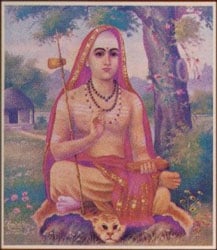 The philosopher/saint Shankara (or Adi Shankara, or Shankaracarya), who lived in the 8th century C.E., is often seen as the founder of the Smarta tradition. Shankara is said to have travelled throughout India spreading his theological message, and is credited with founding four monasteries (maths) where monks could live and cultivate his teachings.
Smartas see any particular manifestation of the divine—that is, any single god—as encompassed by this larger divine power. Since everything, and all gods, are a part of Brahman, smartas typically hold that one is free to choose any god or goddess to worship—or, as is often the case, many different gods and goddesses—since in worshipping any individual god, one is really worshipping Brahman. For smartas, then, the divine is both saguna, "with form"—the individual and particular gods—and nirguna, "without form"—the all-encompassing Brahman. Some Hindus who might technically be classified as smartas favor the nirguna understanding of Brahman associated with the Vedanta, and reject any worship directed to any particular form of the divine.
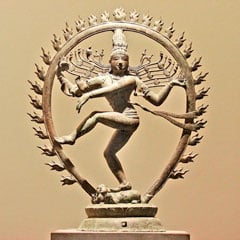 Shaivas and Vaishnavas, in contrast, tend to be more overtly sectarian. The Shaiva tradition (also called Shaivism), is perhaps the oldest sectarian form of Hinduism, emerging out of the Vedas at or around the beginning of the Common Era; the fully developed Shaiva tradition formed significantly later, however, probably between the 8th and 11th centuries. Although it is impossible to date the origin of any of these traditions, the Vaishnava tradition probably emerged slightly later. It too was fully developed in the last few centuries of the first millennium of the Common Era.
Shaivas, as the name implies, worship the god Shiva, who they believe is the creator, maintainer, and destroyer of the cosmos. There are complex theological and philosophical schools associated with the Shaiva tradition, as well as a great variety of devotional practices.
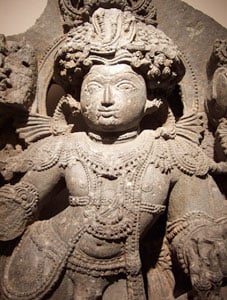 Some Shaivas worship the god in the form of the great ascetic; Shiva in this guise is depicted as a semi-naked yogin who rejects the trappings of the material world in order to seek a higher plane of knowledge. He is typically covered in ash and sometimes is quite wild in appearance, with long unkempt hair and blazing eyes, although his devotees see through his outward appearance and know him as the supreme god. Others worship him as Pashupati, the lord of all creators who shelters and nurtures all who follow him. Still others worship one of his fierce forms, such as Bhairava. As Bhairava, Shiva is a fierce, demonic god with long fangs and a frightening cudgel. His devotees, however, see through this and venerate him as a powerful protector.
 As with their Shaiva counterparts, Vaishnavas have developed an incredibly complex philosophical and theological tradition, with dozens of subschools and sects. Vaishnavas worship one or several of the many forms of Vishnu. Vishnu is typically understood to be the preserver of dharma, order. When disorder threatens to overwhelm the world, Vishnu incarnates himself in an earthly form, called an avatara, literally a "crossing down" from the heavens to the earth. There are ten classical avataras, although in local traditions there are many more than that. The most prominent of these are Krishna and Rama.
| TEN CLASSICAL AVATARAS |
|
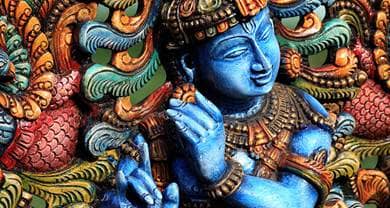
Each of these, in turns, has numerous sub traditions. Some followers of Krishna, for instance, worship him as a playful and mischievous young boy; the devotee loves and takes care of the god in much the same way that a parent loves and takes care of a child. In other contexts, Krishna is a handsome young man, and the devotee approaches him more as a lover does a beloved. And in still other groups within the Vaishnava tradition, Krishna is the wise counselor and guide.
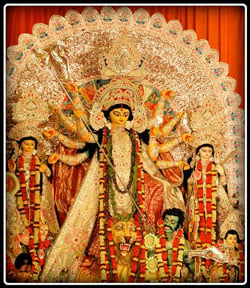 Although it is not certain when Shaktism historically emerged, it may be linked to the Indus Valley civilization, which placed particular emphasis on female figures. Shaktas are, most basically, followers of the various forms of the great goddess (Maha Devi). The name Shakta comes from a form of the goddesses' divine power, shakti. As with the male gods, the goddess can take many forms—fierce and wrathful, motherly, wifely.
Shaktas understand the goddess, Devi, to be the supreme manifestation of divine power and energy. This is mythologically expressed in a number of different accounts of the cosmic origin of the goddess as Durga.  In the Devi Mahatmya, an important Shakta scripture, Durga was created by the three great gods—Brahma, Vishnu, and Shiva—to defeat a demon named Mahishasura whom the gods could not individually defeat. They combined their energy and collectively created Durga to slay the demon. She is thus taken by her followers to be more powerful than—and uncontrollable by—any god, because she is the combined power of all gods.
Both men and women worship the goddess, who takes many, many forms. She is worshipped as the fierce Durga or as Kali, who are tremendously powerful but who also often demand blood sacrifice to appease them (to cool their energy). As such they often have a particular, although by no means exclusive, appeal to the lower castes.
Study Questions:
1. Who benefits from the classification of Hinduism into four major sects? Why?
2. What are the four major sects, and what do the individuals within each believe?
3. Who are the three major gods of Hinduism? What is the role of each? The major goddess?







 Ad-Free & Subscriber Log-In