
- Trending:
- Pope Leo Xiv
- |
- Israel
- |
- Trump
- |
- Social Justice
- |
- Peace
- |
- Love
RELIGION LIBRARY
Hinduism
Beginnings
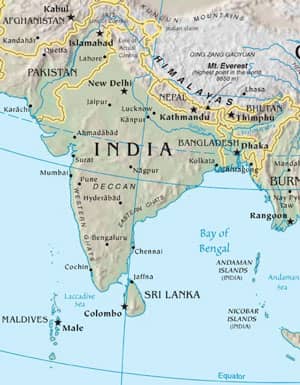 The term "Hinduism" derives from a Persian word that refers to the Sindhu (or Indus) river in northwest India; "Hindu" was first used in the 14th century by Arabs, Persians, and Afghans to describe the peoples of the region. By the end of the 19th century, "Hinduism" was adopted by the British colonial administration in India to describe the various religious beliefs and practices of the majority of India's population.
It is, however, extremely difficult to say when Hinduism began. The tradition itself maintains that it is a timeless religion that has always existed. Historians generally hold that the origins of what we call Hinduism can be traced to the ancient Indus Valley civilization. This would mean that the religion is over 4,000 years old, although it is a dynamic religious tradition that has continued to develop and evolve.
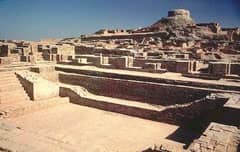
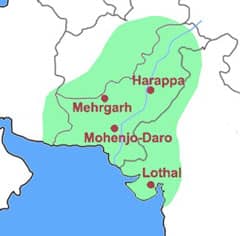 One way to understand the origins of Hinduism is to divide it into several overlapping historical periods. The first is really a pre-Hindu period, the Indus Valley Civilization, which dates to around 2000 B.C.E., and was located, as the name implies, in the region of the great Indus (or "Sindhu") river, in northwest India. Although relatively little remains of this civilization, fairly extensive archaeological evidence indicates that its religion was centered on various fertility goddesses and the purifying qualities of water. Sometime between 2000 and 1500 B.C.E., a new religion began to emerge in India, the religion of the Vedas.
  Some scholars hold that this religion was brought to India by nomadic, horse-riding warriors, a group known as the Aryans, from the steppes of central Asia. This has, in recent years, become a matter of some dispute in India. Regardless of where they came from, the Aryans practiced a sacrifice-based religion that was centered around the purifying and transformative qualities of fire, and that was oriented toward influencing a vast array of powerful gods, called devas.
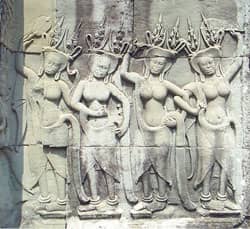 Many of these gods were personifications of natural elements—wind, fire, water—while others were warrior-like figures. The Vedas, a vast corpus of mythological and ritual texts, describe this divine pantheon, as well as prescribe, sometimes in great detail, the rituals to be performed to keep these gods "happy," and thus insure that they benignly interact with the human realm.
| VEDIC TEXTS |
|
The religious realm of the Vedas is centered on the proper performance of ritual sacrifice, which, essentially, involves the offering something of value—an animal or food—in order to receive the favor of the gods; there are Vedic rituals intended to gain wealth, sons, protection, and abundant crops.
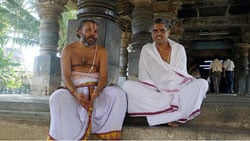 The ritual priests of the Vedas were a group known as the Brahmins. They were entrusted with the sacred texts and with the performance of the rituals. Sometime after 1000 B.C.E., some of these priests began to ask whether there might not be more than this ritual world of exchange in which the "payoff" of religious action was largely material wellbeing.
 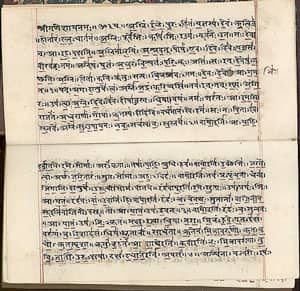 Some began to reject the rituals and their material trappings. They renounced the material and social world, and focused instead on asceticism and meditation. Gradually a new body of philosophically-oriented texts, the Upanishads—sometimes referred to as Vedanta, the end (or completion) of the Vedas—began to emerge.
Unlike the Vedic world of ritual exchange between humans and gods, the Upanishads present a philosophically speculative worldview. They put forward the idea that the material world is not, in fact, "real," but only an illusion that is created by ignorance. What is real is an abstract divine principle, Brahman. The Upanishads focused on how to free oneself from the bonds of material attachments, and thereby attain a state of oneness with Brahman.
| List of "principal" Upanishads (there are over 100 others) |
|
|
|
What is sometimes called "classical" (or "Epic") Hinduism emerges sometime after the Upanishads. In this period, which begins around 500 B.C.E., the major gods and goddesses of Hinduism—Vishnu, Shiva, Krishna, Parvati, Lakshmi—develop their "personalities" through a vast corpus of myths. Innumerable new gods and goddesses emerge, as do a multitude of ritual— many based on the earlier Vedas—and forms of veneration. Devotional traditions also emerge, in which the strictly ordered world of sacrifice is supplanted by loving devotion to individual gods and goddesses.
| Early periods of Hinduism | |
| Indus Valley Civilization | 2500-1500 BCE |
| Vedic Civilization | 1500-500 BCE |
| Rigvedic period | 1500-1000 BCE |
| Brahmanism | 1000-500 BCE |
| Epic period after | 500 BCE |
Hinduism is a perpetually evolving collection of an astounding array of philosophical and ritual and devotional traditions. There is no founder, and although historians may attempt to assign an historical "beginning," really there is no moment of origin. Indeed, Hindus often refer to their religion as "sanatana dharma"—the timeless, eternal truth.
Study Questions:
1. Why is hard to pinpoint the start and founders of Hinduism?
2. What are some possible explanations of its origin?
3. Who were the devas?
4. What are the Vedas, and what is their purpose?
5. What is the relationship of the Upanishads to the Vedas?








 Ad-Free & Subscriber Log-In