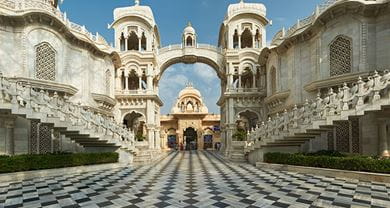
The Hare Krishna movement - formally known as ISKCON, the International Society of Krishna Consciousness - is a semi-monastic religious movement based on Vaishnava Hinduism. In part modeled on the bhakti (loving devotion) movement of the 15th-16th- century Hindu saint Caitanya, ISKCON was founded in 1965 CE by A.C. Bhaktivedanta, who moved to the United States from India with the intention of bringing "Krishna consciousness" to the West. Hare Krishna followers worship the Hindu god Vishnu in his earthly manifestation as Krishna. The ultimate goal of Hare Krishna devotion is to achieve "Krishna consciousness," attained by strict ethical living and spiritual devotion, especially repetitive chanting of the Hare Krishna mantra - "Hare Krishna Hare Krishna/Krishna Krishna Hare Hare/Hare Rama Hare Rama/Rama Rama Hare Har." ISKCON members typically observe a vegetarian diet (including no fish or eggs), do not gamble, ingest alcohol or drugs (including caffeine), and restrain from sex except within marriage for the purposes of procreation. The Hare Krishna tradition has two groups of devotees: "congregational members" and "temple-based" or full members. Congregational members practice the movement's teachings in normal life at home and work, and then worship at congregational temples. The full members live in Hare Krishna temples and lead ascetic lifestyles of devotion. The movement puts particular emphasis on the Bhagavadgita and other Krishna-centered sacred texts.
ISKCON (Hare Krishna)
ISKCON (Hare Krishna) Quick Facts
| Formed | 1966 CE |
| Origin | United States |
| Followers | 250,000 |
| Deity | Krishna |
| Sacred Texts | Bhagavadgita, Vedas, Caitanya-Carita |
| Headquarters | San Francisco (original in USA) / multiple centers |

ISKCON (Hare Krishna)
ISKCON (Hare Krishna) Overview
ISKCON Origins
ISKCON Origins -- ISKCON Beginnings
ISKCON, more popularly known as the Hare Krishna movement, was formally organized in 1966 when its founder brought the Hindu tradition of Gaudiya Vaishnavism to the West. The tradition found new adherents in North America and Western Europe initially before spreading worldwide.
ISKCON Origins -- ISKCON Influences
The Hare Krishna movement's theology derives from a form of Vaishnavism developed by the 16th-century Indian mystic Chaitanya, combined with the spirit of the counterculture in 1960s and 1970s Western world.
ISKCON Origins -- ISKCON Founders
The Indian swami A.C. Bhaktivedanta Prabhupada, born Abhay Charan De, founded ISKCON. The movement traces its lineage back through a series of gurus to Chaitanya, who lived in the 16th century.
ISKCON Origins -- ISKCON Scriptures
The Sanskrit Bhagavadgita and Bhagavatam serve as the central scriptures in ISKCON, with adherents accepting Bhaktivedanta's translations and commentaries of these sacred texts.
ISKCON Origins -- ISKCON Historical Perspectives
Early studies of ISKCON considered the group as one of many new religions in the American counterculture. More recent scholarship on ISKCON now studies it as a Hindu transplant movement.
ISKCON History
ISKCON History -- ISKCON Early Developments
After Bhaktivedanta's death, his followers led ISKCON. A new generation of Western converts became regional gurus, while a Governing Body Commission oversaw organizational concerns.
ISKCON History -- ISKCON Schisms, Sects
Some Hare Krishna adherents have split with the main organization over the status of the gurus who led the movement after Bhaktivedanta's death.
ISKCON History -- ISKCON Missions, Spread, Changes, Regional Adaptations
The most important changes to come to ISKCON have been demographic: the aging of its members and the rise of a second generation. The movement has also spread internationally, though retaining a remarkable theological consistency with the teachings of its founders.
ISKCON History -- ISKCON Exploration, Conquest, Empire (incl. violence, persecution)
ISKCON has experienced its share of both persecution and violence. In many cases, Hare Krishna adherents have been the targets of persecution, and in other cases, members of the group itself have engaged in violence.
ISKCON History -- ISKCON Modern Age
In recent years ISKCON has attracted a sizable number of Indian Hindus, in some cases outnumbering the original Western converts, thereby transforming ISKCON's demographics and identity.
ISKCON Beliefs
ISKCON Beliefs -- ISKCON Sacred Narratives
ISKCON adherents generally follow the normative beliefs and sacred narratives of Hinduism, especially material found in the Vedas and Bhagavata Purana.
ISKCON Beliefs -- ISKCON Ultimate Reality and Divine Beings
ISKCON's theology centers on Krishna, whom adherents believe to be the supreme personality of Godhead, the creator and maintainer of the universe, and the object of all devotion.
ISKCON Beliefs -- ISKCON Suffering and the Problem of Evil
The Hare Krishna movement sees evil as a byproduct of the decayed state of the world during the current cosmic cycle (yuga), and traces individual suffering to the effects of karma.
ISKCON Beliefs -- ISKCON Human Nature and the Purpose of Existence
Human beings seek to reunite with God, and to do so must follow a path called bhakti (devotional) yoga.
ISKCON Beliefs -- ISKCON Afterlife and Salvation
ISKCON upholds the Hindu notion of transmigration, and adherents believe that an individual's karma determines their rebirth. Devotees of Krishna may instead enjoy rebirth in God's spiritual realm.
ISKCON Ritual, Worship, Devotion, Symbolism
ISKCON Ritual, Worship, Devotion, Symbolism -- ISKCON Sacred Time
ISKCON members structure the daily life around a series of rituals and devotional practices intended to create a sense of sacred time. In addition to daily practices, ISKCON features a sacred calendar of holidays, celebrations, and observances.
ISKCON Ritual, Worship, Devotion, Symbolism -- ISKCON Sacred Space
ISKCON looks to the locations associated with Krishna's earthly existence as particularly holy, but have built temples throughout the world as spaces to encounter the divine.
ISKCON Ritual, Worship, Devotion, Symbolism -- ISKCON Rites and Ceremonies
The central rites and ceremony of the Hare Krishna movement are initiation, the communal singing of Krishna's names (kirtan), and the ritual worship of Krishna (arti), although numerous other devotional acts exist.
ISKCON Ritual, Worship, Devotion, Symbolism -- ISKCON Worship and Devotion in Daily Life
ISKCON devotees engage in daily offerings to Krishna and in regular chanting of the sacred prayer (mantra).
ISKCON Ritual, Worship, Devotion, Symbolism -- ISKCON Symbolism
Images of Krishna and his consort Radha are most central to the Hare Krishna movement, as well as those portraying their founder Bhaktivedanta and other members of the lineage.
ISKCON Ethics, Morality, Community
ISKCON Ethics, Morality, Community -- ISKCON Leadership/Clergy
The Hare Krishna movement recognizes a Governing Body Commission that oversees the movement, as well as a series of gurus who serve as spiritual leaders.
ISKCON Ethics, Morality, Community -- ISKCON Community Organization and Structure
ISKCON is organized by temple, with most communities having monastic residents, full-time lay disciples, and larger numbers of congregational members.
ISKCON Ethics, Morality, Community -- ISKCON Principles of Morsl Thought and Action
The four regulative principles of ISKCON are the prohibition against eating meat, fish, or eggs, gambling, intoxication, and illicit sexual activities.
ISKCON Ethics, Morality, Community -- ISKCON Vision for Society
ISKCON is an evangelistic movement that seeks to spread the devotion to the divine, specifically what they call Krishna Consciousness, throughout the world.
ISKCON Ethics, Morality, Community -- ISKCON Gender and Sexuality
Bhaktivedanta founded ISKCON in accordance with what he considered traditional Bengali gender norms, though in recent years the movement has slowly moved toward permitting greater gender equality.