
- Trending:
- Pope Leo Xiv
- |
- Israel
- |
- Trump
- |
- Social Justice
- |
- Peace
- |
- Love
RELIGION LIBRARY
Islam
Early Developments
The period immediately following Muhammad's death until the death of his cousin and son-in-law Ali in 661 is remembered as a kind of golden age by some Muslims. It was the Age of the Rashidun, or "rightly-guided ones," when Muhammad's close companions led the community of Muslims.
| "Golden Age" or "Age of Rashidun" | |
| Death of Muhammad | 632 CE |
| Caliphate of Abu Bakr | 632-634 |
| Caliphate of Umar ibn al-Khattab | 634-644 |
| Caliphate of Uthman ibn Affan | 644-656 |
| Caliphate of Ali Ibn Abi Talib (cousin & son-in-law of Muhammad) |
656-661 |
| Fitna: first Islamic civil war | 656-661 |
| Arbitration between Ali and Mu'awiyah | 658 |
| Death of Ali ibn Abi Talib | 661 |
Muhammad died unexpectedly of illness in 632, depriving the Muslim community of its founder and leader. With little preparation for this loss, the community was divided over the question of succession. Some believed that Muhammad had named his cousin and son-in-law Ali ibn Abi Talib and his descendants to succeed him. Others thought that Muhammad had died without naming a successor, and that the community elders were therefore responsible for naming a successor. This dispute over time divided the community into two major groups, the partisans (singular, Shi'a) of Ali, and the Sunni.
The majority of Muhammad's followers chose to follow Abu Bakr, a close companion of the Prophet's who was chosen by the elders of the community. Abu Bakr thus became the first religious and political leader, called caliph (Arabic, khalifah or successor). Islamic tradition remembers Abu Bakr as a humble and moral man who ruled with great fidelity to the teachings of the Quran. During the two years that he ruled as caliph before his death in 634, Abu Bakr consolidated Muslim rule in Arabia and sent armies into Syria and Iraq on short and successful raids.
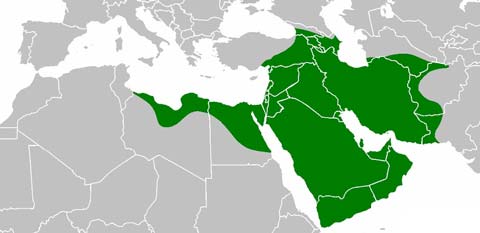
Tradition holds that Abu Bakr designated one of his military advisors, Umar ibn al-Khattab as his successor. A brilliant general, Umar continued the campaign of military conquest with astonishing success. In the ten years of Umar's reign as Islam's second caliph, Arab armies conquered Egypt, Syria, and Iraq.
Umar was also responsible for establishing a variety of important social and legal institutions. Throughout the newly-conquered provinces, Umar appointed provincial judges (Arabic, qadi), to settle disputes. He established regulations to govern public observance of important Quranic teaching, such as the pilgrimage to Mecca, the observance of the holy month of Ramadan, and the punishment of adultery and drunkenness. During Umar's reign, Jews and Christians in the newly-conquered territory were assigned the status of dhimmi, or "People of the Book." The dhimmi were not forced to convert. They were exempted from the zakat, or alms tax obligatory on all Muslims, although they were required to pay the jizyah, or poll tax, which was higher. Whether due to the higher tax burden on the dhimmi, or due to Islam's message of egalitarianism, Islam ultimately won many converts in the newly-conquered territories.
| Legacy of Umar ibn-al-Khattab (634-644) |
| Appoints provincial judges (Arabic, qadi) |
Establishes regulations to govern observance of Quranic teaching, such as:
|
| Jews and Christians assigned status of "People of the Book" (Arabic, dhimmi) |
| Establishes a council (Arabic, shura to select his successor) |
The poll tax was particularly burdensome for poor Christians and Jews, and this caused strong resentment. Some believe this was the motive behind the murder of Umar by a Christian slave in 644. On his deathbed, Umar established a council (Arabic, shura) to select his successor. The shura chose Uthman ibn Affan, a man with a strong reputation for loyalty to Muhammad, as the third caliph. Uthman continued the policies established by Umar, and spearheaded the production of an official written version of the Quran.
 Uthman's caliphate was troubled by the rapid expansion of Islamic territory. Far-flung generals were tempted to challenge the central authority of the caliphs, and Uthman confronted serious problems generated by uneven economic development and the distribution of lucrative government appointments. Uthman was frequently accused of nepotism. In 656, an Egyptian delegation visited Uthman at his home in Medina to discuss economic grievances. The talks turned hostile, and the Egyptians laid siege to Uthman's home. Mu'awiyah, Governor of Syria and a member of Uthman's family, the Ummayads, sent forces to assist Uthman, but they didn't arrive in time. Uthman was assassinated.
Uthman did not appear to receive much support from other influential Muslims in Medina during his hour of need. This included Muhammad's son-in-law, Ali, and other members of the Prophet's family. Ali was only a few years younger than Muhammad, and both had been raised by Muhammad's uncle, Abu Talib. Ali was among the first two or three people to convert to Islam, and had married Muhammad's daughter Fatima. This long and close relationship between Ali and the Prophet had led many people to believe that Ali should have been the first to succeed Muhammad. Called the "partisans of Ali," or the Shi'a, they prefer the title of imam, or spiritual leader, to the title of caliph.
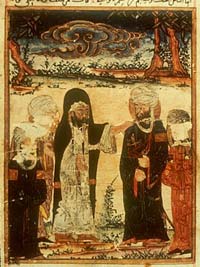 When Uthman died, it finally fell to Ali to assume the role of caliph. He seemed reluctant to accept the position, but ultimately agreed to the role. But while many Muslims pledged their allegiance to Ali, many others did not, and Ali soon left Medina, never to return. As a result, the death of Uthman marks the beginning of the first serious breach in the unity that Muhammad had so carefully built. Muslims call this watershed moment the fitna, or the first civil war.
Ali spent the next five years trying to force rebels to recognize his right to hold the office of caliph. In the garrison town of Basra, in Iraq, he quelled a rebellion led by two Meccan aristocrats and Aisha, the popular younger wife of Muhammad. After a few subsequent successes, he faced the forces of Mu'awiyah, the Governor of Syria who had attempted to save Uthman. Ali had not pursued retribution for Uthman's assassination because many in the community felt that the assassination had been justified by Uthman's poor handling of economic grievances, especially his nepotism. But Mu'awiyah demanded that Uthman's murder be avenged.

| First Fitna | |
| Region under the control of Rashidun Empire (Ali ibn Abi Talib) | |
| Region under the control of Muawiyah I | |
| Region under the control of Amr ibn al-As | |
| Source: Public Domain | |
The disagreement between Ali and Mu'awiyah was handled by arbitration in 658, and Mu'awiyah emerged the winner, the self-proclaimed caliph of Islam. Calling him weak, many of Ali's supporters withdrew their troops. Mu'awiyah's troops pursued Ali and his remaining followers into Kufah, in southern Iraq, but Ali survived until 661, when he was killed in an ambush by a poisoned sword. He was buried in Najaf, in Iraq, which is now an important pilgrimage site for the Shi'a.
Study Questions:
1. How did Muhammad’s death change the course of Islam?
2. Who was Abu Bakr? Umar ibn al-Khattab?
3. Was Christianity’s early resentment of Islam purely religious? Why or why not?
4. When did Islam’s first civil war happen? What was the outcome?










 Ad-Free & Subscriber Log-In