
- Trending:
- Pope Leo Xiv
- |
- Israel
- |
- Trump
- |
- Social Justice
- |
- Peace
- |
- Love
RELIGION LIBRARY
Islam
Worship and Devotion in Daily Life
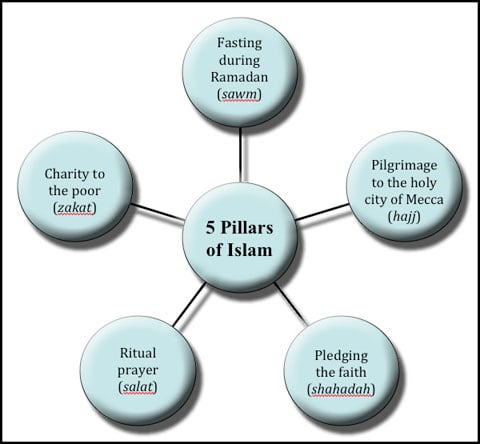 Muslims are united across boundaries of geography and culture through their observance of five practices known as the Five Pillars, or the Pillars of Islam. These include pledging one's faith (witnessing, the shahadah), ritual prayer (salat), charity to the poor (zakat), fasting during the month of Ramadan (sawm), and pilgrimage to the holy city of Mecca (hajj). The Five Pillars are mentioned in the Quran, and are required of all Muslims. Sunni and Shi'i Muslims agree that these are the essential duties of all Muslims. The Five Pillars are strong expressions of the Islamic ideals of equality and unity. The pillars of ritual prayer, the Ramadan fast, and the hajj are particularly powerful signs of Muslim egalitarian unity, since all Muslims in all places pray, fast, and go on pilgrimage at the same time.
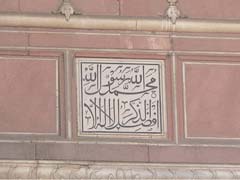 The profession of faith (witnessing), or shahadah, very simply states that "There is no god but God (Allah), and Muhammad is the messenger of God." A person becomes a Muslim by reciting this sentence with sincere belief in the presence of witnesses. It is also recited in daily prayer, and inscribed outside the doors and inside the domes of mosques. It captures the essential Islamic belief in one absolute God, and affirms that Muhammad was God's messenger, the last and final prophet sent by God.
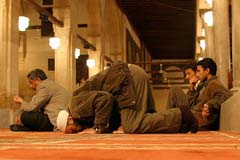
 Ritual prayer, or salat, is a basic activity of daily life. Muslims are called to pray five times a day: before dawn, at midday, in the mid-afternoon, at sunset, and at night. The call to prayer is made by a muezzin, who calls out from the top of a tower, called a minaret. The muezzin's call is an art form, and begins by proclaiming "God is great" (Allahu akbar), and then continues "I bear witness that there is no god but God; I bear witness that Muhammad is the messenger of God; hasten to prayer; hasten to success; establishing the communal ritual of prayer." In many places in the contemporary Islamic world, recordings of a muezzin's call are played over loudspeakers, replacing a live person.
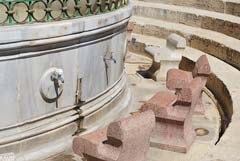 Before praying, one is expected to perform a ritual ablution, cleansing both mind and body. If water is available, the hands, arms, face, neck, and feet are washed. Prayers are performed facing in the direction of Mecca. While praying together is preferred to solitary prayer, Muslims can pray wherever they happen to be, whether alone or in groups. They can pray outdoors, at home, or in the mosque. It is obligatory for Muslim males to attend the mosque for the Friday noon prayer, a special time set aside for communal prayer.
 Charity, or zakat, involves setting aside a portion of one's personal wealth for the poor. This purifies one's wealth. Islam discourages begging, and zakat allows poor people to find help without feeling disgraced. The practice also prompts us to confront our all-too-human tendencies toward greed, selfishness, and materialism. All Muslims who are able are expected to donate roughly 2.5 percent of their net gain annually. This includes total income, but also the value of livestock, produce, jewelry, real estate, and investments such as stocks and bonds. Initially, the collection and distribution of zakat was done by the state, which is why it is commonly called a tax. With the introduction of secular political systems, and especially the advent of the colonial state, zakat became an individual practice. In some countries, such as Pakistan and Sudan, the state has resumed collecting and distributing zakat, while Muslims in other areas can contribute to organized charities that collect and distribute donations to mosques, schools, libraries, and hospitals. In addition to the practice of zakat, Muslims are expected to respond with charity and generosity when called to do so in daily life.
| Islamic Calendar |
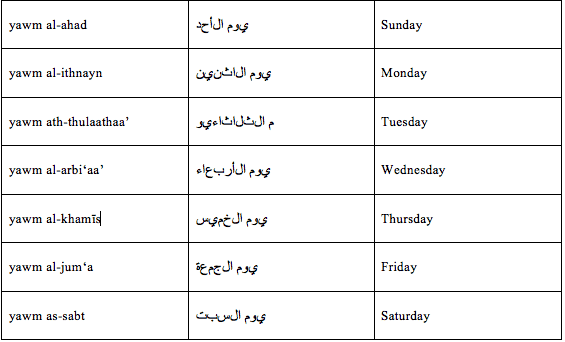
Ramadan, the ninth month of the lunar Islamic calendar, is the month during which Muhammad first received revelations from God. Muslims commemorate this central event by fasting during Ramadan (sawm) and by prayer rituals that cleanse the soul and unify the community. For the duration of the month, devout Muslims abstain from food, liquids (even water), tobacco, and sex from dawn until dusk. This self-denial is believed to focus the devout on God's presence and increase their sense of the abundance of God's blessings. Travelers, the elderly, pregnant women, and the sick are exempted, but are expected to make up the days of fasting at some other time or feed the poor for all the days that one missed. The Night of Power is celebrated during the last ten days of Ramadan. This night is considered the holiest night of the year, the time when all sins are forgiven.
 The month of fasting concludes with the celebration of Eid al-Fitr, a festival of parties and celebrations that can last up to three days. Some people also take this occasion to visit the graves of ancestors. The Islamic calendar follows a lunar cycle, which has 354 days in twelve months, as opposed to the 365 days of the solar calendar. As a result, Ramadan occurs at a slightly different time each year. When it falls during the winter months, the short days and long nights are less challenging than when Ramadan falls during the summer months. The summer days are long and hot, and water and food are most welcome at the end of a day of fasting.
The fifth and final Pillar is the hajj, the pilgrimage to the holy city of Mecca. All adult Muslims, both men and women, are expected to perform the hajj at least once during their lifetime unless they are sick or cannot afford the journey. The hajj falls during the month of Dhu al-Hijjah, which is the last month of the Islamic calendar. During the hajj, Muslims perform special rites that are intended to commemorate important events in the life of Abraham, the founding patriarch of Islam as well as of Judaism and Christianity. Pilgrims typically arrive in Mecca by the seventh of the month. In the past, they came by boat and caravan in trips that would take months or even years. Some pilgrims died along the way. With the advent of air travel, pilgrims can make a short journey by plane to the airport in Jiddah, a port city on the west coast of Saudi Arabia. Air travel has allowed pilgrims to come in vastly larger numbers than before, with roughly two million pilgrims coming each year. In spite of the high numbers, those who return home from the pilgrimage enjoy great prestige, earning the honorific title of hajji (male pilgrim), or hajja (female pilgrim).
Study Questions:
1. What are the essential duties of a Muslim?
2. Describe the ritual of salat.
3. What is zakat? Is it limited to economic wealth?
4. What is Ramadan? How do Muslims participate in it?
5. Has the convenience of contemporary times changed the importance of Hajj? Why or why not?








 Ad-Free & Subscriber Log-In