Patheos Watermark

Jainism

Jainism Quick Facts

Formed 550 BCE
Origin India
Followers 6,000,000
Deity None / Jinas, Tirthankars
Sacred Texts Jaina Sutras
Headquarters None

Jainism

Jainism Overview

Learn More

Jainism dates to the 6th century BCE in India. The religion derives its name from the jinas ("conquerors"), a title given to twenty-four great teachers (tirthankaras or "ford-makers"), through whom their faith was revealed. Mahavira, the last of the tirthankaras, is considered the founder of Jainism. The ultimate goal of Jainism the liberation of the self (jiva) from rebirth, which is attained through the elimination of accumulated karma (the consequences of previous actions). This occurs through both the disciplined cultivation of knowledge and control of bodily passions. When the passions have been utterly conquered and all karma has been removed, one becomes a Jina ("conqueror"), and is no longer subject to rebirth. Jainism conceives of a multi-layered universe containing both heavens and hells. Movement through these levels of the universe requires adherence to the Jainism doctrines emphasizing a peaceful and disciplined life. These principles include non-violence in all parts of life (verbal, physical, and mental), speaking truth, sexual monogamy, and the detachment from material things. As part of the disciplined and non-violent lifestyle, Jains typically are strict vegetarians and often adhere to a quite arduous practice of non-violence which restrict the sorts of occupations the may follow (no farming, for instance, since insects are inadvertently harmed in plowing). Jainism's ethical system is based on the idea that right faith, knowledge, and conduct must be cultivated simultaneously.

Contributors

Jainism Origins

Jainism Origins -- Jainism Beginnings

Details

Scholars trace the beginning of Jainism to the 6th century B.C.E. in northern India, one of several shramanic movements there that arose in response to Vedism. Insiders to the tradition, however, consider it to be eternal.

Jainism Origins -- Jainism Influences

Details

Jainism is a renunciant movement that developed in reaction to the Vedic ritualism of pre-6th century B.C.E. India. This turn toward meditative asceticism is seen also in the Hindu Upanishads and in the development of Buddhism, both contemporaries of Jainism.

Jainism Origins -- Jainism Founders

Details

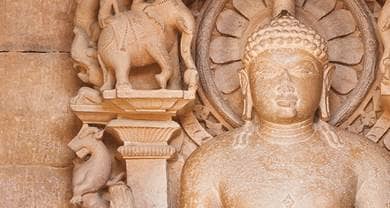
Twenty-four identical tirthankaras (ford-crossers), or jinas (victors), have taught and will continue to teach Jain dharma for all eternity. Though often mistakenly considered a founder by outsiders, Mahavira is rather the most recent of the series of twenty-four.

Jainism Origins -- Jainism Scriptures

Details

Two extensive canons exist, as the Digambara and Svetambara sects each developed their own scriptures. Scriptures are not understood to be divinely revealed but rather eternally existent truths that individual souls may access through correct viewpoint, knowledge, and conduct.

Jainism Origins -- Jainism Historical Perspectives

Details

Traditional studies of Jain karma theory, meditation, cosmology, and scripture have expanded in recent years to include scholarship on lay devotion, Jain political identity in relation to the Hindu majority in India, and the maintenance and adaptation of Jain values in diaspora.

Jainism History

Jainism History -- Jainism Early Developments

Details

The life of Mahavir, the most recent of twenty-four tirthankaras or jinas, is traditionally located between 599 and 527 B.C.E. in northern India and marks the historical beginning of the tradition. By 310 B.C.E., two distinct sects had emerged.

Jainism History -- Jainism Schisms, Sects

Details

Two primary sects, the Digambara (sky clad), and Svetembara (white clad), have held differing positions on the nature of attachment and violence, and have composed their own scriptures from the time of their split in the 4th century B.C.E.

Jainism History -- Jainism Exploration, Conquest, Empire (incl. violence, persecution)

Details

The principle of non-violence entails that Jainism has been a religion of neither conquest nor exploration. Jains, however, have been persecuted by those around them. In particular, the Digambar sect's nudity has not always been properly understood nor well received.

Jainism History -- Jainism Missions, Spread, Changes, Regional Adaptations

Details

Jainism is not a missionary tradition. From its beginnings in northern India the tradition spread to what is now Karnataka in the south of India in the 4th century B.C.E. More recently the development of a Jain diaspora has entailed various adaptations.

Jainism History -- Jainism Modern Age

Details

There are now approximately eight million Jains worldwide, mostly in India. A concern over political identity in relation to the Hindu majority has spurred a bid for Minority Status with the Supreme Court. The growing Jain diaspora reveals various adaptations in practice and philosophy.

Jainism Beliefs

Jainism Beliefs -- Jainism Sacred Narratives

Details

Ahimsa Paramo Dharma: non-violence is the highest religion. Violence and attachment attract karma, a sticky physical substance that clings to human souls, binding them to samsara. Jains can attain liberation by burning off these karmas through strict adherence to non-violence.

Jainism Beliefs -- Jainism Ultimate Reality and Divine Beings

Details

Jainism postulates no creator god. The unfortunate union of soul and matter propels the cycle of samsara. Tirthankaras are enlightened human teachers attributed with supernatural characteristics. The universe consists of three realms: hellish; earthly/heavenly; and that of siddhas (liberated souls).

Jainism Beliefs -- Jainism Human Nature and the Purpose of Existence

Details

Every sentient being has a soul mired in material karmic particles that block its spiritual path. Action, particularly action with attachment, attracts karma to the soul throughout successive reincarnations. Karma must be burned off in order to reach liberation.

Jainism Beliefs -- Jainism Suffering and the Problem of Evil

Details

All sentient beings do harm simply by existing. This harmful action and the karmas it generates are at the root of all suffering. The evil and violence inherent to this existence prove to Jains the absence of a creator god.

Jainism Beliefs -- Jainism Afterlife and Salvation

Details

Following liberation one's jiva ascends to the apex of the universe to join other siddhas. One can ascend to a heavenly realm due to good karmas accrued, but must return to a human incarnation in order to achieve final liberation.

Jainism Ritual, Worship, Devotion, Symbolism

Jainism Ritual, Worship, Devotion, Symbolism -- Jainism Sacred Time

Details

Jain time is cyclical, moving through stages in which dharma grows progressively weaker and conditions in karma-bhumi deteriorate accordingly. Each of these cycles is marked by the return of the twenty-four Tirthankaras, who eternally refresh Jaina Dharma through their identical teachings.

Jainism Ritual, Worship, Devotion, Symbolism -- Jainism Sacred Space

Details

Some Jain sects do not build temples, as they consider their construction and use to be violent attachment. For Jains who do attend temples, there are many important pilgrimage sites in India considered to be sources of spiritual power.

Jainism Ritual, Worship, Devotion, Symbolism -- Jainism Rites and Ceremonies

Details

Rituals differ by sect, but generally include fasts, devotional worship, and meditation. Initiation into renunciant orders is effected by the elaborate Diksha ritual. The ritual of Sallekhana entails fasting until death when one's body begins to interfere with spiritual progress.

Jainism Ritual, Worship, Devotion, Symbolism -- Jainism Worship and Devotion in Daily Life

Details

Vegetarianism is the most common expression of Jain values. Also common are meditation, recitation of mantras, and household or temple puja performance. Daily observance of the five vows (non-violence, truthfulness, non-stealing, sexual purity, and non-possession) is essential for all Jains.

Jainism Ritual, Worship, Devotion, Symbolism -- Jainism Symbolism

Details

The official symbol of Jainism is a pictogram whose geometric outline symbolizes the world (lok); within the image is a raised hand inscribed with "ahimsa" (non- violence); a swastika symbolizing the four worlds into which one can be reborn; three dots symbolizing the three jewels of Jainism; and an arc symbolizing the abode of the Siddhas.

Jainism Ethics, Morality, Community

Jainism Ethics, Morality, Community -- Jainism Leadership/Clergy

Details

Renunciants are the cultural heroes and role models of Jainism. These mendicants own nothing and travel continually for food and shelter (during the rainy season) provided by the laity. They do not teach directly but rather lead by example.

Jainism Ethics, Morality, Community -- Jainism Community Organization and Structure

Details

In addition to the sectarian division of Jains into Digambar and Svetambar, the community is fourfold: renunciants both male (munis) and female (sadhvis), and male and female householders. There is no central religious authority but several individual spiritual leaders (acharyas).

Jainism Ethics, Morality, Community -- Jainism Principles of Moral Thought and Action

Details

Jainism's three paramount principles are Ahimsa (non-violence), Anekantevad (many-sidedness or non-dogmatism), and Aparigraha (non-possessiveness). Thoughts and actions of all Jains should be guided by dispassionate detachment and compassion in an effort to burn off existing karma and prevent its accrual.

Jainism Ethics, Morality, Community -- Jainism Vision for Society

Details

In theory, society should not exist. All existence is mired in violent suffering: the doctrinal ideal is to escape. The practical expression of this among householders translates to a non-violent society that values animal and plant life alongside that of humans.

Jainism Ethics, Morality, Community -- Jainism Gender and Sexuality

Details

The body, a source of attachment and violence, must be strictly controlled. For Digambar Jains, one cannot attain salvation from a female body, as these are inherently more violent. Svetembar Jains permit the ordination of women while Digambar Jains do not.

Recommended Jainism Products

Shop More