
- Trending:
- Forgiveness
- |
- Marriage
- |
- Afterlife
- |
- Trump
- |
- Pentecost
- |
- Deconstruction
RELIGION LIBRARY
Judaism
Sacred Texts
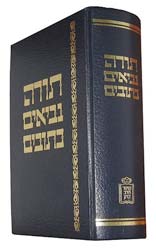 The Hebrew Bible emerged out of an oral tradition developed by the ancient Israelite community in an effort to narrate their history, explain the origins of the cosmos, and define their place in it as members of the larger human community. The process of transcribing this oral tradition into writing began during the period of the Davidic Monarchy in 1000 B.C.E. and lasted approximately 800 years.
| Books of the Torah |
| Genesis Exodus Leviticus Numbers Deuteronomy |
In contrast to other nations of the ancient near east whose national origins were directly intertwined with their creation myths, the Israelite scribes connected their historical emergence as a nation to the creation myths through a series of ancestral narratives depicting the birth of the world, a family, and a nation called Israel. The Hebrew scriptures consist of twenty-four books and is divided into three sections that are referred to with the acronym TaNaKh, an abbreviation for Torah, Neviim, and Ketuvim.
 The Torah (or Pentateuch) refers to the first five books of the Hebrew Bible, associated with its central figure Moses: Genesis, Exodus, Leviticus, Numbers, and Deuteronomy. Although these books are theologically united together as the "Law of Moses" received from God at Mt. Sinai, they are historically understood as a series of narratives grouped together under the other meaning of Torah, "instruction." They lack a continuous theme or a single author and were edited over a period of 500 years and canonized during the 6th century B.C.E.
| Books of the Nevi'im (Prophets) |
| Joshua Judges Samuel (I-III) Kings (I-II) Isaiah Jeremiah |
| Minor Prophets Hosea Joel Amos Obadiah Jonah Micah Nahum Habakkuk Zephaniah Haggai Zechariah Malachi |
Neviim, "Prophets," is the second section of the Tanakh. It is comprised of the books of Joshua, Judges, Samuel I-II, Kings I-II, Isaiah, Jeremiah, Ezekiel, and twelve minor or shorter prophetic narratives, including those of Hosea through Malachi. In the medieval period, rabbinic commentators divided this one section of texts in half, referring to Joshua through Kings as "former prophets" and Isaiah through the twelve minor prophets as "latter prophets," based on their placement within the biblical text. While the books of Joshua through Kings are not named after prophets, it can be argued that they all involve some degree of prophecy. Yet it is even more plausible to group them together as one continuous historical narrative, beginning in the Book of Deuteronomy, involving the worship of one God associated with the Davidic kingdom who actively rewards and punishes Israel for its sins. It is likely that these prophetic books were canonized after those in the Torah during the late Persian and early Hellenistic periods.
| Books of the Ketuvim (Writings) | |
| First Section: Poetry |
Psalms Proverbs Job |
| Second Section: Smaller books |
Song of Songs Ruth Lamentations Ecclesiastes Esther |
| Third Section: Historical texts |
Daniel Ezra/Nehemiah Chronicles |
Ketuvim or "writings," is a collection of books that were most likely canonized together because they were all compiled by the end of the Second Temple period. They are comprised of a variety of material. The first section consists of poetry—Psalms, Proverbs, and Job. Then there is a grouping of five smaller books copied together because they were originally written on small scrolls—Song of Songs, an erotic love poem; Ruth, the story of the first "convert" to Judaism; Lamentations, a dirge over the destruction of the First and Second Temples; Ecclesiastes, a wisdom book portraying a Hellenistic type of fatalism; and Esther, the story of diaspora Jews triumphing over an attempted genocide. The last section of Ketuvim involves the historical texts of Daniel, depicting Judean history from the Persian to the Hellenistic periods; Ezra/Nehemiah portraying the history of the exilic period; and Chronicles, presenting a selective retelling of history from Adam through Cyrus in 538 B.C.E.
| 516 BCE-70 CE: Second Temple Period |
| 70-200 CE: Period of the Tannaim ("repeaters" of oral traditions)→MISHNAH |
| 200-500 CE: Period of the Amoraim (Mishnah "discussers")→GEMARA |
While the official canonization of the Hebrew Bible ended in the 2nd century B.C.E, the transmission of "Jewish scriptures" has continued unabated in the form of midrash or commentary to the Torah up through today. In fact, one could argue that even during the biblical period, priests, prophets, psalmists, and scribes were composing scripture by recycling and reinterpreting earlier versions of it, illustrating what one biblical scholar Michael Fishbane has referred to as "inner biblical exegesis."
The Pharisees astutely referred to this type of dynamic interpretive process as the Torah shebe'al peh or Oral Torah, which they argued was equally as authoritative as the Torah shebikhtav or Written Torah, because both were given to Moses at Mt. Sinai simultaneously as parallel divine truths. Following the destruction of the Second Temple, the tannaim who had memorized the oral interpretations of the Torah by the Pharisees were forced to write them down in order to preserve them, eventually compiling them in the Mishnah by the 3rd century.
| Mishna + Gerara = Talmud | |
| Jerusalem Talmud Babylonian Talmud |
|
The organic process of rabbinic commentary continued with the Amoraim, "discussers" of the Mishnah, who later compiled their interpretations in the book of the Gemara, "learning," by the end of the 5th century. Together, the Mishnah and the Gemara comprised the Talmud. While the rabbis of Palestine produced the Jerusalem Talmud, the dispersed rabbinic community of Babylonia produced its own Babylonian Talmud a century later. Yet the rabbis didn't see these texts as merely literary achievements, but rather as a continuation of sacred scripture itself, arguing that every rabbinic interpretation ever to be given was already revealed to Moses at Mt. Sinai by God as part of the Oral Torah.
In the medieval period, rabbinic commentators perpetuated the divine revelation of Torah with their own midrashic or interpretive techniques to develop legal, philosophical, and mystical commentaries that would further uncover new meanings of God's word.
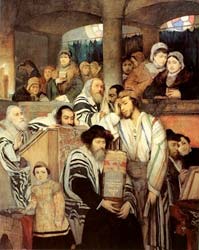 The 18th-century pietistic movement Chasidism would further extend the meaning of the Oral Torah beyond the earlier rabbinic commentaries to include the writings of zadikim, righteous individuals in every generation, particularly the Chasidic leaders themselves who even had the right to "cancel" a divine decree when necessary.
The medieval philosophical and legal interpretations also paved the way for modern and contemporary innovations of Jewish theology and legal observance including traditional, liberal, and feminist approaches. While the Hebrew biblical canon has remained sacrosanct throughout history, Jewish thinkers in every generation have continued to create "scripture" anew by participating in the ongoing process of interpretation.
Study Questions:
1. Why was an oral tradition important to the transmission of Judaism?
2. What is the Torah? How are its sections divided?
3. What is midrash?
4. Why is midrash important to the oral Torah? How does it influence the text in contemporary settings?











 Ad-Free & Subscriber Log-In