Oriental Orthodoxy
Oriental Orthodoxy Quick Facts
| Formed | 451 CE |
| Origin | Middle East |
| Followers | 27,000,000 |
| Deity | God (Trinity) |
| Sacred Texts | Bible |
| Headquarters | None (various churches have headquarters; Coptic/Egypt; Ethiopian; Armenian; Syrian; Nestorian) |

Oriental Orthodoxy

Oriental Orthodoxy Overview
The Oriental Orthodox Churches represents a communion of six churches within Christianity: The Coptic Orthodox, Ethiopian Orthodox, Eritrean Orthodox, Syrian Orthodox, Malankara Orthodox (India), and Armenian Apostolic churches. Although these six churches are still in full communion with one another and have similar theologies and doctrines, they are hierarchically autonomous from each other, lacking any equivalent to the Eastern Orthodox Patriarch of Constantinople or the Roman Catholic Pope of Rome. Because of this independence, the churches have established their own unique forms of literature, ritual, art, and liturgy. Not surprisingly, they use various languages and even have different versions of scripture due to language differences. Each of the six churches traces its heritage back to the missionary efforts of the first century C.E. The Oriental Orthodox Churches were unified with the Christian Church universal until the 5th century C.E. when they split from the Roman and Byzantine (Eastern Orthodox) Churches at the Fourth Ecumenical Council (at Chalcedon in 451 C.E.), thus being termed "non-Chalcedonian" or "pre-Chalcedonian." The split occurred over the doctrine of the "two natures" of Christ, of which the Oriental Orthodox claimed Christ only had one nature, at once both human and divine. One of the modern challenges of Oriental Orthodox Churches is their cohabitation with other majority religious traditions such as Islam, Buddhism, Hinduism, and Judaism. Another modern challenge facing the Oriental Orthodox Church is the potential reconciliation with the Eastern Orthodox Church and Roman Catholic Church. Since the 1960s, numerous conferences have been held aiming at theological reconciliation.
The Oriental Orthodox churches (also called non-Chalcedonian churches) trace their origins back to Jesus and his disciples. From their own point of view, they and their leaders represent an authentic and unbroken chain of witnesses to the teachings and legacy of Christ.
The Oriental Orthodox churches have developed a variety of different cultural expressions stemming from culturally specific traditions native to their places of origin.
The Oriental Orthodox churches claim to represent an unbroken chain of successors going all the way back to the earliest apostles and fathers of the Church. For instance, the Armenian Church claims Bartholomew and Thaddaeus, two of Jesus’ disciples, as its founders.
The Oriental Orthodox churches use the Bible as their authoritative scripture, although the exact number of books included may vary. In addition, these churches have successfully preserved large and important bodies of extra-canonical literature.
The emergence of the Oriental Orthodox churches is often seen as a symptom of internal doctrinal developments within Christianity, although social and historical factors also contributed to the fragmentation of Christianity during late antiquity and the early medieval period.
It is likely that the Christian message was initially carried into the regions that produced the Oriental Orthodox churches at an early date, frequently replacing earlier forms of Christianity.
The eastern churches could not accept the Christological formula proposed by the Council of Chalcedon (451 C.E.), resulting in the schism that endures to this day, although both sides have made recent overtures toward reconciliation.
As a result of their geography, Oriental Orthodox Christians have frequently found themselves being used as pawns in the imperial rivalries of various great powers.
As is the case with most Christian churches, the Oriental Orthodox have facilitated missionary activities in their own spheres of cultural influence and sometimes beyond.
Oriental Orthodoxy can now be found in Europe, North America, and Australia, largely as a result of the emigration of its adherents from these zones of conflict.
The Oriental Orthodox churches share the same set of biblically based sacred narratives as other Christian denominations, although stories about the foundation of individual churches are also important.
God, the Supreme Being, is One although this being is understood as manifesting three forms. Debates about the nature of this Trinity brought about the separation of these churches.
Created in the image of God, the purpose of the individual’s existence is to use one's inherent capacities to conform to God's will and eventually achieve a salvific union with God.
Human beings have been endowed by God with freewill. Therefore, the presence of sin and evil in the world is not the result of some external agency.
Those who live according to God's expectations as expressed by Christ through the Church to be able to participate in an eternal union with God after death.
Like many Christian churches, the Oriental Orthodox follow a regular liturgical calendar that marks the important dates in the life of Christ and in the history of the community.
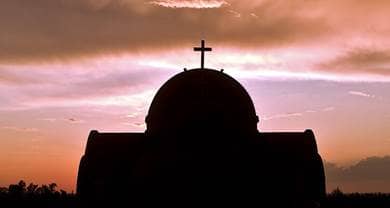
The central sacred space for Oriental Orthodox communities is the church building itself, where regular liturgical services are held. In addition, monasteries and sites associated with saints, Church founders, and patriarchs may also be considered sacred.
In addition to regular liturgical meetings of the community, the Oriental Orthodox tradition has established a number of important ritual ceremonies commemorating important stages in the lives of Church members.
The weekly liturgical celebration is by far the most important act of worship, although many of the faithful have developed methods of private devotion such as prayer and spiritual reading to deepen their daily spiritual experience.
Oriental Orthodox tradition makes use of the full range of biblical symbols available to Christian iconography and discourse, although some of these churches have been influenced by imagery from their respective national traditions.
Each of the Oriental Orthodox churches is headed by a traditional patriarch claiming the authoritative lineage of apostolic succession and considered to be autocephalous, meaning "self-governing."
Oriental Orthodox churches maintain the same basic structure as other episcopal forms of Christianity, being divided into dioceses and archdioceses, each led by their respective priests and/or bishops.
The moral principles adopted by the Oriental Orthodox are essentially the same biblically based ideas as those that guide many Christian churches, although the opinions of the Church fathers are also valued.
Oriental Orthodox churches share the basic vision for a society manifesting the principles of the Kingdom of God as preached by Jesus, although ethnic and national factors may also play a role in how the ideal society is conceived.
Women, although not permitted to be ordained as clergy, may serve the Church as laypersons, deaconesses, or nuns. Clerical celibacy is idealized, although a married man may enter the clergy and in fact is often considered desirable.