Orthodox Judaism
Orthodox Judaism Quick Facts
| Formed | 1851 CE |
| Origin | Europe |
| Followers | 2,000,000 |
| Deity | God (monotheistic) |
| Sacred Texts | Torah, Tanakh (Hebrew scriptures), Talmud |
| Headquarters | None |
Orthodox Judaism

Orthodox Judaism Overview
Orthodox Judaism is the branch of Judaism that has the strictest adherence to traditional Jewish practices and beliefs. It originated in response to the innovations in Jewish practice introduced by the Reform movement. Orthodox Judaism claims that both the Torah (the first five books of the Hebrew Bible) and the Oral Torah (the interpretive Talmud) are authoritative and fixed regarding Jewish doctrine and observance, thus requiring modern Orthodox Jews to uphold ancient Jewish law. God's divine revelation given to Moses on Mount Sinai was both supernatural and eternal, thus, Jews are strictly required to obey this revelation. This stance is a rejection of the positions held by both Conservative and Reform Judaism, which use more flexibility in interpreting Jewish law in the modern times. Orthodox Judaism's religious observances include daily worship, traditional prayers, study of the Torah, dietary laws, and gender segregation in the synagogue. The Hebrew language is essential in Orthodox religious practices. Orthodox Jews are also strict in their observance of the Sabbath. In spite of the doctrinal and ritual strictness of Orthodox Judaism, different Orthodox sects have arisen over the centuries. One distinction within the Orthodox is in regard to social engagement. Some sects of Orthodox Judaism claim the Jews, as the people of God, should live completely segregated from gentiles whereas other Orthodox sects believe Jews can keep the Torah and live in the secular world simultaneously. Most Orthodox Jews adhere to a traditional style of clothing with strict guidelines.
Orthodox Judaism claims to be the faithful heir to classical, or normative, rabbinic Judaism. However, as a distinct denomination of modern Judaism, Orthodoxy was established in mid-19th-century central Europe in reaction to the radical changes to tradition introduced by Reform Judaism.
The rapid spread of the haskalah, or Jewish enlightenment in western Europe, followed by the Reform movement's widespread successes, generated the deeply conservative and separationist ideology that came to characterize Orthodox Judaism. Among the most significant rabbinical influences on the founders of the Orthodoxy were R. Elijah (the Gaon) of Vilna and R. Ezekiel Landau of Prague.
Although Orthodoxy claims no official founders, as it considers itself the authentic version of ancient Judaism and not a product of the modern era, the 19th-century rabbis, Samson Raphael Hirsch in Germany, and Moses Sofer in Hungary, are widely considered to be the ideological forefathers of Orthodox Judaism.
Aside from the Torah, whose full and exact text is believed by Orthodox Jews to have been revealed directly to Moses by God and transmitted intact through the generations, Orthodoxy has a large body of authoritative rabbinical texts - most importantly the Talmud and the 16th-century legal code, Shulchan Aruch.
Despite Orthodoxy's belief that it represents the unchanged will of God as interpreted over the millennia by rabbis representing an "unbroken chain of tradition," the term "Orthodox" first came into use in the 19th century. Orthodoxy has evolved in reaction to a wide range of challenges and changing conditions in the modern world.
A separate Orthodox community in Germany, officially recognized by the German government, was first established in 1876. In Hungary, the Shomrei ha-Dass (Keepers of the Faith) association was created to combat the rapid spread of Reform Judaism. The traditionalist rabbis in Germany and Hungary refused to be associated with the Reform movement, and formally established what was known as Austritt, or separatist, Judaism.
The separationism that characterized early German Orthodoxy was vigilantly opposed by Rabbi Isaac Dov Bamberger. The major schism within Orthodox Judaism to this day, between the ultra-Orthodox and "modern," or centrist Orthodox, can be traced back to the 19th-century divisions between the German and Hungarian schools of Orthodox Judaism.
Orthodox Judaism served as a bulwark against the rapid assimilation and widespread conversions to Christianity of German and Austrian European Jews in mid-19th century central Europe. Later, in eastern Europe, Orthodoxy combated the growing popularity of secular Jewish ideologies, such as Zionism and Jewish socialism, among Russian and Polish Jews.
Since by its very nature, Judaism is non-evangelical, one cannot accurately speak of a deliberate, missionary spreading of Orthodox Judaism. However, since the late 1960s, especially in Israel after the Six Day War, a growing number of Orthodox Jewish movements, most famously Chabad/Lubavitch and Aish ha-Torah, have engaged in active religious outreach to non-observant Jews.
Though all professing the same total commitment to the immaculate truth of Torah and strict adherence Jewish law, Orthodox Jewish institutions in the world's two largest Jewish communities - the United States and Israel - have strikingly different approaches and degrees of stringency with regard to a wide range of social and political issues.
The belief that the rabbis are the authentic heirs to God's revelation of the Torah to Moses, which included an "oral Torah," or interpretive tradition handed down from generation to generation in an unbroken chain of tradition, is the very cornerstone of Orthodox theology, and it is this belief that separates Orthodoxy from all other modern Jewish denominations.
Orthodox Jews believe that God can only be known through the word, namely the Torah. In the absence of prophetic voices and Temple sacraments, whose restoration are contingent on the arrival of the Messiah, deep study of the canonical texts of Judaism, including the Talmud, is believed to be the closest humans can get to communing with the divine.
According to Orthodox pietistic writings, God endows each individual with good and evil impulses that are in a constant struggle for dominance within the human psyche. Orthodox Jews believe that the only effective antidotes to the temptations of the evil impulse are assiduous study of Torah and strict obedience to its commandments.
Orthodox theology adheres to the ancient Jewish teachings, going back to the biblical prophets, which teach that suffering is a sign of divine displeasure with humankind, and that, in the words of the Talmud, "there is no suffering without sin." However, in the wake of the Holocaust's unprecedented challenge to this traditional theodicy, a number of Orthodox thinkers have developed more complex theories about suffering and evil.
While it does not place much emphasis on theoretical doctrinal matters and does not offer an official view of the nature of the afterlife, focusing rather on Torah study and obedience to Jewish law, Orthodox Judaism upholds the classical rabbinic belief in the eternity of the human soul and reward and punishment in Olam ha-Bah ("world-to-come").
Orthodox Jews celebrate the Sabbath and biblical festivals, and strictly observe its restrictions by refraining completely from any manner of labor or commerce. Unlike Reform and liberal Conservative Jews, the Orthodox also continue to sanctify the "exile days" added to all of the biblical pilgrimage festivals, and to observe the four fast days, connected to the destruction of the Jerusalem Temple.
The Orthodox community centers on two religious institutions: the Shul (synagogue) and the Yeshiva (Torah study-house). In striking contrast to the ornate cathedral-like temples of classical Reform Judaism, Orthodox synagogues tend to be modest structures that contain absolutely no iconography. A small number of the world's largest modern Orthodox synagogues do have stained glass windows whose abstract art does not contain any human or animal images.
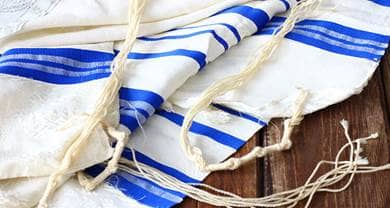
Aside from daily worship, Orthodox Jews uphold hundreds of religious rites and ceremonies. All males keep their heads covered and wear fringes on their undergarments and phylacteries at morning services; women bathe in the mikvah, or ritual bath, after their monthly period; and the descendents of the biblical Cohanim (priests) still bless the congregations during festival services.
Orthodox Jews pray three times daily, and are constantly praising and thanking God through a regimen of mandatory berachot, or blessings. There is no human experience that does not require a blessings. Through this constant recitation of benedictions, Orthodox Jews remain ever aware of, and thankful, to God.
Though it is vigilantly opposed to the use of any religious icons or artistic representations of the divine, symbols such as the Star (or shield) of David, the Tablets of Law containing the ten commandments, and images of Torah scrolls are common adornments in Orthodox synagogues.
The most revered members of the Orthodox community are its rabbis, whose main credential is their scholarship in Torah. Rabbis in Orthodox communities are seen primarily as teachers of Torah and religious judges. While cantors once played a greater role, the large majority of Orthodox synagogues no longer employ cantors at all, and services are led by laymen.
The Orthodox Community is the least structured of all the denominations of contemporary Judaism. While there are a number of rabbinical organizations and synagogue councils, none is officially recognized by all Orthodox Jews.
Orthodox Judaism does not recognize any autonomous, let alone humanistic, ethical system not rooted in the Torah, and derives its moral theory exclusively from the halakha, or rabbinical Jewish law. The ethical standards that determine membership in the Orthodox community are essentially defined by strict adherence to the practices of Talmudic law.
True to its origins as a separatist movement, Orthodox Judaism is almost exclusively concerned with the internal welfare of the observant Jewish community and the State of Israel. It rejects interfaith theological dialogue and shuns religious interaction with non-Orthodox Jews.
Gender roles are clearly and strictly divided in Orthodoxy, in accordance with Talmudic law. Womens' roles in public religious life are strongly curtailed, as priority is given to their domestic and child-rearing duties. However, there is a rapidly growing trend among modern Orthodox Jews in Israel and America for a more inclusive role for women in public religious services.