Patheos Watermark

Protestantism

Protestantism Quick Facts

Formed 1517 CE
Origin Germany
Followers 500,000,000
Deity God (Trinity)
Sacred Texts Bible
Headquarters None

Protestantism

Protestantism Overview

Learn More

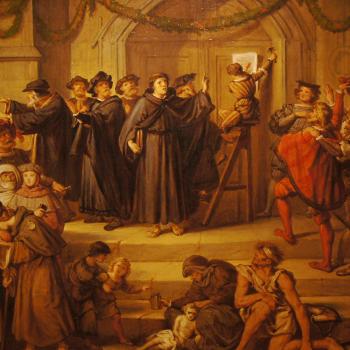
Protestantism is one of the three major branches of Christianity, along with Roman Catholicism and Eastern Orthodoxy. It shares with all other Christians core beliefs in the doctrines of the Trinity and the divinity of Jesus, the necessity of grace to save humans from the consequences of sin, and the centrality of Jesus' death and resurrection for salvation. Composed of hundreds of denominations with an expansive variety of doctrines, rituals, and religious practices, Protestantism formed from the split with Roman Catholicism during the Reformation in the 16th century. Led by Martin Luther, John Calvin, and others, the reformers broke from the Roman Catholic Church due to abusive ecclesiological structures and theological differences. Protestants share an adherence to the centrality of scripture (both the Hebrew scriptures and the New Testament) as well as a doctrine of salvation through faith in Jesus Christ. Different Protestant denominations have to varying degrees maintained or rejected Roman Catholic forms of worship. Anglican and Lutheran churches have maintained liturgies and rituals similar to those of the Roman Catholic Church, whereas other denominations, such as Baptists, Presbyterians, Pentecostals, and United Church of Christ, have developed less liturgical forms of worship. Most Protestants practice baptism and communion as key rites of Christian initiation and ongoing devotion. Though originating in Europe, Protestant Christianity has spread across the globe through missionary activity and now has members from nearly every country, race, and ethnicity.

Contributors

Protestant Origins

Protestant Origins -- Protestant Beginnings

Details

There are roughly 776 million Protestants worldwide - they make up over 40% of Christians. All have their origins, some more directly than others, in the 16th-century Reformation begun by Martin Luther.

Protestant Origins -- Protestant Influences

Details

Several important figures and social changes set the stage for the Protestant Reformation. Some forerunners were influential: Pope Gregory VII, Erasmus, John Wycliffe, and John Hus. In addition, the cultural and intellectual movements of humanism and nominalism influenced the reformers, and created a large audience for them.

Protestant Origins -- Protestant Founders

Details

Almost every branch of Protestantism can be traced back to a few founders. Most of them build, to at least some degree, on the work of Luther, Zwingli, and Calvin.

Protestant Origins -- Protestant Scriptures

Details

The Bible is the scripture and thus the most important set of writings for Protestant churches. Protestants claim to place the Bible as the ultimate authority for belief and practice. In addition, some Protestant churches have creeds (formal statements of belief), while others are non-creedal.

Protestant Origins -- Protestant Historical Perspectives

Details

Historical scholarship on Protestant churches often reflects the theological perspectives of the people writing the scholarship. Recently three trends have emerged in study of the 16th-century origins of Protestantism: a focus on the medieval nature of the Reformation, attention to the lives of all classes of people at the time of the Reformation, and a debate about the meaning of changes to worship space inaugurated by the Reformers.

Protestant History

Protestant History -- Protestant Early Developments

Details

Two early developments in Protestantism were the challenge to the original reformers (Lutheran and Reformed) from the Anabaptists, and the spread of Protestantism from the European continent to England.

Protestant History -- Protestant Schisms, Sects

Details

The Church of England and the Anabaptists continued to form sub-groups. Many came to the North American continent, sometimes because of persecution. In North America, the groups split even further.

Protestant History -- Protestant Exploration, Conquest, Empire

Details

Protestants played a role in most of the major colonial and imperial expansions of Europe and North America. They are implicated in positive and negative aspects of these conquests.

Protestant History -- Protestant Missions, Spread, Changes, Regional adaptations

Details

Protestant churches spread quickly in Europe, England, and America. When these regions became international powers, Protestant missionaries began to spread Protestant Christianity around the globe.

Protestant History -- Protestant Modern Age

Details

There are several important contemporary trends in Protestant denominations: most are experiencing numerical decline in Europe and North America, and growing in the global south; sects that split from each other in the 19th century are working together and sometimes reuniting; and the greatest growth globally is among Pentecostal and Charismatic churches.

Protestant Beliefs

Protestant Beliefs -- Protestant Sacred narratives

Details

Protestants believe that they are saved by God's forgiving grace. There are varying views among Protestants regarding such matters as the nature and extent of human participation in salvation.

Protestant Beliefs -- Protestant Ultimate Reality and Divine Beings

Details

Protestants believe in an all-powerful God who is perfectly good, loving, and holy. Most share the orthodox Christian view of Jesus as fully human and fully divine. Traditionally they believe in angels and the devil.

Protestant Beliefs -- Protestant Human Nature and the Purpose of Existence

Details

Human nature was created good, but through the fall became sinful, that is, fundamentally self-centered. The purpose of existence is to glorify God and live a life of service to God and others, which is possible only through God's free gift of spiritual life.

Protestant Beliefs -- Protestant Suffering and the Problem of Evil

Details

Protestants believe that suffering is a form of evil. Evil has come into the world through the work of Satan and through human rebellion against God. With other Christians, most Protestants recognize that we do not fully understand why specific instances of evil and suffering occur.

Protestant Beliefs -- Protestant Afterlife and Salvation

Details

Traditionally, Protestants believe salvation is a gift of God, granted by faith. On the day of judgment, all people will be resurrected, those who have believed and trusted in Christ to a life of blessedness in the presence of God, and those who have rejected God's gift to a place of torment and separation from God.

Protestant Ritual, Worship, Devotion and Symbolism

Protestant Ritual, Worship, Devotion and Symbolism -- Protestant Sacred Time

Details

Some Protestant traditions do not acknowledge sacred time other than Christmas and Easter. For many Protestants, however, sacred time is organized by a liturgical calendar that celebrates all the major events in the life of Jesus and in the early Church throughout the course of each year.

Protestant Ritual, Worship, Devotion and Symbolism -- Protestant Sacred Space

Details

Protestants have largely rejected the use of images and statues in worship. They tend to have plainer, more austere worship spaces than Roman Catholics and Eastern Orthodox. There are differences, however, Lutherans and many Anglicans tending more toward the Catholic end of the spectrum than other Protestants.

Protestant Ritual, Worship, Devotion and Symbolism -- Protestant Rites and Ceremonies

Details

The rituals of baptism and the Lord's Supper have been among the most important and contentious aspects of Protestantism. These practices embody important theological differences that distinguish the branches of Protestant Christianity (Reformed/Presbyterian, Lutheran, Anglican, Baptist, etc.).

Protestant Ritual, Worship, Devotion and Symbolism -- Protestant Worship and Devotion in Daily Life

Details

Protestant daily life is shaped by the doctrine of the priesthood of all believers, which has implications for such matters as vocation and work ethic, and by the belief that salvation is by faith, which leads to an emphasis on nurturing personal piety.

Protestant Ritual, Worship, Devotion and Symbolism -- Protestant Symbolism

Details

Protestant symbolism tends to direct attention to the key doctrines of salvation by faith in the life, death, and resurrection of Jesus (as a gift of the Spirit), the priesthood of all believers (and so a downplaying of symbols setting aside ministers as different from others), and sola scriptura (the importance of the Bible).

Protestant Ethics, Morality, Community

Protestant Ethics, Morality, Community -- Protestant Leadership/Clergy

Details

Protestant churches do not have priests, but ministers. This is because all Christians have equal status in God's eyes and direct access to God. There is no special class of Christians. At the same time, some people's ���gifts" are well suited to the tasks of preaching and pastoral care, and these people are "called" to the ministry.

Protestant Ethics, Morality, Community -- Protestant Community Organization

Details

Protestantism began with attempts to reform the Church so that it would be in accord with the principles of morality and community found in scripture.

Protestant Ethics, Morality, Community -- Protestant Principles of Moral Thought

Details

Protestants base their moral thought and action on the Bible first and foremost. Corresponding to the theological diversity of Protestantism, there is a diversity of views on moral issues.

Protestant Ethics, Morality, Community -- Protestant Vision for Society

Details

There is a spectrum of Protestant views of the Kingdom of God, from those who believe that it is a this-worldly possibility, to those who believe that it will only be realized in a not-yet-arrived future, to those who believe that it is only a heavenly reality.

Protestant Ethics, Morality, Community -- Protestant Gender and Sexuality

Details

Protestant denominations are divided on questions of gender and sexuality. European churches tend to be liberal. Asian, South American, and African churches tend to be conservative. American churches have become increasingly fractured in recent decades.