Patheos Watermark

Sikhism

Sikhism Quick Facts

Formed1450 CE
OriginIndia
Followers23,000,000
DeityGod (Ik Onkar) (monotheistic)
Sacred TextsShri Guru Granth Sahib
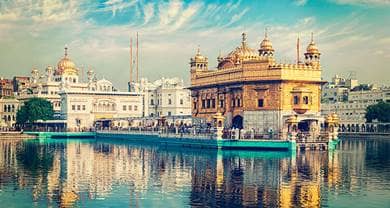
HeadquartersAmritsar, Punjab, India

Sikhism

Sikhism Overview

The Sikh tradition was founded by Guru Nanak in the late 15th century C.E. in the Punjab region of what are today India and Pakistan. According to Sikh beliefs, the same revelatory spirit inhabited Guru Nanak and his nine successors. Today, this spirit can be found in the teachings of the Guru Granth Sahib, the foundational scripture of the Sikh tradition. The Guru Granth Sahib's hymns describe and praise God, and provide moral guidance for all Sikhs. Sikhs reject ideas of divine incarnations, and hold that liberation results from being absorbed into God. Sikhs also reject the social doctrine of caste, and adhere to practices of equality in worship and life. The centers of Sikh worship are known as gurdwaras ("house of the Guru") and langar (communal refectory). All Sikhs must enter a gurdwara with bare feet and a covered head. A Sikh worship service includes prayer and singing hymns from scripture. The service is concluded by the distribution of karah prasad, a sacramental food made of flour, butter, and raw sugar that is shared by all to demonstrate equality and the rejection of caste. Sikhs attempt to live balanced lives of worship, work, and charity centered on community. Besides gurdwara worship, festivals are also important community activities.


Harpreet Singh explains what it means to be a Sikh in today's world.

Starting around 1500 in Punjab, Guru Nanak spread a new message about the divine, which developed into the Sikh religion. He served as the spiritual guide of the original community in the town he founded -- Kartarpur ("Place of the Creator").

The early Sikh tradition challenged the more rigid and rule-based forms of Islam and Hinduism, as well as the self-denying ideologies of other religious groups. The Sikh founders sang of a Universal Creator, and desired to create lasting institutions around worship that could be shared by all people.

Guru Nanak was born in 1469 in a village called Talwandi (now in Pakistan) to a revenue official of the Bedi clan. Nanak was a family man as well as a spiritual guide to disciples ("Sikhs"). In his own lifetime, he nominated the first of his nine successors, Guru Angad.

The Guru Granth Sahib is the sacred scripture of the Sikhs, and its bedrock is the body of compositions of Guru Nanak. The compositions of his successors are also contained in the book, as are songs from other Sikhs praising the Gurus, and non-Sikh poet saints from Hindu and Muslim backgrounds.

The tradition's own scholarship, which wrote about revelation and the growth of the community, goes back several centuries. Today, emerging out of the shadow of colonialism, scholars are involved in the critical study of early Sikh texts and artifacts, and are also trying to understand later trends in the history of the community.

The earliest Sikhs gathered to hear the teachings of the Gurus and sing their hymns. The last of the ten Sikh Gurus died in 1708, passing on authority jointly to the community (Panth) and scripture (Granth).

Early schisms, revolving around issues of family succession and the authority of the Gurus, were resolved around 1700 when the Sikh community was unified as the Khalsa (sovereign body). In the centuries that followed, minor traditions formed within the larger community, but the Panth (community) remains a largely unified body.

Sikh warriors contributed to the splintering of the great Mughal empire in the 1700s. By the early 1800s, a kingdom ruled by Sikhs extended in the four directions around Punjab. By 1850, much of that kingdom was annexed by the British in their conquest of the subcontinent.

Sikh congregations spread throughout the northern part of the Indian subcontinent through proselytizing and trade, from contemporary Afghanistan to eastern India. Sikhs today do not expend much energy in proselytizing, but a diaspora of two million Sikhs has spread communities to East Africa, Southeast Asia, Europe, and North America.

Today, 20 million Sikhs make their home in India. Not living in a sovereign Sikh nation has been a point of contention over the decades, as the Sikh ethos demands independent rule. Nevertheless, there is a large diaspora of Sikh communities around the world.

The creation of the universe came from a single divine command, and human history has been helped along by divine compassion. God sent Guru Nanak to save a world lost in spiritual and moral confusion.

Kartar, the universal creator, is the only divine being. In his aspect as Universal Preceptor (Satiguru), he reveals perfect knowledge, which can be gained through interaction with the teachings of the Gurus and in communal worship.

According to Sikh belief, human nature is rooted in self-centeredness (haumai), as opposed to the divine consciousness (gurmat) and benevolence (parupkari) that are ideal. Humans exist in Kartar's total will, which pious Sikhs understand and enact in their daily lives.

Human suffering is caused by ignorance of divine ways and by human self-centeredness. This can be overcome by human effort, self-reflection, and divine grace (gur-prasad) through the Guru's teachings. There is no "evil," apart from the failings of human conscience, and neither Satan nor rival divinities exist.

Liberation from the constraints of this life is available only through entering into the deep protection (sharan) of the Gurus' teachings. The pious reach the divine court (dargah), the location of true justice, after their human lives are over.

Sikhs do not believe that Kartar, the divine, divided time into sacred and secular portions. Through the calendar year, Sikhs memorialize the life-events of the Gurus, read special verses on the first of each lunar month, and celebrate the founding of the Khalsa.

For the early community, wherever the Guru settled was considered holy. Today Sikhs see the city of Amritsar in northwestern India, founded by the fourth Guru, as their communal center. Places associated with the Gurus' lives are remembered in sacred memory.

Communal worship, singing, and sharing of meals (langar) are most important, and all life-event rituals revolve around the holy word. For example, the Sikh marriage ceremony (Anand Karaj) entails circumambulating the scripture while verses from the Gurus on spiritual marriage to the divine are read.

Sikhs strive to achieve divine consciousness in all aspects of their daily lives. This search is rooted in set daily prayers (early morning, sunset, and before sleep) and contemplation of the divine name (simran). Sikhs also congregate to sing the Guru's hymns (kirtan) and hear discourses (katha) on the Gurus' teachings.

The most important Sikh symbol comes from the first letters in the Guru Granth Sahib, "Ik onkar," symbolizing the unity and infinity of the divine. A second image, called "nishan" symbolizes the triumph of justice (deg teg fateh).

In the Sikh community, authority rests only in the Guru (who is a manifestation of the Divine will), the scripture, and the collectivity of the congregation. Thus there is no room for a formal priesthood. Typically custodians of the holy book, preachers, and musicians are afforded respect for their interaction with, and impartation of, divine revelation.

In the face of the rigid Indian system of caste and class, Sikhs offer adherents a casteless and egalitarian social structure. Sikhs believe that any two Sikhs make up a congregation, and where as many as five gather, the divine is present. The immersion of the congregation in the Guru's teachings checks individual self-centeredness.

Sikhs strive to attain consciousness of the Guru's teachings (gurmat) through reflection on sacred hymns and recitation of the divine name. Ethical actions trump dogma in Sikh tradition, and the most important principles are benevolence, honesty, charity, and striving for justice.

The core Sikh social vision is that of equality of all people. Part of the community's reason for existence is to help morally redeem the world in working for social equality and justice.

In Sikh belief, women and men are equal. Guru Nanak spoke out against the denigration of women in his society. This doctrinal equality provides an ideal to temper the cultural inequalities that Sikh women face around the globe.

Most Popular on Facebook