
- Trending:
- Forgiveness
- |
- Marriage
- |
- Afterlife
- |
- Trump
- |
- Pentecost
- |
- Deconstruction
RELIGION LIBRARY
Sikhism
Founders
Written by: Rahuldeep Singh Gill
The ten Gurus, whom Sikhs revere as the founders of their community, lived in succession from 1469 until 1708 C.E. For Sikhs, no other humans outside of this lineage of ten hold comparable authority. Guru Nanak's authority is attributed to his experiences with the Shabad (divine word) and his life of piety. He did not claim to be a divine being. Guru Nanak's social position was probably one of some influence. His father and his wife's father were both part of the revenue collection apparatus of the state. One of Guru Nanak's most important associates at Sultanpur, and subsequent disciple, Daulat Khan Lodhi, became an influential figure in setting up Mughal rule in India. Guru Nanak himself spoke out against the status quo, including the power of the Mughals. At his community in Kartarpur, Guru Nanak himself worked the fields, and his successor, Guru Angad was selected in part because of his work ethic and selfless service.
| The Ten Gurus | Birth year (CE) | Guru Period (CE) |
| Guru Nanak | 1469 | until 1539 |
| Guru Angad | 1504 | 1539-1552 |
| Guru Amardas | 1503 | 1552-1574 |
| Guru Ramdas | 1534 | 1574-1581 |
| Guru Arjan | 1563 | 1581-1606 |
| Guru Hargobind | 1595 | 1606-1644 |
| Guru Harrai | 1630 | 1644-1661 |
| Guru Harkrishan | 1656 | 1661-1664 |
| Guru Teg Bahadur | 1621 | 1664-1675 |
| Guru Gobind Singh | 1661 | 1675-1708 |
Guru Angad continued Guru Nanak's tradition of composing poetry containing his teachings for the community, and signed his compositions with the pen name "Nanak," a tradition that would continue until the ninth Guru. The locus of the community shifted to Guru Angad's home village, Khadur, after Guru Nanak's death as the successor ran into a succession dispute with Guru Nanak's biological heirs. Guru Angad's wife, Mata Khivi, is remembered for running a thriving communal kitchen at Khadur, where great sweets and delicacies were served to attendees.
Guru Angad's successor, the third Guru, Guru Amardas (1503-1574), moved the community to the thriving town of Goindval when Guru Angad's sons claimed Khadur. As Guru Angad had received Guru Nanak's book of compositions at his succession ceremony, so did Guru Angad pass on the book with his own composition to Guru Amardas. Guru Amardas also contributed many compositions to the growing corpus. Two of the four volumes of the Gurus' sacred teachings that Guru Amardas prepared are still available today, and are known as the "Goindval Pothis."
Guru Amardas oversaw the beginning of a thriving period for the community. The Mughal emperor Akbar's policies of tolerance contributed to early Sikh success. Trade and agriculture also grew under Akbar, and the Sikhs spread out along North Indian trade routes. Scribes, bards, and other professionals sought and received patronage at Guru Amardas's court. Another of Guru Amardas's lasting accomplishments was the building of a well for a communal water supply that can still be found at the Goindval complex.
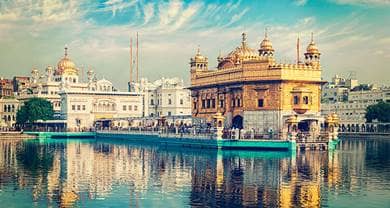
For the first time, in 1574, a nominee for the office of Guru was chosen from the prior Guru's own family. Guru Ramdas (1534-1581), the fourth Guru, was chosen to succeed the third Guru and was the third's son-in-law. This provided some institutional continuity, as the geographical location that Guru Amardas selected became the community center in Guru Ramdas's reign, and became known as the holy Sikh city of Amritsar. The success of "Ramdaspur" centered on a tank of water, in the middle of which sat a house for worship (gurdwara). The Gurus and Sikhs boasted of its beauty and uniqueness. They reported that it was a place free of administrative meddling, and Sikhs arrived there from all over.
Guru Ramdas went a step further than his father-in-law and predecessor, and chose his own son as successor, thereby eliminating the problem of rival claimants and keeping the community's lands intact. Or so that was the idea. Guru Arjan (1563-1606) was the youngest of three sons, and his older brothers sought their share of spiritual and temporal inheritance. Jealousy amongst Guru Arjan's rivals seems to have led to complaints to Mughal administrators in the Punjab. Guru Arjan wrote about a plot against his life, which he said was foiled with divine grace (Guru Granth Sahib [GG] 1137). However, in the words of one major Sikh historian, with the death of the Akbar-the-tolerant in 1605, the "protective umbrella" had been lifted from over the Sikh community. In the first year of Emperor Jahangir's reign, Guru Arjan was arrested and killed in Mughal custody.
Two years before his death, Guru Arjan had completed work on an updated version of the holy Sikh text, which contained his own writings in addition to those of his four predecessors, earlier bards, and non-Sikh poets. The sixth Guru, Guru Hargobind (1595-1644), did not compose poetry (nor did his two immediate successors), and instead focused on consolidation of the temporal leadership. He had to contend with an increasingly hostile Mughal state and by the 1630s was forced to relocate to the east of Amritsar.
The last four of the ten Gurus completed their periods as community leaders from this region. The ninth Guru, Teg Bahadur (1621-1675), re-ignited the practice of composition and added his own poetry to the Sikh canon. He travelled more than any other Guru since Guru Nanak, and consolidated support for the Sikh center among the prosperous trading communities in the Gangetic plains. His travels and political activity triggered the ire of the Mughal state and like the fifth Guru, the ninth was arrested and executed by the Mughals. Like the sixth Guru before him, the tenth Guru (Guru Gobind Singh, 1666-1708) organized a military response to his father's execution, and this time that response instigated an all-out revolt that led to the eventual fall of the severely over-extended Mughal Empire.
Study Questions:
1. How and when was the city of Amritsar founded?
2. What were some of the problems with the succession of the office of Guru?
3. When was the first time the Sikh community had a confrontation with the Mughal Empire and what was the result?








 Ad-Free & Subscriber Log-In