Taoism
Taoism Quick Facts
| Formed | c. 550 B.C.E. |
| Origin | China |
| Followers | 20,000,000 |
| Deity | Pantheistic |
| Sacred Texts | Zhuangzi, Daode Jing, Yi Jing |
| Headquarters | White Cloud Temple, Beijing, China |

Taoism

Taoism Overview
Taoism, also known as Daoism, is an indigenous Chinese religion often associated with the Daode jing (Tao Te Ching), a philosophical and political text purportedly written by Laozi (Lao Tzu) sometime in the 3rd or 4th centuries B.C.E. The Daode jing focuses on dao as a "way" or "path" — that is, the appropriate way to behave and to lead others — but the Daode jing also refers to Tao as something that existed "before Heaven and Earth," a primal and chaotic matrix from which all forms emerged. Taoism did not exist as an organized religion until the Way of the Celestial Masters sect was founded in 142 C.E. by Zhang Daoling, who based the sect on spiritual communications from the deified Laozi. The Way of the Celestial Masters and other later sects of Taoism engaged in complex ritual practices, including devotion to a wide range of celestial divinities and immortals, and thousands of Taoist religious texts were produced over the centuries. Taoists also engaged with Chinese politics in a variety of ways throughout Chinese history. At one time, scholars in both China and the West distinguished philosophical from religious Taoism, but more recently a continuity of belief and practice between these has been recognized. In both, a harmonious relationship between nature, humanity, and the divine is emphasized, and both are concerned with appropriate behavior and ways of leading and governing others. The term "Tao" has a number of meanings. Taoist religious sects were persecuted in China during the 19th and 20th centuries, but are currently undergoing a revival. Western interest in Taoism has, for the most part, been confined to the Daode jing, but in both the West and in the East, there is considerable interest in practices which, while not "Taoist" per se, are often associated with Taoism, ranging from fengshui to taiji quan to acupuncture and herbal medicine.
Quick Fact Details:
- Formed: As with many ancient religious traditions, an exact date is impossible to determine. Taoist ideas and early writings long precede any organizational structure. The date given here (c. 550 B.C.E.) is generally the time period when a variety of spiritual thinkers were putting their ideas into writing. These writings were not collected as a composite teaching of the "Tao" until the 4th or 3rd century B.C.E.
- Deity: While Taoists recognize a vast pantheon of gods and goddesses, they do not acknowledge any that are omnipotent or eternal. All the gods, including Laozi, are divine emanations of celestial energy.
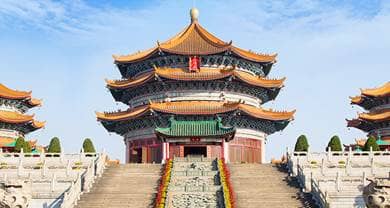
- Headquarters: Taoism has no centralized authority and different sects have different headquarters. However, the White Cloud Temple in Beijing is a key center for training for priests and for administration.
Quick Fact Sources include www.adherents.com, www.bbc.co.uk/religion, The Oxford Handbook of Global Religions (2006), The Encyclopedia of Religion (2005), the Religious Movements Page at the University of Virginia, The Cambridge Illustrated History of Religions (2002), and the Encyclopedia of World Religions (1999).
While many in the West associate the term "dao" with Taoism, it was originally used by many participants in a lengthy debate about the proper way to behave and to lead others.
Taoism was influenced by the divine bureaucracy of Shang dynasty religion, by Buddhist social organization and ideas about the afterlife, and by ancient Chinese magical, shamanic, and self-cultivation practices.
Authorship of the Taode jing is traditionally attributed to Laozi, a mythical figure who is often regarded as the founder of Taoism. The founder of organized Taoist religion was Zhang Daoling.
Thousands of Taoist scriptural texts, most said to have been transmitted by deities or immortals, have been collected together in a canon called the "Taozang," or Treasury of Tao.
An old distinction between religious and philosophical Taoism guided scholarship in the West until the last decades of the 20th century. Recent scholarship has questioned this distinction, while focusing on Taoist religious groups.
During the Han dynasty, aristocrats continued to study and refine the teachings of Laozi and Zhuangzi, and some sought immortality through alchemy, self-cultivation techniques, and the advice of the fangshi or "recipe masters."
Toward the end of the Han dynasty, and continuing for several centuries, sacred texts were revealed by deities and immortals. Around these texts were formed enduring religious organizations.
Taoist groups sometimes formed alliances with rulers. As rivals, Buddhists and Taoists occasionally tried to destroy one another, and rulers often tried to control both as a way of sustaining their authority.
Each Taoist sect experienced notable changes over the centuries, and Taoism also became an integral part of Chinese popular culture. Transmission of Taoist religious organizations beyond China has been limited almost entirely to immigrant communities.
Taoism was nearly destroyed during the upheavals in China during the late 19th and 20th centuries, but temples and monasteries are now being rebuilt and new clergy are being ordained.
While it lacks a primary and foundational sacred narrative, Taoism has many sacred stories. Among these are narratives describing encounters with spirits and journeys to spirit realms.
Tao existed "before heaven and earth." From Tao came a primordial matrix of undifferentiated energy, and from this matrix, all of existence, including myriads of Taoist gods, emerged.
To maintain or recover a natural alignment between humanity and the world, many perform self-cultivation techniques. These are believed to improve one's health, and potentially even lead to immortality. They also promote order and harmony within the community.
Taoist ideas about suffering and evil come from a variety of sources and are quite diverse. Many look to Taoist priests to resolve illness or misfortune by communicating on their behalf to the gods.
Early Taoism focused on this-worldly goals or on immortality of the physical body. Later, in reaction to Buddhism, Taoism incorporated concepts of heaven, hell, and rebirth.
Sacred time is experienced when one is aligned with the movement of nature through its regular cycles. It is also experienced as a return to the state of the cosmos before creation occurred.
Before Taoist ritual begins, a sacred space is created that links heaven and earth. Mountains and caves are also considered sacred spaces, and are often occupied by Taoist hermits.
Taoist rituals are elaborate dramas, lasting over several days, incorporating costume, music, recitations, and stylized movements, and culminating in an ascent to the gods to present a written memorial on behalf of the participants.
Lay people may consult a Taoist priest when they have an illness or a problem. Priests participate in daily rituals of self-cultivation to prepare themselves spiritually for their role.
There are a multitude of Taoist symbols, some representing immortality, others related to nature or the stars. A constellation of symbols revolving around writing is essential to Taoism.
Some Taoist clergy are married and live at home while others reside in monasteries or temples. They may be male or female, but most today are male. Within each Taoist sect, clergy are ranked according to a formalized hierarchy.
Organizational structures in Taoism have varied considerably over time and sect, and have ranged from a tightly structured theocracy, to monasticism, to informal relationships with local communities.
Early Taoism discouraged excessive regulation of morality in favor of natural or secret virtue, but later Taoism adopted and built on the moral precepts of Buddhism. Still later, Confucian elements were added as well.
Taoism has always had a strong utopian vision in which humans, nature, and heaven coexist in peace and harmony. Today, Taoism is often identified with the environmentalist movement.
Taoists strive to unite masculine and feminine energies, in a ritual context, or within internal alchemical practices. Men are also encouraged to embrace feminine characteristics, and women may take on traditionally masculine roles.


Julia Hardy