About Peter T. Chattaway

Jesus section of The Bible now a 135-minute movie

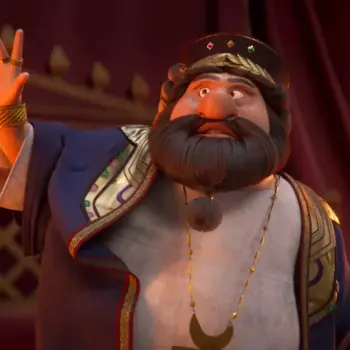
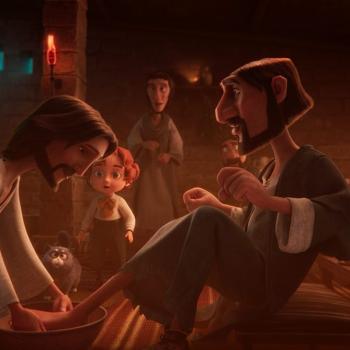
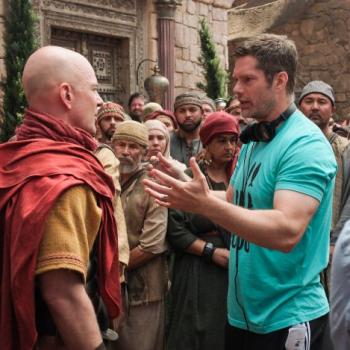
It has been seven weeks since The Bible producer Mark Burnett revealed that he was re-cutting the Jesus portion of the mini-series for a big-screen release and thinking about producing a follow-up to the mini-series for television, as well. Today, speaking at the Produced By Conference, Burnett declared that the editing on the Jesus movie is complete, and that the movie runs 2 hours and 15 minutes, rather than the 3 hours that had previously been indicated. (The New Testament section of the mini-series, most of which was based on the gospels, ran between 3.5 and 4 hours.) No word yet on what the TV follow-up will be, exactly, but Burnett did say that he and his wife, Roma Downey, “will do a follow-up to ‘The Bible.’ No question about that. Something big.” June 10 update: The Hollywood Reporter says the film will be 2 hours and 13 minutes long.

Noah: possibly “psycho”, definitely not “benevolent”

This blog has spent quite a bit of time speculating on the broad narrative contours of Darren Aronofsky’s Noah: What mix of biblical and apocryphal texts will it use? Which characters will it include? What connections will it have to the flood mythologies of other religions, such as Hinduism?

But one thing I haven’t looked at much is how the film will depict Noah himself. I have quoted something Aronofsky said six years ago — long before the movie was in active development — about Noah being a “dark, complicated character” with lots of “survivor’s guilt”. But that’s been about it.

Now we have some new insight into the character, courtesy of Russell Crowe, who told Entertainment Tonight recently (while promoting Man of Steel) that the Noah he plays will not be the “benevolent” figure that some viewers might expect:
[Read more...]

Making Superman, Jesus and other iconic figures “relatable”

It’s something of a cliché for religion-minded pop-culture writers to talk about the parallels between Superman and Jesus, especially when there’s a new Superman movie in the works, but Zack Snyder, director of the upcoming Superman reboot Man of Steel, said something in one of the film’s newer promotional featurettes that got me thinking about the parallel from a slightly different angle than usual.

Specifically, Snyder described how the approach taken by producer Chris Nolan and screenwriter David S. Goyer would make Superman relevant to a 21st-century audience: “What Chris and David did was, ‘Let’s let the audience participate in the experience of being Superman, without breaking the things that make him Superman.’ They were able to sort of make him relatable, ground him and make him feel real.”

Two things came to mind on hearing this statement.

[Read more...]

After Earth isn’t great, but it’s not that bad, honestly.

The performances in M. Night Shyamalan’s films have often had a stilted, solemn quality, and Will Smith’s performance in After Earth is no exception. There are a couple reasons for the woodenness this time, though.

First, the story is set in the distant future, a thousand years after humanity has fled the Earth — more on that in a moment — and it stands to reason that speech patterns might have changed in the interim. Indeed, according to co-writer Gary Whitta, the filmmakers “worked with a dialect coach to come up with an original accent, because the idea of the characters speaking with an American accent or a British accent one thousand years in the future, after you’ve left Earth, would seem kind of preposterous.”

[Read more...]

Bible movie of the week: Samson and Delilah (1949)

The Bible epic, as a genre, is typically associated with the 1950s, and for good reason. That’s when Hollywood churned out a series of Bible-themed films, such as David and Bathsheba (1951), The Robe (1953) and The Ten Commandments (1956); and both the decade and the genre reached their climax with Ben-Hur (1959), which won a record number of Oscars in addition to becoming one of the biggest box-office hits of all time.

But the decade arguably got its start in the 1940s, when Cecil B. DeMille produced Samson and Delilah (1949), starring Victor Mature and Hedy Lamarr. It was the first major Bible movie made by an American studio since the silent era — or since the early sound era, if we count DeMille’s The Sign of the Cross (1932), which takes place after the Book of Acts, as a “Bible movie” — and it was a fairly big hit, thereby paving the way for all the bathrobe epics that followed.

[Read more...]

Ethnic criminals and colour-blind casting

Warning: This post will reveal one of the key spoilers in Star Trek into Darkness. It’s not that big a spoiler, especially if you’ve been paying any attention to the buzz around that film for the past two years, but, if by any chance you have been avoiding the spoilers around that film, you may want to avoid this post, too.

Two films in theatres right now feature significant characters who happen to be (1) villainous, or at the very least somewhat shady, and (2) members of an ethnic group that has sometimes been subject to stereotyping. In both films, the characters in question are played by members of an entirely different ethnic group — and this has puzzled some observers, who have asked if the films could have found a more creative but authentic way to navigate the issues raised by their source material.

[Read more...]

Godfrey Reggio’s newest film to premiere in September

You don’t need stories or dialogue to make a movie. Sometimes you just need some really interesting images set to some really good music.

This point was proved for me almost a quarter-century ago, when I discovered Godfrey Reggio’s Koyaanisqatsi (1983), a sort of 86-minute docu-poem that explores the relationship between nature, technology and human society. It quickly became one of my five favorite films of all time, and it made me an instant fan of composer Philip Glass; seven years ago, I even had the joy of attending a screening that was accompanied by Glass himself.

[Read more...]

Credits where credit is due in Bible films

I recently watched Cecil B. DeMille’s Samson and Delilah (1949) for the first time in years, and I hope to write something about it soon. But one detail caught my eye, and got me curious to see if it was part of a trend that might have popped up in other Bible movies, too.

Specifically, I was struck by the writing credits that appear during the opening titles. The film gives credit to four different screenwriters, which is fairly typical — no doubt there were other writers who worked on the film without credit, too — but the film also goes on to specify not just that it is based on the Bible, or on a particular book of the Bible, but that it is based on particular chapters within that book.

[Read more...]

Star Trek into Darkness — first impressions (spoilers!)

This post has taken a lot longer to write than I expected. I saw Star Trek into Darkness on Wednesday night (the studio, in its wisdom, decided to hold this film back from most critics until the last possible second) and began writing this post on Thursday morning, but life got in the way and I couldn’t finish it all in one sitting — and then, whenever I came back to this post, I found that I had more things to say, or different ways of saying what I had already said, and so on, and so on. But here we are now, on Monday, and the film has finished its first weekend in North America (where it slightly underperformed at the box office), and I am finally going to force myself to finish this thing.

So. Here’s the thing about the J.J. Abrams Star Trek movies: He throws so many things at you, so quickly, that you cannot help but miss some details that are actually fairly important, at least on first viewing.

For example, it wasn’t until the second time that I saw his 2009 “reboot” of Star Trek that I realized virtually all of Kirk’s fellow Starfleet cadets had been killed by Nero, except for the ones who were on Kirk’s ship. As you may recall, Starfleet gets a distress call from Vulcan while Kirk is in the middle of being reprimanded by Starfleet authorities — and the disciplinary hearing is put on hold so that all of the recent graduates can board their ships and fly to Vulcan. When all of the ships go to warp speed, the Enterprise accidentally stays behind, because of an error on Sulu’s part — and when the Enterprise finally gets to Vulcan, it finds nothing but a debris field orbiting the planet. Which, when you think about it, means that everyone on all those other ships — including the green alien roommate of Uhura’s that Kirk slept with — is dead, dead, dead. But by that point, the film has forgotten them and moved on to other things; and then, at the film’s conclusion, everyone at Starfleet Academy cheers when Kirk is promoted to captain. Do they make at least a token nod to the fact that they just lost dozens, if not hundreds, of their classmates? Nope.

So, take anything I say in this post with a grain of salt. I have only seen the new film once, and I may have missed all sorts of stuff that won’t register until a second viewing. (One e-pal has already informed me that the movie refers to an incident from the comic-book prequel Countdown to Darkness, but I completely missed that reference as I was watching the film. And I’ve actually read that comic!)

[Read more...]

Scripture on the silver screen / New productions bring Bible-based stories to life

You often hear that the Bible is the best-selling book of all time. It turns out that movies and TV shows based on the Bible can set records in their own mediums, too.

The most recent example is The Bible, an ambitious mini-series produced by reality-TV mogul Mark Burnett (Survivor, The Apprentice) and his wife Roma Downey, former star of Touched by an Angel.

[Read more...]