Riding in Cars with Satan

2001: Driver’s Education on a warm spring day. Despite years of riding in cars, I felt the tremors of Western decadence between my legs once I sat behind the wheel. My hijab felt a little looser, and I was overwhelmed with so many haraam thoughts that I could not hear a word that my driving instructor was saying.  My brush with life behind the wheel showed me a darker element to driving. Professor Kamal Al-Subhi recently warned against lifting the ban on women driving in Saudi Arabia, as women driving directly correlates with the moral decline of society. I would have to agree with him; the moment that the key to the car rested in my own hand, I did not think of errands or going to school, but of unlocking a world of nightclubs, sin, in a station wagon that was most certainly steered by the devil.  It made me want to wear “a pair of pants so tight that [my] innermost organs were discernible.”** But thanks to Al-Subhi, I resolve to never drive again.

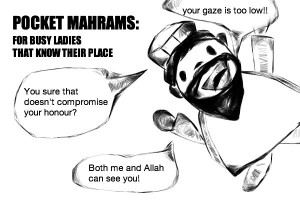
Please do not place pocket mahram in a haraam location, especially when batteries are in the device. This is to avoid forbidden sensations.

First and foremost, what Al-Subhi reiterates is something that I accept to be a reality about being a Muslim woman: my self-worth is directly proportional to my chastity, and we must never forget this. Clearly, this is our primary goal when we discuss Muslim women: keeping them pristine. I am not fooled when I read about the work of female activists in Saudi Arabia that want to drive. It is not about convenience or autonomy, or, I don’t know, trying to get to work on time. It is really about a Hollywood induced vision of broken hymens and debauchery in the backseat of cars, which, by the way, would be a logistical nightmare if women could drive.  Let us forget the other roles that women play in Islam; after all, what matters most is keeping women on the straight and narrow paths to avoid exciting them, as even the slightest taste of independence turns them into filthy-minded beings.

But in blaming the decline of society on women driving, Al-Subhi missed the real culprit:  unchaperoned women.  The problem is not the actual act of driving, but perhaps the fact that a woman is left in a space without a guardian. We cannot trust women with their urges, as even a speed bump could create worrisome scenarios. After all, a car can even become a portable whorehouse if it goes unsupervised. In order to avoid temptation and protect their honour, it would be wise for Al-Subhi to create Pocket Mahrams, which would be a collectible and fun way to teach women the importance of never leaving home without their small piece of patriarchy.

And as a final note: I would encourage Al-Subhi to push for heightened web censorship in Saudi Arabia. I was alarmed to read about such a learned scholar knowing what kind of a gesture would indicate availability. I presume that he gained this knowledge in research and good faith to protect the innocent and pure minds of Saudi women. However, I worry that women may be able to accidentally pollute their minds and perhaps expedite moral decline by being influenced by such rude gestures. Perhaps gender-based censorship would be most pertinent, after all, men must know what to keep out of the minds of women. Either way, I am glad that Al-Subhi is taking a stand and showing us the real value of women – and most importantly, keeping me from ever driving again.

** This part? Not making it up.  It’s a direct quote from Al-Subhi himself.

Jezebel and the Broken Jihad Record

Following the lead of the always reliable Daily Mail, Jezebel recently published a post declaring how awful it is to call your child “Jihad,” suggesting that this is tantamount to naming a child “Hitler.”

Cassie Murdoch starts by drawing a parallel to the story of a New Jersey couple that named two of their children Adolf Hitler Campbell and  JoceLynn Aryan National Campbell. Murdoch links this case and with a Daily Mail story about a woman who named her baby Jihad, a word that Murdoch defines as a “religious war all followers are to wage against non-believers.” Murdoch’s quick-fire definition is not only inaccurate, it reeks of ignorance, and let’s face it: it’s just plain lazy.

Jihad is a word that many Muslims have wrestled with over the past ten years. It’s been misinterpreted, twisted, re-adjusted and scrutinised, and sometimes I get sicker of looking at those five letters than I am of the word hijab. Let us take a step back and regurgitate the first lesson from Not-All-Muslims-Are-Terrorists-101: jihad means struggle and not really the carnal holy war fantasy that keeps Pamela Geller aroused and awake at night. That isn’t to say that it cannot be used to describe something violent, but that it is complex and contested, much like any other religious word or figure. If you would like to beat a dead horse on the definition of jihad, please click here, or I don’t know: research any conversation about Islam in the past ten years.

The name “Jihad” signifies an important struggle to defend religion, or be a good Muslim, all things that would understandably be important to religious parents. And besides, Jihad is a really common name. And I mean, really common. In fact, I am sure that attendance records in our nations schools have featured that name for years, which might possibly be a sign of Shari’ah destroying our free and liberal society from within.

While I believe that it is important to be critical of Islam and any other religious institution, scrutiny through the lens of stereotypes is not a very good start, and I am disappointed to see a website that I held in such high regard perpetuate such stereotypes. Put down the Islamophobic sippy cups, Jezebel; a slow news day is never an excuse for pointless sensationalism.


Smearing Farha Ahmed

In June, a small business lawyer and politician named Farha Ahmed was in a run-off election against Harish Jajoo for a city council seat in Sugar Land, Texas. In the final hours of the election, an anonymous mailer was sent around the town proclaiming that Ahmed is connected to Al-Qaeda. The “concerned citizen” links her to Dr. Aafia Siddiqui, a woman branded as “Lady Al-Qaeda” in the media. She is also questioned for her connection to CAIR.

While these mailers did not necessarily cost her the election, this smear campaign relied on many stereotypes of not only Ahmed, but Siddiqui as well. The mailer charges that Ahmed, a long-time member of the Sugar Land community, was appointed as the lawyer for Siddiqui. The piece of evidence used is an article in The Express Tribune, a Pakistani daily. According to the article:

Less than a month after the sentencing, Siddiqui fired her lawyers and waived her right to an appeal. Siddiqui wrote that she had fired her five lawyers and would be represented by Farha Ahmed, a Texas-based attorney. Ahmed declined to speak to The Express Tribune about Siddiqui.

While the details in the article may be correct, they are not necessarily true. While Ahmed was sent as an individual to represent Siddiqui, this does not mean that she actually represented her. Ahmed is not a criminal defense lawyer, and I would think that her connection to such a high profile case would make it easier to connect her to Siddiqui. According to comments Ahmed made to Fort Bend Now, Siddiqui might have requested her as a lawyer based on her pro bono work against domestic violence, as well as her assistance in recovering missing children:

“Because of my pro bono work with missing and abused children as well as my contacts in the Bush State Department, they believed I could be of help,” she said. “It is inappropriate for me to discuss the details of the case any further other than to state that the children were found. I would also like to humbly request that the identities of the children be safe-guarded for their protection.”

[Read more...]