Mormonism, Interfaith Marriage, and the Practice of Pluralism

Behold, I say unto you that all old covenants have I caused to be done away in this thing; and this is a new and an everlasting covenant, even that which was from the beginning. (D&C 22:1)

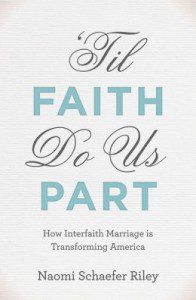
As America continues to navigate the intended and unintended consequences of pluralism, interfaith marriage has become a significant arena of interest. This week, Stanley Fish highlighted Naomi Schaefer Riley’s new and provocative ‘Til Faith Do Us Part: How Interfaith Marriage is Transforming America. In the last decade, nearly half of all American marriages involved individuals of different faiths. On the one hand, such a statistic both reaffirms and perpetuates the nation’s increasingly pluralist tradition: besides demonstrating the extent to which individuals have become tolerant of other faiths, interfaith marriages also ensure that the succeeding generation(s) will come to accept religious diversity as commonplace. Richard Putnam and David Campbell’s American Grace persuasively argued that America’s, well, grace is found in the nation’s increasing exposure to and acceptance of religious pluralism, largely through building a network of kinship and friendship with those outside one’s own faith. [Read more...]

Mending a Fractured World

In his Bancroft Prize-winning book, Age of Fracture, Daniel Rodgers tells the story of how, following the 1970s, America’s intellectual world fell apart. Ideas that were taken for granted during the mid-twentieth century, like national consensus, gender norms, racial identities, historical meaning, and market-based capitalism, fragmented into numerous directions. The social unrest of the 1960s (which challenged traditional assumptions), the end of the Cold War (which eliminated the nation’s most potent unifying rhetorical mobilization), and the culture war battles (which politicized and bifurcated cultural meanings) left Americans grasping to find some form of hegemonic basis to hold on to while all semblence of mainstream consensus fleeted away. (Such hegemony was never actually present, of course, but it had previously played an important public, if superficial, role in a perceived national consensus.) In short, the intellectual foundations of what “society” meant were coming unhinged. The key task for American thinkers in the last quarter of the twentieth century, according to Rogers, was to figure out what to do with the fractured mess that modernity produced. [Read more...]

Thanksgiving as a Political Arena

Perhaps because it always falls several weeks after elections, Thanksgiving is never very politicized. (Perhaps the ritual of gorging oneself on turkey and stuffing is too sacred to be profaned.) While we certainly have enough political debates throughout the calendar year, and we are now gearing up for the nauseating annual “War on Christmas,” Thanksgiving is often seen as a benign and happy holiday in which all people, regardless of political or religious beliefs, are thankful for the blessings in their lives—not to mention food on their plates and football on their televisions. Indeed, perhaps the most pressing debate that comes up is, “why do the Detroit Lions and Dallas Cowboys always get the nationally broadcasted games?” [Read more...]

Narrating the LDS Past: Past and Present

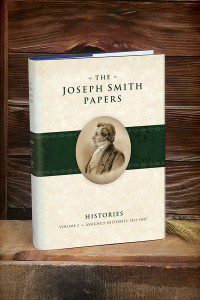
[Yesterday, I had the privilege of virtually attending the blogging event held in honor of the Joseph Smith Papers most recent contribution: Histories, Volume 2.]

On the day the Church of Jesus Christ of Latter-day Saints was organized in 1830, Joseph Smith claimed a revelation that “there shall be a record kept among you.” The Joseph Smith Papers Project, which has been going strong for over a decade and has now published its sixth of a projected twenty to twenty-five volumes, is perhaps the most ambitious and significant result of that charge. Endorsed by the National Historical Publications and Records Commission, the project has taken Mormon documentary editing standards to a new level and established a pattern nearly impossible to duplicate. The most recent volume, the second in the “Histories” series, reproduces early attempts to narrate the Church’s history prior to (and immediately after) Joseph Smith’s death. Unlike the first volume in the series, though, these texts were not directly overseen, dictated, or even supervised by Smith himself; rather, they were commissioned by him and composed by others who claimed their own first-hand experience. [Read more...]

Individualism, Communalism, and the Foreign Past of Mormonism

For verily I say unto you, the time has come, and is now at hand; and behold, and lo, it must needs be that there be an organization of my people, in regulating and establishing the affairs of the storehouse for the poor of my people, both in this place and in the land of Zion.

For a permanent and everlasting establishment and order unto my church, to advance the cause, which ye have espoused, to the salvation of man, and to the glory of your Father who is in heaven;

That you may be equal in the bonds of heavenly things, yea, and earthly things also, for the obtaining of heavenly things.

For if ye are not equal in earthly things ye cannot be equal in obtaining heavenly things.

Doctrine and Covenants 78:3-6


You didn’t build that.” This one-line quip of Barack Obama has received plenty of attention. The topic of pundit television shows, talk radio, and a plethora of made-for-Facebook posters, that brief sentence has struck a nerve amongst the American ideal, based on the myths of Andrew Carnegie and Donald Trump, of self-made man. In this country, our national myth declares, one’s potential is only limited by desire and effort. This is a narrative founded by Benjamin Franklin, sacralized by the Transcendentalists, and crystalized by Henry Ford. This particularly “American” mind-set has also been adopted as a core of Mormon culture in the 20th and 21st centuries: the hard-working, forward-moving, and success-attaining image so poignantly represented in Mitt Romney.

Yet such an individualistic refrain has an unusually communal religious pedigree. The verses quoted in the epigraph, which represent a large thrust of Joseph Smith’s expanded scripture, were part of a revelation Smith received in March of 1832. Prior to that, he had previously received a handful of revelations outlining an economic worldview hinged upon communal sharing, principles that were referred to as the Law of Consecration. The basic premise was simple: all possessions, talents, and any other form of ownership are due to divine appointment, and all humans were mere stewards working toward communal stability. To believe in private ownership was to overlook the hand of Providence, and to assume personal precedence over communal need was a severe sin. [Read more...]

Mormon Patriotism and the Cultural Reading of Scripture

At the New York Review of Books blog, Garry Wills recently asked some important questions about Mormonism and the Constitution. Recalling discussions he had with an LDS student two decades ago who believed that America’s two founding documents, the Declaration of Independence and the Constitution, were both inspired, Wills raised several provocative questions: Should every section and article of the original Constitution—including those that perpetuated slavery—be considered inspired? If the text constructed in 1787 was inspired, why did it require later amendments? How does viewing the document as inspired make one approach it differently than those who view it as a pragmatic compromise written by intelligent, if still flawed, politicians? And, most importantly for today’s political world, would this have any bearing on Mitt Romney’s presidency? [Read more...]