A Host of Gods and Goddesses

Religion is a way of life.  It is not about which tenets you may espouse, but about the  actions you perform. This concept takes on a special relevance in the Religio Romana where a cultor Deorum is defined by the rituals he or she performs, as well as  by the principles on which his or her actions are made. That is, there are Roman virtues by which we live our lives, and there are certain rituals we perform, not on a weekly basis but on a daily, and sometimes even an hourly, basis. We are not forgiven, after all, while we are conscious of always being under the eyes of our parental Gods and Goddesses.

Speak towards your fellow men as though the Gods were watching; speak to the Gods as though your fellow citizens were listening.

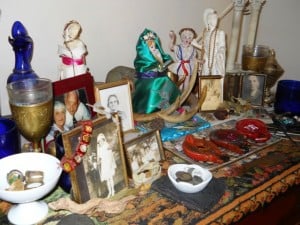
In a certain sense, this can be thought of quite literally since one class of deities, the Lares, are  our deceased relatives, parents, and grand parents.  The Lares are invited to remain with us in our homes, ever watching our actions, helping us, and at times judging us in this life.   Familial piety is one of the Roman virtues, which is expressed in part by daily rituals for the Lares, as well as celebrating an annual Parentalia and a number of other festivals for the departed souls.  For example, in the month of May we just celebrated the Lemuria (May 9, 11, 13) with a series of rituals of exorcising our homes of unwanted Manes, inviting our Lares and Penates to remain, and leaving out offerings at the crossroads for the wandering Lemures.  A gentilis Romanus is one who attends funerary rites, tends to the grave site of relatives, performs rites for this Lares, and perhaps honors the genius of an ancient Roman he admires.  The gentiles maintain the customs of their clan (gens), not only for their deceased relatives, but also the customary rites of the family.  This can lead a gentilis, then, to a different category of deities, whether to the celestial Gods, above and below, or to the lesser gods of Nature.

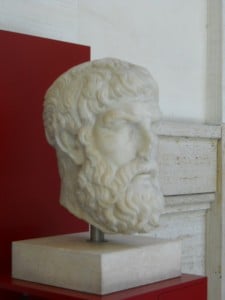
A cultor Deorum Romanorum, on the other hand, is a worshiper of the Gods; or more precisely, he is one who offers worship to particular Roman Gods in a particularly Roman manner of performing ritual.  Which particular Gods, you might ask?  There are well over one thousand names of Gods and Goddesses recorded in Roman inscriptions and texts. There are a multitude of Gods, and yet, according to Cicero,  there were only so few names by which They were invoked by the ancient sacerdotes.   For the most part though a cultor worships but a few deities who are relevant to her or his life.  Many cultores have reported being “called” into the service of a Goddess or by some God.  Others feel a certain affinity towards select Roman deities.  Minerva seems to be popular among modern practitioners of the Religio Romana.  Still others continue familial traditions of devotion to a specific God or Goddess.   Generally these are deities who are familiar from myth, and from Western art, architecture, and literature, as They permeate Western culture still in our music videos and in television advertisements.   They include Jupiter, Juno, and Minerva, Mars, Venus and the other Di Consentes. These are the Rome Gods most often confused with the Greek Olympians, or the Council of the Gods that is associated with the northern sky above, just as the Egyptian Council of the Gods and the Hebrew Council of the Gods in the Book of Psalms were said to be located in the northern portion of the sky.  The familiar deities would also include the Gods of the Underworld; that is, those deities, like Hades, Pluto, Proserpina and Dis Pater, who are associated with the southern portion of the sky, beneath the celestial equator.  There are patron deities of crafts and sciences, a host of deities of the sea, personified virtues, and Mother Nature Herself, the Great Mother of the Gods and humans, Magna Mater, Tellus.

Lesser known today are the more immediate lesser gods of the land and the goddesses of place.  These are the divine and the semidivine beings of Nature.  They are the spirits of the land,  sometimes named and sometimes not, the spirit of a forest, the Lady of the Lake, the Old Man of the Wood, the nymphs of springs and ponds, the river gods, the god of the mountain.  These are deities of which we become aware on an emotional level, as a presence we intuit, or sometimes see in a vision, or as a whisper on the wind.   These are ambiguous spirits.  Perhaps they are departed souls, Manes, who have attached themselves to a special place, like ghosts who haunt a house, only in a beneficial way.   More often, though, we feel a more potent entity inhabiting a place of Nature than may be just a ghost.   “Whether a god or a goddess,” the genus locii is the spirit of a defined place.  The place may be defined by a single ancient tree, and thus the genius locii in that case may be a semidivine Dryad, Maenad, or Helike, depending on the type of tree.  It may be bound by the bend of a river, or defined by a stand of trees, a naturally formed grotto, or the ecological niche of a small brook.  Whatever it may be thought to be, we honor the genius of a place just as we honor the genius (or juno) in every person.

Beyond the gods of family and home, those in Nature on land and beneath the sea, the Gods and Goddesses of myth, Justice, Mind, Good Fortune, and the other abstract Gods and Goddesses,  still further beyond than the celestial deities, and the infernal ones as well,  there are the cosmic deities of philosophical speculation.  For even Jupiter, King among the Celestial Gods, has no power over the Fates or over Nemesis, who is sent by the higher Unknown Gods, the Involuti. We acknowledge the Involuti, but They are rarely the focus of our worship as in the mystery religions.

So, in a religion where one defines himself or herself in virtuous action and in devotional  practice, with so many Gods and Goddesses attending, how does the Religio Romana impact on the daily life of a gentilis Romanus, cultor Deorum?

Kalendae Februariae

Juno Sospita

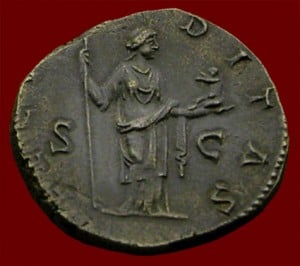
The Kalends of February honors Juno Sospita of Lanuvium. She is called the Queen of Heaven, our Heavenly Mother, and Savior. Juno Sospita is generally depicted armed with a shield and spear.  Her long gown is covered by a goat skin that is drawn up with the horns  on Her head.  Her temple stood high atop the acropolis at Lanuvium, , where She was probably named Catana, the Goddess of Good Wisdom.  In Her attributes She is similar to Athene atop the acropolis of Athens. At Rome both Catana and Athene were known as Minerva. A reference to a temple for Minerva Medica on the Esquiline Hill may have referred to Juno Sospita since this is the location where one of Her temples once stood (Cicero de Div. II.123; CIL VI.10133, VI. 30980).

In 338 bce Rome took Lanuvium, accepting its people as citizens of Rome and honoring their Gods and Goddesses. As Rome did with Etruscan Vei and later with Tanit of Carthage, Rome honored the juno of the Goddess.  Just as every man has his own unique genius, and every woman her own divine spirit called her juno, so also every Goddess has Her own female essence called a juno. Thus we find Proerpina called Juno of Enna, or sometimes She is known as the chthonic Juno.   Vei became Juno Regina of the Aventine Hill in Rome, while another temple at Rome was dedicated to a different Juno Regina represented Tanit.  Simply because a Goddess is worshiped by Her Juno, it does not mean that She is the same Goddess as Juno Capitolina, the consort of Jupiter, who in all likelihood was probably Ceres. It was not until 197 bce that Catana received a temple in Rome itself, as Juno Sospita on the Esquiline Hill.  She was seated there along with Juno Lucina, who was Diana Nemorensis of Aricia (Pliny NH 16.85; Dionys 4.1.5; Ovid, Fasti 2.435-436), and with the widowed Juno, who was brought to Rome by the Sabines as Mefula (Fest. 348; Ovid Fasti 3.245-246; Varro L. L. v.49), as well as groves for the Nymphae, the Fevers, and related Goddesses of healing.

During the Social War (90 bce) Caecilia Metellus dreamt that Juno Sospita was angry and would soon depart Rome for Her city of Lanuvium. The Goddess, prophesised to Caecilia that disaster would come to the health of Romans and Her prophesies soon began to come true. Caecilia awoke and immediately rushed to the temple. There she found that the women of the City had been using the temple as a lavatory and that a dog had whelped her pups at the foot of the Goddess’ statue. Caecilia thus saw to it that the temple was cleansed, purified, and restored, before inviting Juno Sospita to return. Thereby Caecilia gained famed as a woman who had saved Rome (Cicero De Div. 1.99).


Da mihi hasce opes, quas peto, quas precor porrige opitula.

Grant me the strength, Goddess, to whom I ask, to whom I pray; extend your assistance to me.”


Juno Februa

Also celebrated on the Kalends of February is Juno Februa. The month of February is the last month of the Roman sacrificial year and thus it is dedicated to purification in anticipation of the New Year. The word februa refers to anything that is used in purification rites. A ceremony was held where the flamenica Dialis, who was the wife of the priest of Jupiter, would ask for februa from the rex sacrorum who represented the priest-kings after Numa Pompilius. In return she received a bough of pine. Other priests were give woolen fillets as their februa, or else wreathes of laurel to crown their heads. Houses are cleaned, the front door is washed down and then wiped with februa using a measuring motion, the hinges are dabbed with olive oil or wolf fat using a bough of arbutus or mulberry, and three leaves from the same tree is placed on the threshold.  Offerings for Juno Februa are then placed on the door sill outside the house. Offered to Her are roasted kernels of spelt, salt, milk, honey, water, and a lighted candle.  This ritual honors the Juno who is the minor goddess, associated with Janus Janitor. Both guard the door of the house, with Juno Februa holding off all evils from the home, whether the evil is disease, false rumors, or the jealousy of neighbors. Think of the home as the temple of the family. One starts the month of purification outside the house, at the front door representing the boundary of the whole, and then over the weeks ahead one proceeds to clean and purify the rest of the home. The kalends of every month are dedicated to Janus and Juno, and thus the same offerings should be provided every month at this time, but in February there is a special emphasis to purify the home and renew it as the residence of our ancestors and our household Gods and Goddesses.