A good new book on the Bible reviewed (continuing the discussion on the word “inerrancy”)

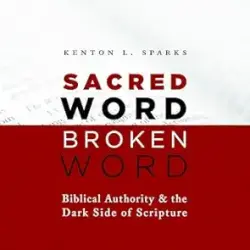
Review of Sacred Word, Broken Word: Biblical Authority and the Dark Side of Scripture by Kenton L. Sparks (Eerdmans, 2012)

I’m sure this book will stir up a hornets’ nest among the neo-fundamentalist evangelicals. No doubt others will also criticize it as it breaks some new ground, at least among evangelicals. I find it refreshingly clear and honest; the author pulls few punches in explicating the “dark side” of Scripture.

Kenton (“Kent”) Sparks is professor of biblical studies at Eastern University (American Baptist) in Pennsylvania. He has authored books such as Ancient Texts for the Study of the Hebrew Bible and God’s Word in Human Words. He identifies as an evangelical. Some critics will question that identification, but I tend to give people the benefit of the doubt and view “evangelical” as a fuzzy category. In my opinion, a person can be evangelical without adhering all the way to every part of the so-called “received evangelical tradition” (stamped as that tends to be by Old Princeton theology).

Without question Sparks’ argument is bold—at least among evangelical and relatively conservative Protestants. It will be interesting to see how it plays out among moderate to progressive (postconservative) evangelicals.

What’s especially interesting about the book is Sparks’ response to the Old Testament “texts of terror”—something we have discussed here quite a lot. If I understand his thesis correctly, it is very similar to what I have argued here—that the Old Testament must be interpreted in light of the New and that, at least occasionally, reports in the Old Testament (about what God commanded people to do) must be relativized in light of the character of God revealed in Jesus Christ who is the Word of God in person.

Here is one especially clear statement of the book’s overall thesis:

Scripture, as a book written by fallible human beings, is itself a book of theological discourse that that advances the truth but also stands in need of redemption. Scripture is beautiful and broken, and it is being read and studied in the church, and sometimes outside of the church, by beautiful and broken human beings. Nevertheless, Christians have theological and philosophical reasons to suppose that, when we read Scripture well, we are able to understand it. And as we understand it, we shall find that God’s truth and beauty run deeper, and are more potent, than the brokenness that God is healing. (88)

In other words, according to Sparks, there are records in Scripture that simply cannot be trusted as true because of the Bible’s humanity. He begins with blatant contradictions such as the accounts of Judas’ betrayal of Jesus and death in Matthew and Acts; they cannot be reconciled. Most people are not particularly bothered by that. Only neo-fundamentalists find it necessary to try to harmonize them. The differences are not important theologically. One can easily respond to them by saying that, in spite of such contradictions, the Bible is “perfect with respect to purpose” (John Piper). We can chalk such flaws to human fallibility so long as we hold to a dynamic rather than verbal view of inspiration. (By “verbal inspiration” here I mean the idea that God led the writers to the exact words he wanted them to use. By “dynamic inspiration” here I mean the idea that God led the writers to the ideas he wanted them to record but allowed their personalities and cultures and fallible memories, etc., to affect what they wrote.)

What will trouble many evangelicals more is Sparks’ handling of the Old Testament texts of terror:

Where we judge that Scripture presents God as saying or doing something he would not say or do, we should confess that “these texts tell us more about the purposes of their human authors than about the purposes of God.” We will simply admit that the author of Deuteronomy wrongly believed (as Luther did) that God told his people to slaughter their enemies. To express in theological jargon, Scripture includes both “God-talk” (first-order words from God to humanity) and “god-talk-talk” (mistaken, second-order accounts of what God has supposedly said. This is an important distinction…. (105-106)

Telling the difference between these two types of texts is a matter of Christological discernment, not cultural accommodation. Sparks adamantly rejects any idea that his proposal is based on modern sentiments. To those who disagree he rightly points back to church fathers such as Gregory of Nazianzus and John Chrysostom and others who freely admitted that the texts of terror in question could not be taken at face value. The way premodern Christians handled them was to allegorize them. That method isn’t open to us. So where does that leave us?

I think this is one of Sparks’ strongest arguments. He clearly demonstrates (you need to read the book to get the whole argument and all its nuances) that many orthodox premodern Christians did NOT believe these texts of terror are to be taken as commands of God. Allegorical interpretation saved them from having to say the human authors erred. Once we jettison allegorical interpretation (as almost all modern Christians have done!) we are still left with the problem of how to interpret these texts.

Sparks uses Deuteronomy 20 as one example. There, according to the text, Moses told the people of God that God commanded them to annihilate the inhabitants of the towns across the Jordan River. Then he shows how such texts were used by later “Christians” to justify genocide. For example, one American colonist wrote after annihilating a group of Native Americans “Sometimes Scripture declareth women and children must perish with their parents…. We had sufficient light from the Word of God for our proceedings…It was a fearful sight to see them frying in the fire, with streams of blood quenching it; the smell was horrible, but the victory seemed a sweet sacrifice.” (72)

Sparks quotes extensively from theologians such as Dietrich Bonhoeffer to justify (or illustrate) his argument that Scripture’s writers were not only fallible but also fallen and that therefore some of what they wrote must be redeemed. Scripture not only contains factual errors; it also contains some records about God that simply cannot be embraced as sacred Word of God. They must instead be relegated (not stripped from Scripture) to the category of Scripture’s “dark side.” An illustration is Luther’s handling of James. He did not expel it from the Bible but argued that its theology is simply wrong and should not be taught as gospel.

Again, throughout the book, Sparks uses Jesus Christ as the touchstone of interpretation and demonstrates that Jesus did not merely “fulfill” the Old Testament in terms of continuing a trajectory (which is true enough) but corrected much of it (e.g., how to treat enemies). The underlying theme is that Jesus Christ is the primary revelation of God, the clearest revelation possible in humanity and to humanity of God’s character. When we run across elements of Scripture impossible to reconcile with God’s character as revealed in Jesus Christ, we ought to bite the bullet and admit they are simply wrong, the result of the humanity (finiteness and fallenness) of Scripture.

I find Sparks’ argument compelling if not flawless. One flaw is his admission that there is no theory of inspiration that really squares with this. He leaves inspiration in the realm of mystery; we simply cannot know what it means except that God adopted these human writings as instruments of his revelation to us.

Here is why I am writing this review—following up on my earlier post about John Piper’s definition of “inerrancy.” “Perfection with respect to purpose” (as a definition of inerrancy) ought to be judged completely inadequate by those conservative evangelicals and neo-fundamentalists who oppose an account of Scripture such as Sparks’. Given what Sparks has written in this book, he could (he doesn’t) say he believes in inerrancy IF “inerrancy” means “perfection with respect to purpose.” Scripture’s purpose is to identify God for us and God does this through Jesus whom we meet in Scripture. This is why Carl Henry, who, in personal correspondence, criticized Piper’s definition of inerrancy did so. He saw that defining inerrancy as “perfection with respect to purpose” could and probably would lead to something like Sparks’ view of Scripture.

Here’s the upshot of what I am saying. If a neo-fundamentalist, conservative evangelical, says that Sparks’ view of Scripture is defective, low, he could always object that he actually believes in the Bible’s “inerrancy”—a very high view of Scripture. (I’m not saying he does say that; I’m saying he could.) If the critic scoffs he could always point to Piper’s definition of inerrancy as “perfection with respect to purpose” and turn the tables on the critic who, no doubt, admires Piper as a paragon of conservative evangelical “high” view of Scripture.

I am NOT arguing that Piper would agree with Sparks’ view of Scripture. What I am arguing is that Piper’s definition of “inerrancy” COULD cover Sparks’ view of Scripture.

This is why I keep arguing that “inerrancy” is a meaningless concept until it is explained clearly. And once someone does begin to explain it clearly one of two things happens. EITHER the explanation does not fit the actual phenomena of Scripture OR necessary qualifications (to make it fit the phenomena of Scripture) kill it so that it becomes a special use of “inerrancy” that fits no other context.

I want to mention one especially helpful aspect of Sparks’ book—his chapter on “Christian Epistemology: Broken Readers of Sacred Scripture” (Chapter 8). This is an exceptionally lucid explanation and defense of what I have been calling “critical realism.” Sparks calls it “practical realism” and distinguishes it from tacit realism, reflective realism, modern realism and anti-realism. He explains “Practical Realists believe that ‘the Truth,’ though it exists, is accessible to human beings only by analogies that yield partial, useful, ‘small t’ truths.” He quotes Merold Westphal: “the truth is that there is Truth, but not for us, only for God.” (81)

By the way, having just finished my book on modern theology (to be published next year by IVP), I find this very similar to what American mediating theologian Horace Bushnell argued in the mid-19th century. Against the prevailing Common Sense Realism of his day Bushnell argued that all language is metaphorical (not just God-talk).

I strongly recommend Sparks’ book to everyone, but especially to those who read Christian Smith’s The Bible Made Impossible: Why Biblicism is Not a Truly Evangelical Reading of Scripture which I reviewed here some months ago. Smith’s book is primarily critical; Sparks’ goes beyond that to a constructive proposal for an evangelical doctrine of Scripture that takes the actual phenomena of Scripture seriously while holding to a high view of Scripture as God’s sacred Word.


More about prayer for unsaved loved ones and friends

Communication is such a problem. No single set of words seem capable of clearly expressing what one means to a large and diverse group of people (such as readers of this blog). So I often find comments reflect misunderstanding of what I said even though I can’t really think of a better way of putting the thought.

In a recent post I said Arminians should not pray for God to save their friends and loved ones. The reaction has been interesting (I’m trying to keep calm and objective). I think there’s some misunderstanding in some of the reacting comments and questions.

The issue is not the words prayed so much as the meaning intended. And what I would say to a person about it depends on who they are and the context.

Because I like my prayers to be consistent with my beliefs (e.g., about God’s sovereignty and about reality) I never ask God to change the past. I don’t think God can do that. I think it’s even incoherent to talk about changing the past. In that I agree entirely with Calvinist philosopher-theologian Paul Helm.

However, I clearly recall an incident where my mother prayed that God would work it out that whoever found her purse (which was no longer where she lost it) would turn out to be a Christian or at least an honest person and return it to her. Of course, at the point of her prayer, she was asking God to change the past (or assure that something that already happened have happened in a certain way).

I didn’t criticize her; she was my mother and I was pretty young and didn’t want to show her disrespect or get into an argument with her. I let it go. What harm did it do? None.

However, if someone asks my theological opinion about praying for God to change the past, I will kindly tell them I don’t believe in it and explain why. (For example, there’s not a single example in Scripture of it and it’s illogical.)

If someone prays for God to save their loved one, I’m not going to get all worked up about it and criticize them and tell them to stop it. But if they come and ask me about that kind of praying I will tell them what I believe about it.

And what I believe about it is that it depends on what is intended. Normal language interpretation would seem to me to indicate that asking God to save someone, without any qualifications, is tantamount (whatever is intended) to asking God to do the impossible (from an Arminian perspective).

So, if a person asks me about such praying I will lead off the discussion with “What do you intend for God to do?” If the person says “I am asking God to intervene in their life to force them to repent and believe” I will say “That’s not possible” and explain why. If the person says “I am asking God to bring circumstances into their life to show them their need of him…” I will say “Well, that’s not what I think those words mean, but okay, if that’s what you mean, God knows what you mean and so go ahead and pray that way.”

It seems to me that “God, please save my friend” without qualifications normally means “God, break my friend’s will and force him to repent.” Perhaps not everyone who prays that prayer means that, but that’s what the words alone imply. That’s not consistent with Arminian belief. In my opinion, only a Calvinist (or maybe also a Lutheran) can pray that way consistently.

However, if the context is a lesson on prayer and the issue of praying for salvation of friends and loved ones comes up I will share my opinion.

And my opinion in this case is–it depends on what you mean because God always knows what you mean and you’re praying to God. And if you mean to ask God to violate someone’s free will and force them to be saved, then I don’t think that’s proper. If you mean to ask God to bring circumstances into a person’s life that will probably convince them of their need of salvation, then it’s proper. But why not pray with words that communicate what you mean?

Now, having said that, there is one exception to what I would do. If I hear my pastor or Sunday School teacher or a student pray something like “God, please save so-and-so” I will probably go to that person and inquire what they meant and suggest changing the words in the future to match the intended meaning. Why? Because public prayers also teach. People hearing a pastor or Sunday School teacher or student pray such a prayer will probably get the wrong idea (unless the prayer was intended monergistically).

Having said all that (a lot of words to attempt to explain what I thought I could take for granted), let me give an illustration of proper non-Calvinist praying for a loved one. I know a man who was raised in a Christian (Pentecostal) home and church but wandered away. In that context, he “backslid.” As an adult he was living a life of sin far from God. His friends and loved ones prayed that God would “work a miracle in his life” by which we meant bring some circumstance to bear on him that would convince him of his need for God.

The man rarely went to church with his wife, a devout Pentecostal Christian, but one Sunday reluctantly went along. That Sunday a person gave a prophecy during the Sunday morning service (something quite rare even in most Pentecostal churches!) that contained some message the man interpreted as “just for him.” He felt God was speaking directly to him through a prophecy–a phenomenon he was familiar with and had great respect for. That brought him to his knees and he repented and has been serving God faithfully for years afterwards. When his friends and loved ones prayed for his salvation, God heard their prayer. Even though God could not just “save him” willy-nilly, he could create a situation in which the man’s heart would be convicted in a powerful way so that to refuse to repent would have been unlikely–something like Saul on the road to Damascus.

If someone means THAT by “Lord, save my friend,” then fine. But I don’t think that’s what happened or could have happened. “Lord, save my friend” (without qualification) normally reflects monergism, not synergism. However, it doesn’t mean God won’t hear the theologically incorrect prayer and act on it. Yet, if it is prayed publicly, some people may misinterpret it and think monergism is intended and right (when the prayer is answered as described).


What I admire about Calvinists

Obviously, I do not agree with the distinctive doctrines of Calvinism–especially divine determinism and monergism. However, I admire how MOST evangelical Calvinist churches teach theology/doctrine and how to integrate that into everyday spirituality and ordinary life. That kind of integration of theology/doctrine with practice is too rare in non-Calvinist churches. I do not say it is absent; I only say it is too rare.

I have never been a member of or regularly attended a Calvinist church. I’ve only visited them. But I have had many Calvinist speakers, both pastors and lay people, visit my classes and speak to them. They always seem to have a ready answer to questions about practical matters such as preaching, praying, worshiping, witnessing, etc., and how those are affected by their Calvinism. The same has not as often been true of non-Calvinist visiting speakers.

I think part of the problem is that most non-Calvinists don’t know what they are–theologically. So, it’s easy for them to fall into practicing the Christian faith AS IF Calvinism were true when, IN FACT, they do not actually agree with the distinctive doctrines of Calvinism.

A case in point is prayer for friends and loved ones who are not saved. I know many non-Calvinists who pray, and see nothing wrong with praying, that God will simply “save” them. Of course, only a Calvinist (whether by that label or under another one) can reasonably ask God simply to “save” someone.

My experience of non-Calvinist Christians (from membership and leadership in about 12 churches during my lifetime) is that they are not, by and large, theologically trained at all. They have picked up pieces of this and that (theologies) and pasted them together in ways that seem good to them without any real reflection on the outcome (the eclectic worldview, theology that results from that informal process). I’m not saying that doesn’t also happen among Calvinists; I’m just saying it’s not as common IN CALVINIST CHURCHES.

What I long for is a church that knows it is not Calvinist and teaches non-Calvinist theology/doctrine (about God’s sovereignty) and actively helps members and attenders develop spiritual lives that are consistent with non-Calvinist (e.g., Arminian) beliefs.

Recently I visited a church I know is not Calvinist (although there may be a few Calvinists sprinkled among the members) in overall ethos. A mature Christian person gave a “testimony” from the pulpit during the Sunday morning worship service. He concluded with (paraphrasing) “I don’t know why God chose for my mother to have cancer” (but I’m learning to live with that, etc.).

I heard that and subtly looked around to see if anyone whose face I could see registered any kind of surprise or dismay. None. I mentioned it to a few people who are members of the church and who I know are not Calvinists; they didn’t think anything of it. Their response was of the nature of “Well, that’s his belief about God and so who are we to question it?” What I think they really meant was “If that’s what makes him feel comfortable….”

However, I am convinced that if I took that man aside and queried him about God and, say, the holocaust, he would deny divine determinism.

I could give numerous similar examples of what I’m talking about. I’ll mention just one more.

I knew a husband and wife who were most definitely not Calvinists and do not believe in divine determinism as a true account of God’s sovereignty. However, after their son’s death in a car accident, they talked about it as if they were Calvinists! For example, they loved to tell friends how God planned and executed the accident so that their son did not suffer any pain; he was killed instantly.

Here is how I teach my students. DO NOT wait until your parishioners experience a tragedy to talk with them about God’s sovereignty. If you are a Calvinist (many of them are), teach that to your congregation and clearly communicate its implications for practical life including how to understand evil and innocent suffering. If you are not a Calvinist, figure out your theology of divine sovereignty especially as it relates to salvation, evil and innocent suffering (I’ll be happy to help! :) , and teach your congregants about that. Do not wait until they face horrible tragedy and then try to answer their cries of “Where is God!?”

Overall and in general, I judge, Calvinists churches and pastors do a better job of this than non-Calvinists. An exception is Greg Boyd, pastor of Woodland Hills Church in St. Paul, Minnesota, who clearly articulates a non-Calvinist view of God’s sovereignty and teaches it to his congregation. Nobody in his church could ever miss it. But most non-Calvinist churches avoid the subject until tragedy strikes.

Doctrines of God’s sovereignty are too important to ignore. Everyone in a church ought to be able to say quickly and clearly what its overall view of God’s sovereignty is–at least in general outline form.

This is why I say that Calvinists need to go to Calvinist churches and non-Calvinists need to go to non-Calvinist churches. In mixed congregations two things happen. Either the subject is ignored or there’s tremendous cognitive dissonance among the congregants leading eventually to division.

Calvinist and non-Calvinist EVANGELICAL churches should be able to cooperate and have fellowship with each other. These are not doctrines that need to cause separation between congregations. I once was associate pastor of a decidedly non-Calvinist church (although God’s sovereignty was rarely if ever the subject of a sermon or Bible study) that actively cooperated with the town’s evangelical ministerial alliance on evangelistic efforts (e.g., Billy Graham associate evangelist crusades, supporting the local union gospel mission, planning and carrying out the high school baccalaureate program, etc.). Many of the pastors of the evangelical ministerial alliance were Calvinists. (Both the pastors of the Reformed Church in America and the Christian Reformed Church were active members of the alliance.) In the alliance, Wesleyans and high Calvinists got along famously. Within their churches, however, they taught doctrines directly contrary to each other. That did not hinder their friendship and cooperation.

Given the significant difference among biblically-committed, evangelical Christians on secondary matters of faith and practice, I do not think it realistic to expect one congregation to contain all of those peacefully. The only way to do that is to avoid doctrine altogether (except maybe the most general orthodox beliefs). I see no value in that especially when people need answers to questions like “Where was God when my child was killed in a car accident?” and “Why is my loved one not getting saved when I pray for him daily?” Answers to such pressing questions are going to be either Calvinist or non-Calvinist (or rooted in divine determinism or indeterminism).

I would like to see more non-Calvinist churches and pastors get busy teaching their congregations about God’s sovereignty from a non-Calvinist perspective and even correcting congregants who express beliefs that are Calvinistic–just like Calvinist churches teach their congregants about God’s sovereignty from a Calvinist perspective and even correct congregants who express beliefs that are contrary to Calvinism.

Review of Carson’s The Intolerance of Tolerance

Review of The Intolerance of Tolerance by D. A. Carson (Eerdmans, 2012)

The Intolerance of Tolerance is Carson’s latest jeremiad about postmodernism. His earlier one was The Gagging of God: Christianity Confronts Pluralism (Zondervan, 2002). The basic thesis of The Intolerance of Tolerance (henceforth simply Intolerance) is that our culture is in the process of adopting an intolerant attitude toward real moral and intellectual pluralism in the name of tolerance. Carson’s thesis is expressed in many ways and illustrated by numerous anecdotes. Here is one statement of his thesis: “In the name of not offending anyone, we are in danger of appealing to the virtue of tolerance to become more intolerant.” (p. 28) An example (anecdote) from the “domain of education” is the case of one Scott McConnell whose term paper for a class at Le Moyne College advocated corporal punishment received an A minus. However, according to Carson, the student was dismissed from the college by the chair of the education department due to an alleged “mismatch between [his] personal beliefs…and the Le Moyne College program goals.” (p. 29)

Most of his anecdotes about intolerance in the name of tolerance have more to do with persecution of religious believers and especially Christians in education and the media.

Throughout the book Carson works with a distinction between two views of tolerance—one “old” and the other “new.” According to him, the old view combined tolerance with realism regarding truth. That is, truth is “out there,” real, objective in itself. In this older view of tolerance, it is a path toward social harmony and, at least in some cases, toward a greater grasp of truth through dialogue between competing visions of truth. According to Carson, “the new tolerance argues that there is no one view that is exclusively true.” (p. 11)

It seems to me that, throughout the book, Carson describes the “new view” in different and sometimes confusing ways. For example, “there is no one view that is exclusively true” isn’t incompatible with the old view. And it doesn’t equate with “all paths are equally right.” (also p. 11)

Let’s look at that again.

On a single page (11), Carson describes the “new view” in two very different ways. First, it is that “no one view…is exclusively true.” Second, it is that “all paths [to truth] are equally right.”

Then, on another page (13) Carson muddies the waters even more by describing the new view as that “all truth is relative”—a definition (or description) of the new view of tolerance he uses repeatedly throughout the book. This would seem to be a third definition/description of the “new tolerance.”

Are these three descriptions of the same thing? Not necessarily. A person might very well believe there is objective truth “out there” (realism) without believing that any one view of it is “exclusively true.” (Remember that “exclusively” means “to the exclusion of everything else.” A view that is “exclusively true” would imply that it has no mixture of error in it and that other views contain no truth.) A person might very well believe that truth is real, “out there,” so to speak, and at the same time deny that any view of truth is “exclusively true.”

Also, a person might believe that all paths (to truth) are equally right and believe in real truth “out there” (realism); it’s just that all the major paths toward it are equally fallible but also lead there in the end. (Nobody thinks literally all belief systems are “equally right.” Some are plainly delusional such as solipsism.)

What Carson seems to mean by the “new tolerance” is relativism; that’s the one he settles down with throughout most of the book. And the book’s argument is that 1) relativism is unstable and inconsistent, and 2) relativism should not allow intolerance—even with regard to absolutism, and 3) many movers and shakers of contemporary culture (especially British and North American as all the examples he cites come from them) act hypocritical because they claim to embrace the new tolerance (relativism) while at the same time acting against absolutisms such as traditional Christianity on the ground that they are intolerant.

A quote near the book’s beginning expresses well what Carson opposes. It is from Leslie Armour, professor emeritus of philosophy at the University of Ottowa: “Our idea is that to be a virtuous citizen is to be one who tolerates everything except intolerance.” (p. 12) (Carson doesn’t cite a primary source for this quote; his sources are radio talk show host Bob Harvey and authors Josh McDowell and Bob Hostetler. See footnote 14 on p. 12) One has to wonder about that quote. Could Armour really have meant that without qualifications? The quote also raises questions about context. In what contexts (government, corporate, education, home, church) ought a virtuous citizen tolerate everything except intolerance?

In any case, throughout the book Carson is attacking the gist of that quote and the practices to which it gives rise and especially the common idea among movers and shakers of culture that, since Christianity is intolerant because it makes exclusive and absolutistic truth claims, it ought not to be tolerated.

Again, he attacks it on the basis that it is 1) inconsistent and therefore hypocritical (especially when put into practice to persecute people who make truth claims, and 2) dangerous to true pluralism. In the name of pluralism, the new tolerance excludes all views that claim to be true to the exclusion of other views even when they are not trying to persecute anyone. The new tolerance assumes that to claim access to truth is to persecute others even if only by hurting their feelings.

I agree with Carson that this extreme version of “new tolerance” is inconsistent and often intolerant. Most of the examples he cites, however, are of individuals or private organizations (not government) exercising bad judgment—sometimes out of ignorance of the law, sometimes out of desire that no one’s feelings be hurt, and sometimes out of antipathy toward absolutism of any kind and especially religious. Occasionally an agent of government or a court engages in “new tolerance” reasoning. Especially when that can be shown to be the case, Carson’s argument needs to be heard and heeded. (And, by the way, it is a case that has been made many times before by both secular and religious people on both the “right” and “left.”)

I think, however, that it would be helpful to distinguish more clearly between cases of the intolerance of new tolerance, relativism, anti-absolutism, in private and in public spheres. (By “public” here I mean government.) Most of it goes on in private organizations and institutions even if those are very “public” as in broadcast media. I wonder why that surprises or even dismays anyone? It seems to me that surprise and dismay at it reveal an expectation that Christianity (and clearly Carson is mainly concerned with persecution of Christians at the hands of adherents of the new tolerance) should be socially acceptable. I think a good case could be made that Jesus expected that his faithful followers would always be criticized and persecuted by “the world.” That is not to say it’s not worth pointing out that advocates of the new tolerance are being inconsistent; it’s just to express some bemusement at Carson’s apparent desire that culture tolerate Christians to the extent of accepting us “in the conversation,” so to speak, as equals with everyone else. I suspect that, to the extent we are really following Jesus Christ, we will not be seated at that table and given a fair hearing by the movers and shakers of culture.

In my opinion, it is worthwhile for Christians to expect a government such as ours, based on our Constitution, not to persecute Christians by marginalizing or excluding us, that is by singling us out for special negative treatment. On the other hand, it should not surprise us when efforts to do that are attempted even by government. But I have no objection to those legal organizations that come to the aid of Christians whose constitutional rights are being violated.

One type of intolerance Carson does not address is contemporary Christian intolerance of others. He decries past examples of it (e.g., the Inquisition, the Crusades, etc.), but says little about contemporary attempts by Christians to suppress minority voices WITHIN Christian organizations and networks (e.g., evangelicalism). As I have argued here many times before, there is a certain very vocal element within evangelicalism that uses pressures on publishers, colleges, seminaries and universities, etc., to suppress views other than their own. Carson might argue that such people have a right to do that. Of course they do, if we’re talking about constitutional rights, legal rights. But it seems hypocritical to me to tout true tolerance, “old tolerance,” and then engage in efforts to suppress or silence others’ views. (I’m thinking, for example, of evangelical authors who threatened not to publish with an evangelical publisher if it published books by open theists.)

A major point of Carson’s book with which I agree is that, to a very large extent, contemporary secularists pretend their world view is neutral and normal so that it ought to be privileged in the “public square” while all religious world views should be privatized. Carson is right to point out that there is no neutrality; every worldview, secular or religious, has at least a quasi-religious aspect to it. None should be privileged in the public square and that includes secular humanism or just plain secularism.

However, it also seems to me that neither should Christianity be privileged in the public square. I don’t know what Carson thinks about that. One could get the impression from this book that he agrees, but to me it’s not clear. Many conservative evangelicals do think that Christianity ought to be privileged by government and extensions of government (e.g., public schools). I think a great deal of the “new tolerance” arises from that phenomenon—the threat of conservative Christians grabbing power and marginalizing or even silencing other voices. The perception is that conservative Christianity is inherently anti-pluralistic. Conservative Christians don’t help with that perception when they, for example, support legislation of specifically Christian morality (i.e., criminalizing behavior deemed immoral only by Christians or some sect of Christians). As Christians, we could help the situation (if that’s what we want to do) by disowning and even publicly repenting for some of our past behaviors in which we have criminalized and persecuted people we considered “ungodly” because of their appearance, behavior that didn’t harm anyone, expressions of opinion, etc. We have a lot to live down—especially in parts of the country where conservative Christianity was tied in with intolerance toward minorities, ethnic and ideological.

Having said all that, it is my opinion that belief in God or a Higher Power is conducive to public morality because, without it, there is no ground or basis for belief in objective right and wrong. Without it there is no possibility of appeal to a “higher law” than “man’s law” (as Martin Luther King, Jr. rightly appealed to in his Letter from Birmingham Jail). That does not mean I think atheism or agnosticism should be criminalized; it just means I think theism should be privileged in the public square even as non-theistic voices are allowed to speak. There is no such thing as absolute, unfettered tolerance. We require public officials to take an oath to uphold the Constitution of the United States. That could be interpreted as intolerant toward persons who wish to abolish the Constitution. Nobody thinks that is intolerant, or at least nobody thinks that’s bad intolerance.

One complaint I have about Carson’s book is its treatment of “postmodernism.” Throughout the book Carson treats postmodernism as inherently relativistic. Yet he displays no first hand acquaintance with postmodern philosophers such as Derrida, Foucault, Levinas, et al. My own study has convinced me that most of them were not relativists. The Christian secondary literature on this is, in my opinion, largely mistaken. Most of it simply quotes other conservative Christian anti-modernist literature. Few conservative Christian critics of postmodernism demonstrate any serious engagement with postmodern philosophy’s primary sources. I’ve talked about that here before and recommended a few evangelical sources that seem to me reliable because they have actually read postmodern philosophers themselves as opposed to relying on secondary sources. (An excellent example is Bruce Ellis Benson’s Graven Ideologies [IVP].)

My (Roger Olson’s) follow up to Austin Fischer’s guest post

I do agree with much of what Austin wrote. In fact, I agree with the substance of it. I think a lot of critics of his post entirely missed his concluding remarks (criticisms) about “moderate” preaching–that it is sometimes too weak and lacking confidence in its own gospel message.

I have a one frame cartoon from (I think) Leadership magazine (years ago) showing a bespectacled minister sitting at his church office desk. Behind him is an attendance chart showing Sunday attendance at his church declining steeply. Across from his desk sits someone (a deacon?) saying “Well, pastor, maybe it would help if you didn’t end every sermon with ‘But then, what do I  know’?”

But another one shows a church custodian cleaning up around the pulpit on a Monday and seeing a post-it note in the pastor’s handwriting on the pulpit saying “Weak point, pound pulpit here.”

Austin rightly called for the current crop of “neo-Calvinist” preachers to preach with less certainty and authority (because what they are preaching is often opinion) and moderates to preach with more assurance and confidence (of the gospel).

I will stop speaking for Austin (and ask him to correct me if I got him wrong) and add my own commentary on the subject.

Yes, as some commenters here have rightly pointed out, Arminian preachers can also preach with over-reaching certainty that leaves no room for disagreement or doubt (that is, calling into question a person’s spirituality if not salvation for disagreeing or doubting). That’s just not currently as much of a problem with college students (especially) who are flocking to student conferences attended by upwards of twenty-to-thirty thousand students who hear neo-Calvinist (or whatever they should be called) preachers proclaim Calvinism as if it were the gospel itself and saying things like “If you received Jesus Christ for any other reason than the glory of God you might not be saved” and “Godordained sin” and “Christ died for God and not for you” and “If a dirty bomb fell on a city it would be from God,” etc., etc. (These are statements students returning from these conference and ones like them have reported hearing.)

These statements and things like them are preached in some contexts by Calvinist preachers as if they were gospel truth and not theological opinion. They are preached as if they were quotations straight out of the Bible on a par with “For God so loved the world…” (a biblical statement not often quoted by these preachers without defeating qualifications).

The problem I point out is some preachers’ lack of signals to help listeners distinguish between gospel and theological opinion that they should go home and check out with Scripture, tradition, reason and experience–in other words that they should exercise discernment about.

Paul says in 1 Cor. 14 that the elders (spiritual leaders) of a  congregation should discern the truth of prophecies. My question is how can that happen when people over 26 are not allowed to attend some of these conferences? Is that possibly WHY people over 26 aren’t allowed to register and attend some of these conferences? It does make me suspicious.

I have heard GOOD preachers who proclaimed the gospel with confidence and assurance but stopped to mention that something they also added to a sermon was their own opinion that might help listeners understand. EVEN PAUL did this in his letters. “Not the Holy Spirit but I say….”

One way I discern fundamentalism at work is when I hear (or read) a preacher proclaiming what I recognize as theological opinion or even denominational doctrine as gospel truth–implying by tone of voice, if not direct words, that anyone who disagrees might not be saved or might be on the slippery path to hell JUST FOR DISAGREEING OR DOUBTING.

Yes, this happens in all types of religious settings–even liberal ones (although it wouldn’t be on the path to hell but to being dismissed as simply ignorant or prejudiced). I can remember many times when I was Pentecostal hearing preachers loudly proclaiming, in pulpit-pounding fashion, an opinion that couldn’t be supported from any clear passage of Scripture and that wasn’t part of the gospel. As I got older and challenged them (afterwards, of course, one-on-one), asking for biblical proof of what they were proclaiming with such certainty, I was shamed for it.

So the problem isn’t unique to one movement.

HOWEVER, as Austin rightly points out, numerous, thousands of Christian young men and women (but especially young men) are being sucked into high Calvinism by preaching that borders on demagoguery (especially when it implies that Christians who think otherwise are “still in darkness” or not yet fully converted). This is much more of a problem on college campuses and in churches that attract college students than non-Calvinist preaching that falls into the same error and than “moderate” preaching that occasionally revels in doubt even about the gospel itself. (I actually haven’t heard that in any moderate churches, but I won’t question that it sometimes happens. It’s common in out-and-out liberal churches.)

So what’s the solution? I agree with Austin: “Less and more.” Less confusing the gospel with human theological opinion in proclamation in some contexts and more confidence in the gospel itself in others.