The Burial of Jesus: Deconstructing and Reconstructing

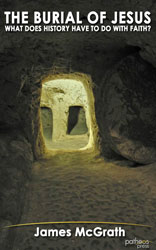
I tire of the modernist propensity to deconstruct the biblical narrative, reducing it to a pile of superstitious stories about a deity who does magic tricks, and “plays god” with creation. I tire of it and so I was grateful to have read to the end of Dr. McGrath’s book, The Burial of Jesus; What Does History Have To Do with Faith?. Grateful because, after Dr. McGrath did a credible job of deconstructing the fantasies he understands Christians of a more evangelical ilk believe, he did not leave it at that.

True there is insufficient historical evidence on which to base our faith, (liberal scholars who wish to appeal to the authority of a reconstructed “historical Jesus” take note), but McGrath says that resurrection faith “was not born from historical deductions regarding the whereabouts of a body, but from life-transforming religious experiences.. . . [faith is] what we can only speak of in symbolic terms as a life-transforming relationship to the ultimate. . . . [And so] if you ask me how (or in what sense) ‘I know he lives,’ the answer will be, as Ackley’s famous hymn says, ‘he lives within my heart.’”

All good stuff, maybe not exactly how I’d put it, but all good stuff. Still I find myself wanting to ask him, (just as I’ve been asking myself), “Who cares about the deconstructive enterprise?” Really, who are we writing for? Since the book methodically rips apart superstitious fantasies concerning the death and resurrection of Jesus, it seems to be addressed to more fundamentalist types who hold onto those ideas. But they are the people who aren’t going to read a book like this. The group more likely to read it are those who already think the mythic worldview is utter foolishness. In my experience that group reads a book like this just to reinforce their belief that the whole thing is stupid to begin with. Can’t you just hear them? “Can you believe those backwards evangelicals actually think that Jesus rose from the dead, when McGrath clearly shows that it is far, far more likely that his body was stolen?”

I’m just guessing, but I don’t think Dr. McGrath wrote the book to elicit that reaction. Which brings me to my question, or maybe it’s even a challenge for Dr. McGrath, for me, for those of us who accept the modernist deconstruction but do not believe that leaves us with a pile of irrelevant superstitions. It is time to do the reconstructive work in earnest, the work of describing Christian faith in terms intelligible to the modern mind. It will require us to dig deep into our tradition finding within its motifs, doctrines and narratives, a clarion call to living life in the presence of a love that calls us to ever increasing expressions of beauty and meaning in a world groaning in travail, seeking to resurrect the life of the human family. That, and not the deconstruction needs be the focus of our work.

About Sam Alexander

Sam Alexander is pastor of First Presbyterian Church of San Rafael and also serves as Adjunct Instructor in Homiletics at San Francisco Theological Seminary.

  • http://www.patheos.com/blogs/exploringourmatrix/ James F. McGrath

    Thanks for taking the time to review my book! I was going to leave a brief comment in reply, and then decided a full blog post was in order. Here’s a link: http://www.patheos.com/blogs/exploringourmatrix/2012/03/demolishing-and-reconstructing-the-burial-of-jesus-and-christianity-itself.html

  • Paul

    My goodness. Christianity is based on the assertions of a certain set of historical facts. You aren’t the slightest bit concerned about whether there is any truth to those assertions?

    Let’s assume for a minute that you are not concerned about historical truth. I would assume you are concerned about a correct reading of scripture. How can you have any confidence that you are reading it properly if you casually dismiss an examination of the context?

    There is more at stake than personal faith. How should we view and use the bible? Christians are increasingly pushing their interpretation into the public realm, to infuse public policy with religious principles.

    For example, today’s big argument is about the morality of birth control. I’m confounded, not by why this issue is suddenly a litmus test of government interference, but where the idea came from that birth control is the slightest bit immoral. There doesn’t seem to be anything in the bible about oral contraceptives, but there seem to be a lot of people buying into birth control as a faith issue.

    You seem to be denigrating those who want to seriously wrestle with the intersection of faith and knowledge. Is it preferable to just shut up and believe whatever we’re told? And if so, told by whom?

    I don’t think you’ve thought this through very much.

  • Pingback: Demolishing and Reconstructing the Burial of Jesus (and Christianity Itself) « Exploring Our Matrix

  • http://www.gracecomesfirst.net Sam

    Hi Paul,
    For whatever reason I didn’t see this post until this morning. You say that “Christianity is based on the assertions of a certain set of historical facts.” I think it is based on interpretations of events, the details of which are hopelessly lost to history. (In the case of the New Testament, interpretations that rely heavily on the work of the earlier communities of writers of Torah.) If critical scholarship has taught us anything, it is that the texts of Scripture are anything but objective history. I suppose I could deny that – I tried for quite a while – but eventually too many questions piled up and the idea the Bible was offering historical fact simply became untenable. But that doesn’t mean what the Bible says is somehow false. Why did the writers and their communities interpret events in these ways? Why did they write the poems and the letters that we have now collected in the Bible? I think it was for the same reason I reflect on life – public and private. I’m trying to live in harmony with creation’s purpose. (Over simplified, but it will do.) The texts we have represent a century’s long conversation about that issue – a conversation we continue to be involved in even now as I write and you read and perhaps write again. I believe that these Scriptures, this conversation, inspired by the same Spirit that inspired the writers and communities responsible for their collection, leads us toward truth. We ere if we assume they are truth.

  • Andrew

    Sam,

    As a Christian, though historical inquiry can never verify what actually happenened, do you still believe in the resurrection of Christ? I’ve read several of your posts and I agree that the meaning of the story goes deeper and has more value than whether it historically happened or not, but I am wondering if you still believe it to have actually happened? As a Christian myself, I struggle imagining a Christianity without a physical resurrection. I am just wondering what your own personal beliefs about the event are? Thanks

  • Pingback: Reviews, Interviews, Authors and Books to Note Across the Web « Theology for the Road