
 The Anchoress
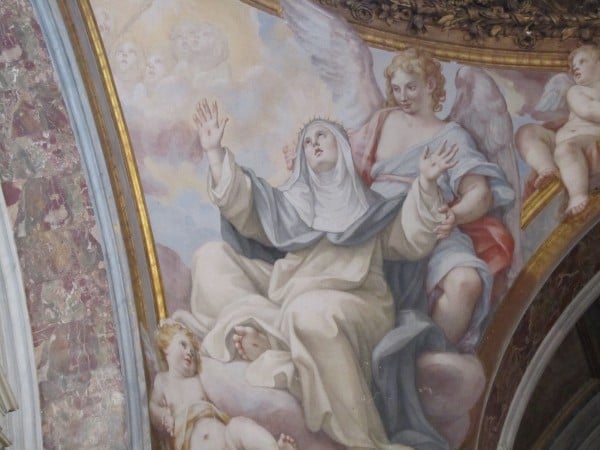
“If you are what you should be, you will set the world on fire”
– St. Catherine of Siena
St. Catherine of Siena – one of my all-time favorite saints. She was not -as many believe- a professed nun of the Order of St. Dominic (Order of Preachers) but rather what we would today call a “lay” Dominican, like our new friend Bl. Pier Giorgio Frassati.
She was a woman who bucked every trend of her time, and dared to write to a pope, telling him what he must do: “Be a manly man…” she exhorted Pope Gregory.
“…wanting to live in peace is often the greatest cruelty. When the boil has come to a head it must be cut with the lance and burned with fire and if that is not done, and only a plaster is put on it the corruption will spread and that is often worse than death. I wish to see you as a manly man so that you may serve the Bride of Christ (the church and its people) without fear, and work spiritually and temporally for the glory of God according to the needs of that sweet Bride in our times.”
People like to repeat the easy, thoughtless lie that the Catholic Church is suppressive to women, that she holds women back. Nothing has ever been further from the truth, and Catherine, a Doctor of the Church whose feastday we observed yesterday, is a prime example that:
…there has been no other institution in history which has given women such free reign to create, explore, discover, serve, manage, build, expand, usually with very little help from the coffers of the diocese in which they worked, and often with little to no intrusion on the part of the male hierarchy. …[there is not] a single institution on the face of the earth, other than the Catholic Church, which would have allowed them to run with their madness, BE who they were and accomplish great things.
Catherine of Siena dictated her letters with the fist pounding, and she could keep three transcribers going at once. Just think what she would have done with a blog!
Today that sense of surety, fire and urgency, which characterized everything Catherine taught, is still speaking to the hearts of the young. In a world full of noise and distraction, our young people are told they can be “anything;” they are served up a lot of self-esteem-boosting positivism in schools and the broader culture, and told they are “special” because “everyone is special” which means, of course, that no one is – and they have already figured that out by the third grade.
But our young people rarely hear (except through surprising sources like the last two Catholic popes and these moldy-old saints) that they are loved into being, distinct and individual and irreplaceable and that their creation is part of a plan; that they have specific roles to fulfill in their journeys. When they hear such a message, young people — who want their lives to mean something and their energies to be well-used, rather than tamped-down — respond with electricity.
We can see that in the hugely popular World Youth Days, instituted by John Paul II and continued with record-breaking attendances by Pope Benedict XVI. Youth will travel far and endure a great deal of discomfort in order to hear something more substantive than “you are special”, however true that may be. Youth is idealistic and generous; it longs for the challenge, and responds.
It is true that vocations to the priesthood and religious life have sharply dropped off since the Great Catholic HeyDay of the late 1950’s where vocation numbers reached their summit. But I have always rejected that comparison as meaningless. The great vocation numbers in the mid-twentieth century were actually an aberration. Throughout history, and well up to the first World War, priests and nuns were distinct, small minorities. Convents, abbeys, friaries grew then scattered, and their growth (as today) was always greater where people were poorer, and thus less distracted by the lure of materialism – more open to the small, still voice calling their names.
And too, vocations used to bring with them a bit of social cache. If you were a priest or sister, you may never be a king or queen, but you were likely to get some education, a sense of community and your meals, however frugal. Many a sound and fervent vocation began with an empty belly and a thirst for learning, and there is nothing wrong with that. The Holy Spirit has ways of using everything to God’s own purpose.
Vocations are now on the upswing; I read a report recently, and will try to find it, stating that “worldwide” there are more seminarians studying for the priesthood now than in 1961. They are coming from Asia and Africa, Poland and Eastern Europe, as missionary priests to the spiritually impoverished West. Here in America, the coastal seminaries may be too empty (although St. Benedict’s visit to New York City has begun a priestly springtime that I pray Archbishop Timothy Dolan –and his fellow bishops– can nurture and grow into a season of harvest), but in the Midwest and the South, the seminaries are bursting at the seams, as are the monasteries, both male and female, and while the Franciscans are more than holding their own, it is the Dominicans -the spiritual children of Dominic and St. Catherine- who are growing and spreading, upwards and outwards (come to New York!) from “flyover” America, to where they are so badly needed.
They’re setting the world on fire, little flames seeking out the dry kindling in their own generation, and burning to (as St. Catherine exhorts) “run, run, run.”
I am a Benedictine, myself, and I will have to talk up my own flourishing brothers and sisters, in a few months, but for now, take a look:
Dominican Sisters of St. Cecilia
Dominican Sisters of Mary, Mother of the Eucharist
Dominican Province of St. Joseph
Dominican House of Studies
Dominican Nuns in the USA
Dominican Friars in the USA








 Ad-Free & Subscriber Log-In