If Your True Love Suffered a Brain Injury, What Would You Do?

They met in college and fell in love. They talked about getting married, and he started looking for a ring. They dreamed about life together, a life of beauty and joy, raising babies and laughing with friends and growing old.

They did not imagine a car accident. They did not imagine his brain injury. They did not dream about the need for constant care and a wheelchair and fear that food might choke him. They did not plan for this.

Ian and Larissa Murphy tell their story in a short film produced by Citygate Films (whose director, Carolyn McCulley, has written for Her.meneutics) for John Piper’s Desiring God website.

YouTube Preview Image

Ian did not choose his injury, but together he and Larissa chose to get married after the initial years of his recuperation. They chose to bind themselves to one another in front of a host of witnesses and the presence of the Lord. They chose a hard road marked and guided by love.

Continue reading Ian and Larissa: A Story of Choosing the Hard, Good Road

A Letter to the Tooth Fairy

Penny lost her third tooth today. They are falling out just as expected–first the bottom two, and now one up top with the one beside it wiggling as well. It came home from school with her in a small lavender box.

At first, she was feeling brave. “The tooth fairy can come into my room.”

I didn’t expect that, given that the first two teeth had to be placed in our room with notes outside her door barring the TF from entry.

But soon enough, she requested the note. “Dear tooth fairy, please don’t come in Penny or William’s room.”

A few minutes later, she said, “Mom. Tell the tooth fairy she can’t come. Ever.”

“Ever?”

“Ever.”

I tried to hedge, thinking I could get her to go to sleep, have the tooth fairy deposit a dollar in my room, and tell her in the morning that I forgot to pass along the message but it was really no big deal.

Magical creatures have always freaked out my daughter. We’ve been talking about Santa Claus for years in a love-fear (I can’t quite call it hate) relationship. With Santa, as with the tooth fairy, I have gotten to the point where I tried to convince her that they weren’t real. Last night, I finally said, “The tooth fairy is just pretend, Pen.”

“So I shouldn’t be afraid because the tooth fairy is pretend?” She considered it carefully. “Where does the tooth fairy live? If she’s pretend, how can you tell her not to come ever? I will write her a note.” And then:

"tooth fairy don't come ever Penny"

She woke up this morning regretting her decision, so we’ll see what happens tonight. It’s certainly no big deal if we abandon tales of the tooth fairy. Penny hasn’t used her other two dollars, and the Easter bunny never gained any hold on their imaginations, so maybe we can move forward and only contend with Santa. The big deal to me is that our baby girl is now losing teeth and asserting herself and solving problems. Growing up.

“A Perfect Child” Wins First Place…

My Perfect Child,” an essay in Christianity Today about coming to understand Penny as a gift and her life as very similar to mine in both its brokenness and its perfection, won First Place in the Evangelical Press Association’s Higher Ground Awards for 2011. One paragraph from the essay that sums it up:

Five years ago, the hopeful and joyous words from the hospital room next door—”She’s perfect! She’s perfect!”—haunted me. Now they seem prophetic. Penny was not the “perfect baby” that I expected, but she was exactly the baby I needed. I look at her now, giggling with her little sister, complaining that her brother isn’t sharing his toys, sitting in my lap and whispering that she’s afraid she’ll be lonely when she goes to kindergarten. I don’t see much that’s different from other children.

Penny is both created in God’s image and fallen from grace—like everyone else.

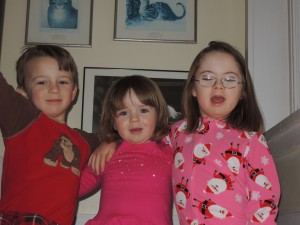
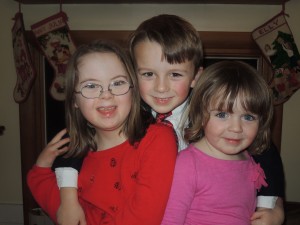
The photo of Penny that accompanied the essay won 2nd place. I just spent 20 minutes trying to figure out how to give you a glimpse of that winning photo, because I love it, but the file is too big and I am technologically challenged, so I’ve just added a cute picture of Penny which is certainly NOT the winning photo!

The funny thing about the photo, though, is that it took HOURS to try to capture Penny smiling. She’s so incredibly relational that trying to get her in a solo shot was virtually impossible. The final product, which looks like a straight on portrait, actually came when she was sitting in my lap, which seems rather appropriate, as it happens.

I should add that A Good and Perfect Gift is a much longer version of this essay, so if you like/are challenged by/want to think more about the thoughts contained in it, you might as well just buy the book, and then let me know what you think…

Why Adoption Feels Harder than Abortion

I’ve held naive assumptions about both abortion and adoption in the past, and I’ve asked naive questions. One of those questions brings the two together as I’ve had trouble understanding why women who are unexpectedly pregnant chose abortion instead of adoption, especially when many of those women believe abortion is ethically wrong. At the Q conference in DC a few weeks back, Angie Weszely, President of Caris, explained it to me. For a woman facing an unplanned pregnancy, pregnancy involves what feels like a total loss of self. (Even for women like me who have only experienced planned pregnancies, pregnancy involves a bewildering sense of self loss.)

Carrying the baby to term involves losing the self but saving the baby. Abortion staves off the loss of self, but it includes the loss of the baby. Adoption, Weszely explained, is in some ways the hardest choice because it feels like both the loss of self in seeing the pregnancy through and then the loss of the baby.

I’m grateful for the wisdom and grace of women, like Angie Weszely, who are offering supportive care for women facing such difficult choices.

For further posts on abortion, visit Karen Swallow Prior and Ellen Painter Dollar’s exchange from last fall: What Do You Think About Abortion?

For further posts on adoption, read reflections from Margot Starbuck, Ellen Painter Dollar, Jennifer Grant, and Sara Hagerty from last summer: What’s Happening on Thin Places this Week

Isabel and Sam: Friends without Labels

A few weeks ago, I ran a series of posts about the possibilities for friendship for kids and adults with disabilities. I’ve written about Penny’s friendships, I shared a post from Ben Conner about friendship among adolescents, and an exchange between two adult women– Tryn Miller, who has Down syndrome, and her friend Anna Broadway. Today I have the privilege of sharing Jennifer Grant’s story of her middle-school age daughter Isabel’s longstanding friendship with Sam, who also happens to have Down syndrome. (I should mention that Jen’s new book, MOMumental: Lessons in the Messy Art of Raising a Family, just came out. I’m on chapter three and loving her honesty and hopefulness. If you’re a Mom who is wondering whether you can make it through, give yourself this book…)

Isabel and Sam

From a young age, my daughter Isabel has seemed determined to keep up with the big kids. Or, to be more precise, I should say she has met the challenge of having two brothers – brothers not much older than herself – with a steely resolve to out-perform them.

She learned to pump on the swings, ride a two-wheeler, and climb all the way across the monkey bars at a much younger age than either of my sons did. When her brother Ian, 18 months older than herself, was in kindergarten, Isabel kept close to us when I read to him or helped him with homework. She’d rush to sound out a word or give the answer to a math problem before he had a chance to do so.

Isabel!” he’d moan.

People often mistook her for an older child and asked me if she and Ian were twins.

“Yes, we are,” three year-old Isabel would answer, before I had a chance to speak. “We’re in kindergarten.”

People believed it.

When she started school herself, I wondered whether she would choose other achievers as her buddies and be caught in a metaphorical arm-wrestling match with her friends throughout her school years. (Of course, I hoped she would not.) Early on in elementary school, Isabel came home with stories about the new cast of characters in her life. Kelson and Jenna and Bjorn and Rebe and Sam. Games they’d play at recess. Jokes they told at lunchtime. Who chose her as a partner in gym class.

I noticed that many of the stories she told were about her new friend Sam. When their classroom was assigned a student teacher, Isabel reported that Sam initiated the practice of giving the young woman hugs at the end of the day. “Now we all hug her when we leave,” she reported. Another time, she told me that she’d failed a task in P.E. and was “really sad and mad,” but felt better when Sam told her it didn’t matter and gave her one of his hugs.

“He gives me joy,” she said.

When I finally met the famous Sam, I noticed his playful smile and the easy way he and Isabel related with each other. I also noticed that he had Down syndrome. That it was not the first thing she told me when describing her friend, but that Isabel never even considered this a fact worth mentioning was compelling to me. [Read more...]