Rick Riordan I Love You

Rick Riordan is the author of several YA series, Percy Jackson and the Olympians (beginning with The Lightning Thief), The Kane Chronicles (beginning with The Red Pyramid), and the Heroes of Olympus (beginning with The Lost Hero).

Dear Rick,

Let me tell you why I’m professing love for a man not my husband in a public post.

4 years ago, a week into summer vacation, my daughter trounced into the house with the CDs for your YA novel, The Lightning Thief, which had been assigned as summer reading. Ling had already borrowed the book from the library and finished it.

“We HAVE to listen to this book–it’s SO good, even though it’s really scary.”

That became the summer of Percy Jackson and The Lightning Thief.  Percy Jackson learns he is a demi-god, the son of Poseidon, anathema to all the monsters and evil forces from ancient Greek mythology.  Having always been the worst student in his class, he now finds his ADHD serves him well as he fights to stay alive and defend his friends in modern day New York (Olympus rests on top of the Empire State building).  The books are funny, exciting, and provide an excellent motivation to delve further into Greek mythology.

We listened to the first 4 books of the series as we drove to and from Niagara Falls and all became rabid Rick Riordan fans, all except for my husband.  Scott and I have had a little struggle around long trips ever since I discovered that books on tape are the best way to keep the kids from melting, fighting and whining.  I enjoy listening to the books as much as the kids.  Scott would prefer to invest in our marriage by carrying on adult conversations.

The nerve of the guy!  He finds it annoying when he thinks I’m listening intently to him, only to discover I’ve drifted back to Olympus.  Sorry, Rick, I don’t think my husband likes you very much.

We went into mini-mourning when the last Lightning Thief book was published,.  But then to our delight we found out that you started a new series, The Kane Chronicles, based on Egyptian mythology.  And then to our joy we learned you started yet another series based on Roman mythology.  Even better–it intersected with Camp Half-Blood, the world of The Lightning Thief.

Even muchos more better, I discovered that giving the latest copy of your book to my son, NOT my daughters, gave him immense motivation to read.  He just loved the power of having a book they so desperately wanted.

Here are some other reasons I heart you:

  • I love that I know where my son will be after each new book you write is published—sprawled somewhere immersing himself in the latest adventure.  I have to order him to read most days, but when your book shows up, there’s no need for cajoling—he’s out there reading.
  • I love that Percy Jackson has ADHD and that ADHD is a strength.
  • I love that Carter Kane is African-American and so is Walt, the super hot charm-maker with skin the color of roasted coffee beans who’s dying from an Egyptian curse.  I appreciate that you get in the head and heart of an African-American boy with an African-American father who’s tried to ensure his boy will grow up strong, resilient and respected. I love that other characters are Indian, Egyptian, Chinese, and South American. Too often, great YA writers create an entirely White world, and only when their books are made into movies do some characters become multi-ethnic.  Thanks for including heroes that can personally inspire kids from all sorts of backgrounds.
  • I love that the female characters are strong, strong, strong—Annabeth, Sadie, Piper.  These girls are brave, loving, smart and funny, and although boys are always falling in love with them, they don’t exist in the story as mere love interests.  They risk their lives for their friends, loved ones and the fate of the world.  They’re beautiful, sassy and brilliant.
  • I love your books even if some monotheists probably worry that you’re pushing pantheistic religion.  I appreciate what you wrote on your website:

The Lightning Thief explores Greek mythology in a modern setting, but it does so as a humorous work of fantasy. I’m certainly not interested in changing or contradicting anyone’s religious beliefs. Early in the book, the character Chiron makes a distinction between God, capital-G, the creator of the universe, and the Greek gods (lower-case g). Chiron says he doesn’t want to delve into the issue of God, but he has no qualms about discussing the Olympians because they are a “much smaller matter.” The gods of Olympus are archetypes. They are deeply embedded in and inseparable from Western thought. The book pays tribute to the legacy of Olympus as one of the roots of our culture.

  • I love that I want to read the books as much as the kids.  That I have to sneak the books out of their bedrooms after they go to sleep so I can have a crack.

Thank you Rick for writing.  We will keep reading.

But watch out for my husband.

Rick Riordan’s latest YA book, The Serpent’s Shadow, came out May 1st.

Book Review: A Good and Perfect Gift

Early in her first pregnancy, Amy Julia Becker found herself chafing at its timing.  Having a baby a semester before she finished seminary was not a great plan.If only we had waited, she thought. And then it hit her, Then you wouldn’t have had this child.

When her daughter, Penny, is born with Down syndrome, Amy Julia is shocked and terrified, but remembers that she was to have this child.

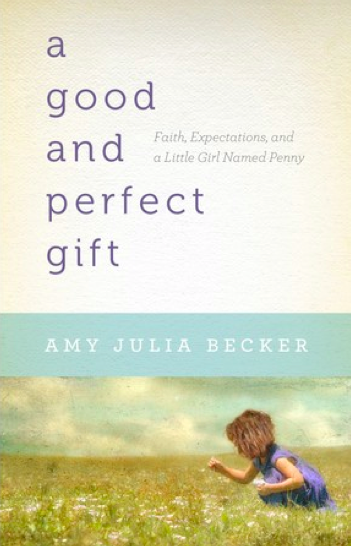
A Good and Perfect Gift details Amy Julia and Peter Becker’s first few years with their daughter. It is a refreshingly honest account of new parents learning to care for a child who will never meet their original expectations but who will continually amaze them with her indomitable spirit. Peter quickly reconciles himself with their new reality, but Amy Julia fights against it. She shares her grief, her struggles with faith and her relationship with God, her sensitivities as a parent of child with a disability, and her fears as they expand their family. And she shows how her love for this child, for Penny, expands along the way.

As the Beckers learn about people with Down syndrome, they hear stories that make them cringe and others that encourage them. Amy Julia tells Peter, “It’s the thought that she might teach me to slow down, to love deeply, to compete less, to live more fully—those are the stories that bring hope.” As she tells Penny’s story, she manages to bring that hope.  God, after all, not only redeems those who are broken emotionally and spiritually, but also those who are broken physically.  There is also the hope that these children can enrich lives far more than believed possible.

A Good and Perfect Gift is not for other families with disabled children or friends of families with a person who has Down syndrome; this book is for everyone. It teaches all of us to look deep inside and see our fatal faults and our marvelous possibilities—and to see them in the people around us. This book is about grace: receiving grace in the face of great struggle and disappointment, giving grace when our friends and family cannot meet our needs, and finding grace to move forward in our lives. Beautifully written, A Good and Perfect Gift is the gift of an honest story that points us to the good and perfect God.

We’re giving away a copy of A Good and Perfect Gift this week!  Please leave a comment below for your chance to win!

On May 31 at noon (EST), we’ll pick a name in a random drawing from all eligible entries received and send you an email notification if you are the winner!

Limit one (1) entry per person; NO PURCHASE NECESSARY TO ENTER OR WIN. Open only to legal residents of the 50 United States and Washington D.C. who are 18 or older as of date of entry.

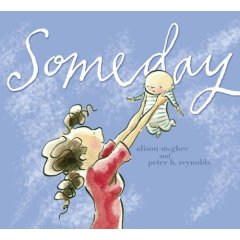
Someday, a Book Review

Need a book for a mom of any age? How about the New York Times bestseller, Someday?

Alison Mcghee joins forces with illustrator, Peter Reynolds to create a mother/ child journey similar to Robert Munsch’s, Love You Forever. This book presents an insightful, gestalt view of parenting – reminding the reader that Some Day they will be looking at their children from a different vantage point.

Told from a mother’s perspective, a woman moves from holding her newborn baby to watching that baby grow up to becoming a mom herself.  At the end of the book, she is no longer the brunette young mother, cuddling a newborn. Rather, she’s a silver haired grandmother watching her own baby who’s matured into adulthood. How many of us can relate to the, sometimes overwhelming, emotion of our babies growing up? Many moms are in tears over the first day of kindergarten, high school, and college already, and this book definitely tugs at the maternal heartstrings. Along with capturing these tender moments, the book expresses a mom’s dreams for her child’s future:

“Someday you will swing high-so high, higher than you ever dared to swing.”

McGee doesn’t shy away from expressing the hurts a child will encounter either:

“Someday you will hear something so sad that you will fold up with sorrow.”

The Bottom Line:

McGhee has tenderly penned a chronicling of all of the various events that happens in one child’s life. As touching as the story is, it is simply not written for the kiddos.

To Think About:

People tend to have intense personal responses to this book — perhaps because the journeys with actual, real life moms are less than ideal, sometimes cut short, or simply too emotion-laden to think about without feeling. Some readers — in the throes of mothering their own kids right now — find this book a little too emotional.

Nevertheless, this author really captures what it feels like to be a parent. Interestingly… a little boy was asked what he thought of the book, as he slowly put it back on the table.

“It makes me sad,” he said, though he couldn’t explain why.

Quite possibly it captured something that kids experience all too often in their lives, sometimes a little prematurely… navigating the complex waters of adult emotions.

Leave a comment for a chance to win Someday.

Next week, we will pick a name in a random drawing from all eligible entries received and send you an email notification.  Limit one (1) entry per person; NO PURCHASE NECESSARY TO ENTER OR WIN. Open only to legal residents of the 50 United States and Washington D.C. who are 18 or older as of date of entry.


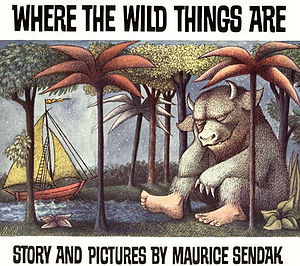
Where the Wild Things Are: Longing for More

Today, the world lost a prolific children’s writer, Maurice Sendak, author of Where the Wild Things Are. For many, the sight of this book and it’s iconic images, first published in 1963, conjures up childhood memories. You may remember the lap, or lack thereof, that you were sitting on when you first experienced Mischievous Max run his mouth to his mom (who calls him “WILD THING!”) by yelling, “I’LL EAT YOU UP!” and is promptly sent to bed without dinner. In his room, still dressed in his wolf costume, Max imagines himself as King of the Jungle. The captivating pictures (the ones some parental critics find too scary) show Max’s room transformed from a forest into an ocean.  On it, he braves dragons to reach the island of the wildthings.

And when he came to the place where the wild things are they roared their terrible roars and gnashed their terrible teeth and rolled their terrible eyes and showed their terrible claws” til Max said “Be Still.”

Through the simple sound of his voice, the monsters not only obeyed, but deemed Max their King, to which he decrees, “And now, let the wild rumpus start.” The next few pages hold a picture of every child’s dream, right? Not only does Max hold complete dominion, he’s organized every mom’s nightmare-of-a-play date with unsupervised boys.  After Max exerts one last bit of power in ordering the wild things to “Now Stop!” he sends them to bed without their supper. And then the book takes a powerfully redemptive turn,

And Max the king of all the wild things was lonely and wanted to be where someone loved him best of all. Then all around from far away across the world he smelled good things to eat so he gave up being king of where the wild things are.

What Max then discovers is that the yummy smell is coming from the dinner sitting on his bedside table. The home (or better yet, the parent) to which he ultimately returned had graciously left him dinner.

Bottom Line: Many adults and children have expressed sadness after reading this book, perhaps because it is so true to the human experience. People are inclined to chase autonomy, power, and self-reliance only to find themselves lonely and stuck on self-created islands.

For me, it created a different sort of emotion, more along the line of an unfulfilled longing. At the conclusion of the story — the simple image of the loving dinner sitting on the bedside table, evidence of a gracious and loving parent – is not enough. It is an incomplete picture of reconciliation, without the complete abandoning love of the Father lifting his clothes, running to embrace the Prodigal Son. As the stubborn, autonomy loving, fool that I am — I need the story to end differently. I need more than the reminder of love and forgiveness – I want to be with my love.

Rest assured, my fellow pilgrim, the day will come when we experience by sight what we can only access by faith now.

And our longing will be no more.


C.S. Lewis On Scary Images

In his essay “On Three Ways of Writing for Children”, C.S. Lewis makes a helpful contribution to the discussion of exposing our children to things that may frighten them,

Those who say that children must not be frightened may mean two things. They may mean (1) that we must not do anything likely to give the child those haunting, disabling, pathological fears against which ordinary courage is helpless: in fact, phobias. His mind must, if possible, be kept clear of things he can’t bear to think of. Or they may mean (2) that we must try to keep out of his mind the knowledge that he is born into a world of death, violence, wounds, adventure, heroism and cowardice, good and evil. If they mean the first I agree with them: but not if they mean the second. The second would indeed be to give children a false impression and feed them on escapism in the bad sense. There is something ludicrous in the idea of so educating a generation which is born to the…atomic bomb. Since it is so likely that they will meet cruel enemies, let them at least have heard of brave knights and heroic courage. Otherwise you are making their destiny not brighter but darker.


Would you be Forever Fertile?

(I do almost all of my reading on the Kindle app for iPhone — I love it!  I can carry a novel, a spiritual classic, my new testament, and whatever hefty nonfiction my husband has recommended all in my purse wherever I go.)

I just finished reading State of Wonder by Ann Patchett.  I picked up the book for a book club with Amy Julia Becker, and I hope that she will weigh in as well, but I can’t wait to talk about it.  As you may know from the reviews, the book revolves around the work of pharmacologists studying a remote Amazon tribe in which the women do not experience menopause and continue bearing children into their seventies.  There are some great plot lines which lie over this main topic, including a mysterious death and lots of intrigue about employer and employee relationships, so the book works both on the level of engaging beach read and deep conversation starter.

I had my first child when I was 23 and I am now, at 33, pregnant with my seventh.  In such a state, wondrous though it may be, I can tell you that 10 years makes a big difference, this pregnancy is harder on my body, but lots of things about my life are easier.  My husband is further along in his career, I am more at peace within my family and relationships and even with myself than I was 10 years ago.  Still, I am physically exhausted and I don’t quite have the “setting out into the deep” trust and excitement that I had earlier, I know too much about life to think that anything will ever be easy.  I am happy to be welcoming another baby into my family, and I hope that I will be able to have more after this if we feel that we can handle it.  Still, though I don’t know what the next 10 years will bring for my family life, right now I imagine that I will be fairly content to see my fertility begin to run its natural course in the next decade or so.

Personally and spiritually, I have seen major benefits from having children when we were very young.  My husband and I were forced to grow up and get our acts together a little sooner than some of our peers, and we have developed on our journey of character and virtue through the self sacrifice required in parenting.  I would not put that off for anything – why spend my 20s, 30s and 40s the way that I did my teens, thinking that the world existed primarily for my entertainment and pleasure?  I am sure that there are ways to experience this sort of personal growth outside of motherhood, but for me that was the path.  Still, as much as I have gained and grown from having children, and as hard as it might seem to face being “done,”  I hope that at some point I will be able to face the next stage of my life with peace and trust and some days I really look forward to a time when I will have room for activities other than birthing and nursing, which I have been doing at a rather extreme pace for the past 10 years.

I recommend State of Wonder as an intriguing novel and a great book club pick, and I’d be very curious to know what other mothers think about this one, of many questions, which the plot raises:  If you could stay fertile forever (or just for longer), would you?

————————————————————————————————-

Want to talk more about fertility and all sorts of other topics with a fun group of Princeton educated women?  It is a little bit like joining a great book club.  Come on over and visit me at Building Cathedrals.