Authentic Practice

In a recent email exchange with Dosho, I made an offhand comment about “authentic practice.” Dosho, very reasonably, then asked me to explain what I mean by that. I want to acknowledge that there are lots of practices which I consider “authentic,” and that authentic practice can take lots of different forms in lots of different contexts.  That said, my simple answer is that authentic practice has (at least) these two components:

1. Authentic practice is radically, emphatically impersonal.

This practice is not about me.  Of course, we arrive at spiritual practice because of something we want—answers to questions, or comfort, or (common in Zen) the means by which to become a particular kind of person, one we imagine must be wise or confident or compassionate. Those desires are natural and human, and they can serve as catalysts for positive action.  Whatever brings us to the practice, we can be grateful for it. But the depth of the practice doesn’t offer the kinds of rewards we seek at the start.

One of the most critical aspects of practice is the experience of giving up.  In a weeklong sesshin, it’s normal for participants—for some this happens in the first hour, though it seems to be most common (and most dramatic) about three days in—to waver in their commitment.  The posture is zazen, but the mind is on fire with the question, “Why on earth am I here?”  You think of the things you could be doing, and that shifts dramatically towards what you should be doing (“It was irresponsible of me to leave my family for so long—I should go home right away.” “I’ll never get that report in on time—what was I thinking?”).  They decide that the pain in their legs is too much, that they’re hurting themselves. They say, “I’m just not ready for this.”  Or whatever it is. And so a good number of people will just go home.  But many—even though they have all those same impulses and all those same concerns—stay.  They give up, but without moving from where they are.  After that moment of letting go, in my experience, zazen suddenly reveals itself in a very different way, and the aches and pains and fears and excuses tend to largely fall from view.  That moment of giving up is critical to this practice, but it is only possible when we hold ourselves to a standard that is not entirely comfortable, one which confronts us—and our stories about who we are, what we need, what we are capable of—directly.

It is a basic human impulse to “fix” what is uncomfortable—Zen training, in my experience, runs completely counter to that impulse. When we really commit to something (a teacher, perhaps, or a community, or even just a schedule), we don’t suddenly come to love all the things that were previously difficult or ill-fitting, but we do let go of the idea that we need to adapt that thing to make ourselves feel better.

Because I trained in Japanese monasteries and tend to do things in a way that seems formal or traditional, people often assume that I feel strongly about adhering strictly to traditional Soto Zen ceremonial forms.  But that’s not really the case.  My only real allegiance to traditional Soto forms, if I even have one, is that 99% of the time, when I see people adapting/rejecting/replacing them, it’s obvious that they’re doing so for their own comfort. The forms can fall away. They can be different forms. And they’re constantly changing anyway. But they offer us practitioners two things that are very difficult to manufacture on our own: (a) a strict and thorough template for action, which frees us from the potentially self-serving pitfalls of making things up; and (b) a kind of culture shock which forces us out of our comfort zones and begs the question—the very critical question—“What is this?”

If you are called upon to sing a song to a crowd of people, you can either refuse, or you can sing, offering your voice to those people and to the song itself.  All the stuff you might add to that—saying you’re not a good singer, or insisting that you don’t know the song, or singing meekly out of embarrassment—only serves to make that experience about you.  But it’s not about you.  So in Zen, you just stand up and sing.

I have heard it said that Zen practice is recognizing that something is impossible and just doing it anyway.  We don’t get to rehearse something until we get it right, nor do we get to offer excuses—we “get it right” by throwing ourselves into it completely.  “Standing in one’s position,” which I wrote about last week, is like this.  Vowing to save all beings is like this—if we hold up that vow to our own story of what we think we can and cannot do, we won’t even start (that, or we’ll drown in delusions of grandeur).  But if we just do it, whatever it is—with all the flailing, human energy we can bring to that work—then that offering is complete. Nothing is lacking.

2. Authentic practice is expressed physically, moment by moment; that is, it is not purely internal or mental.

Zen practice, put very simply, is the practice of giving everything, in every moment, in every action (A student of mine once offered this definition: “Realizing the whole moment, in every moment, knowing it’s going to change.” Also true, and a beautiful way of putting it.). I think most people readily agree that practice should carry beyond just sitting in zazen, but what does that really look like?

Often, I think people misinterpret “continuous practice” to mean that they should be thinking Zen-like thoughts all the time, or that they should be doing mental exercises to cultivate compassion, or that they should be “mindful.”  But if Zen is the practice of giving everything (I suppose there are many who would disagree with that simple definition)—if that’s the case—then when we walk, we give everything to walking.  We invest ourselves in it completely.  When we speak, we speak to the very best of our ability.  When we sit, we sit as well as we can.  In shikantaza we learn this very directly, to just sit as a complete activity, to be still actively, with every cell in our bodies.  It’s the total activity of sitting still.  But too often, when we try to bring zazen into the rest of the day, we imagine that what we’re bringing is a mindset, a kind of lens on the world.  But it’s simpler than that:  It’s the total activity of this moment.

I have known people (monk and lay) who express buddhadharma in the way they read a book, or in the way they step out of a car.  But just a few.  I have also known exalted Zen teachers (in Japan and around the world) who, for all their rank and training, still teach only with words. Those are too many to count.

To take it upon oneself to sit, stand, walk, lie down, dress, speak, listen, eat, breathe as a living expression of buddhadharma is a radically impersonal act, one which is probably born from an experience of impersonal training. This is not walking around like one’s image of a Zen person, putting on one’s roshi face and saying deep things all the time–it’s getting oneself out of the way so that when you walk, walking is your complete expression.

This action, whatever it is (answering the phone, washing the dishes, walking to the mailbox, bowing), is the climax of our lives—everything we have learned and experienced and thought up to now has been leading to this moment, and is expressing itself in this moment.  We only have this moment once, and in this moment, this action is all we have—the rest is just a story.  This action is our expression.  If we invest ourselves, then this action is the full expression of itself, of living practice. It is the selfless offering of all we can offer.  It is the realization of the moment.  It is the fulfillment of vow.

I believe this is something we can recognize in others, and in ourselves.  It is palpable. It does not look the same on any two individuals, but still, we can know it. For me, this kind of expression—which I forget and remember, forget and remember, countless times a day—is at the very center of the center of what it means to bring zazen into daily life, to do “continuous practice.”

(Thank you, Dosho, for the generous invitation to write about these things.)

Standing in One’s Position

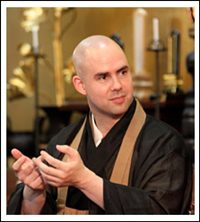
Koun Franz

It’s a pleasure to introduce Koun Franz to you as a guest blogger. This is great fun for me because Koun is fine, young priest and in my crystal ball, I see him as an important emerging figure. He’s 100% shikantaza, Japan-Soto trained. This background gives him quite a different perspective, I think you’ll agree.

Koun was born in Helena, Montana, but has spent more than half of his adult life in Japan.  From 2006 to 2010, he served as resident priest of the Anchorage Zen Community (some of his talks can be found on their website).  Two years ago, Koun and his family moved back to Japan (Kumamoto), where he studies, trains, lectures, and does Buddhist-related translation work.

I encourage you to read this post through (and the upcoming offering on authentic practice) and mix it up with Koun by making a comment or asking a question.

Here’s Koun:

In his post of January 14 (“More on Koans and Who Gets to Comment”), Dosho wrote, “This mode of interpretation, btw, may be largely a Western invention as a Japanese-trained priest once told me. Kind of literary interpretation, I think he said, which he’d never heard in a dharma talk in Japan.” That priest is me. After some email back and forth, Dosho very generously suggested that I expand on a couple of our exchanges directly, as a guest blogger. I’m honored.

The conversation in question took a place a couple years ago in Alaska, when Dosho was visiting the Anchorage Zen Community. Specifically, we were discussing a style of dharma talk in which a classical Zen text (maybe Dogen, maybe a koan) is juxtaposed with something from Western literature, maybe a Stevens poem or a Dylan song. In my limited exposure to Western Zen teachers, I have bumped into this style of talking quite a few times, but in all the years in Japan, I have never heard anything even remotely similar.

For that matter, I have never even heard a Soto Zen teacher in Japan talk about a koan–as a koan, that is.  I cannot recall any teacher using the word “koan” to introduce a story.  But that doesn’t mean they aren’t part of the conversation.  I recently watched a lecture on koan literature by T. Griffith Foulk from the Dogen Conference held last year, and in it, he explains how new research is showing that Dogen is constantly referencing both known and obscure koans in his writing, to a degree far beyond what we previously knew.   In the talks I hear in Japan, the famous exchanges and awakenings do occasionally come up, but they are presented as illustrative stories, as a part of our history.   They are a launching pad for expression of the dharma, but then, what isn’t?

In Japanese Soto Zen, there are a few different categories of what we might generally call “dharma talks.” The following terms are defined differently according to region and individual, but the categories stand:

Houwa (法話, literally “dharma talk”). Houwa are usually short talks given to laypeople on the occasion of a private ceremony, such as a wake. There might be a discussion of impermanence (and how death is like the changing of the seasons), but what’s being conveyed is more emotional than philosophical. (I have heard many priests, especially those in small towns, express their exhaustion at trying to come up with something new to say in houwa when the same people attend every single funeral. It’s a kind of performance, one that a priest might have to repeat every month or even every day.)
Sekkyou (説教, “expounding on the teachings”). These talks are also directed towards laypeople, but the teacher is usually invited, and the event is often a larger annual ceremony (such as one marking the Buddha’s enlightenment). The tone is usually encouraging, and the message is a simple one. There is actually a testing process by which one can receive various ranks as a lecturer, and since the lecturer’s audience is almost always a new one, it’s possible to repeat and polish the same basic talk for years. (I have given quite a few of these talks in the last few years; I assume that people hope the novelty of a foreign lecturer will bring more people to the temple that day. The expectation is that I will explain how I—of all people—became a priest, and that I’ll tell interesting stories about feeling out of place in Japanese culture. I always disappoint by talking about Buddhism.)
Houyaku (法益, “benefit of the dharma”). This is the kind of talk you might find at a genzo-e (Shobogenzo study group) or at a monastery. Houyaku tend to be very academic in nature, picking apart a text line by line while adding information about its historical context, its application in a monastic setting, and so on. Teachers who are “good at” houyaku must be very knowledgeable, but unlike the categories above, there is no expectation that a houyaku will be inspiring or polished or even engaging. It is a class, not a performance.
Teisho (提唱, “a proposal”). It is rare to hear teisho in Japan, but this is the category that corresponds most closely to what people in the West call a “dharma talk.” In my experience, the context in which one is most likely to hear teisho is during sesshin, while people are actually sitting in zazen. An in-depth discussion of zazen and true moment-to-moment practice would be surprising in any of the above categories, but since teisho are so often delivered during periods of sitting, zazen is a favorite topic.

Skillful or not, interested or not, all priests who do temple work related to laypeople will deliver houwa, perhaps frequently. A particularly charismatic or respected or even just confident (oh—or foreign!) priest will probably receive some invitations, in the course of his career, to do sekkyou. Houyaku is the realm of those who are particularly well educated, or who have become specialists in one or more areas of the tradition. And teisho is the domain of a very limited few, usually just the officers of monasteries. The vast majority of the priests I know in Japan will never be in a position to deliver either houyaku or teisho, nor could they imagine themselves doing so. In a country with tens of thousands of Soto Zen priests, there are people to do those things.

But I suspect that in the US, the situation is perfectly reversed: teisho are offered almost constantly; houyaku are expected whenever there’s some kind of study group; sekkyou are for the occasional guest-speaking gig, for larger groups, and for outreach; and houwa are relatively rare. It’s not just that Western priests have to do it all (since there are so few around), but also that the audience’s expectations are completely different. (When the AZC first contacted me about serving as their resident priest, a teacher here congratulated me—jokingly—on my promotion to ikinari douchou, “instant head teacher of a monastery.” He suspected, from what he’d heard about Zen centers, that my job description would be closer to that than to the duties of an ordinary priest. And he was right.)

In 2006, when I was preparing to move to Anchorage, one of my teachers sat me down and offered this advice: “Always stand in your position.” What he meant, essentially, was to accept the role of being a priest, not to apologize for it. It’s easy to refuse to sit in the high seat, to laugh at the silliness of having everyone bow in your direction, to wink and say in a thousand little ways, “Don’t worry—I know we’re just playing. I’m just like you.” People practically beg you to do it. But my teacher’s stance was, and is, that deep down, people do not want the priest to be just like them. They want that person to have the strength to sit in the position of the Buddha, unflinchingly, and to speak and act from that place. Because who else will do that?

“Stand in your position” means to open your mouth and let it fill with the dharma, to put on the robe of the Buddha and to embody the lineage stretching back to the Buddha, with no excuses. It also means to accept the projections and transference of others—as father figure, as distrusted school principal, as saint, as charlatan—without stepping outside of your role to say, “No, no—I’m really this.” It is not about being stubborn or immoveable; it is a question of knowing one’s function and realizing that function wholeheartedly. It is a way of offering yourself to others.

In my whole life, no single phrase has permeated my consciousness in the way that “Stand in your position” has. It pokes me every day—not just in the role of Zen priest, but also as an educator, as a citizen, and recently as a father. It is incredibly difficult—in part because there are so many tempting excuses not to do it, but mostly because in order to stand in one’s position, you must first understand, even if only intuitively, what that position is. Even if you cannot fully know what to do, you have to do it anyway.

I bring this up because as I kick around the questions Dosho raised about commenting on koan literature, I keep coming back to this issue of position. Who gets to talk about what, and how? I don’t know who gets to talk about what. I’ve been thinking about it for days, and my perspective keeps shifting. In some cases, maybe it’s better to say nothing. Perhaps just the word “koan” can mislead listeners to believe that they are entering an entirely different kind of dialogue, one the speaker does not intend. Could it be that simple? I’m not sure about that.  But if we do open our mouths, if we do take that leap, if we stand in that position, then I am sure that part of that function is to speak with the full thunder and music of the Buddha’s own voice. We do this while not knowing, because not knowing is our fundamental condition. But we do it. We just do it. Because who else will?