

A few months ago, I wrote about something that started making a good, big difference in my life: having a prayer corner at home. However, today I had to pack it into a plastic bin until I can move into a new place because the one I am in is an absolute nightmare. And, of course, you didn’t come here to read a rant at the end of the year, but to read my reflections about it.
The truth is that I have had a housing situation far from ideal. I live with my family, I spend time with them, and that’s amazing, but the rental company has been nothing but a living hell. Due to this, I had to make extra space in the bedroom, which meant packing up my altar, my prayer corner. Did it hurt? No, because I know it’s for a good (private) reason. Did I care about it? Extremely.
The Importance of an Altar
Why is it important for me to have an altar? Rachel Patterson (2019) gives you a great starting point (my bolds):
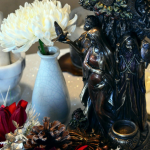
Let’s start with the traditional idea, that an altar is a flat surface often a small table or the top of a cabinet where you lay out all your ritual tools, offerings and image of deity. It is also a place that you can go to for meditation and connecting with the Divine, it provides a focus. It is also a practical place to put everything you need when in ritual so that you don’t have to run around looking for everything once you have cast a circle.
I also agree with Joey Morris (2024), who believes that “your altar should reflect YOU as well as the path that you’re walking, and the spirits/Gods that you’re working with.” My altars have always been a WIP because I am very eclectic, which means I am constantly learning new things, practicing new ideas, different prayers, trying new approaches to see what works best. I have worked with Aphrodite, Hekate, Tawusê Melek, Diana, Artemis, Apollo, Thor, Odin, Cernunnos. I’ve practiced with tarot cards, palmistry, crystal ball scrying, Viking runes, dream interpretation, different types of offerings… the list is long.
Finally, blogger magnifique John Beckett (2013) goes into more detail explaining altars
An altar is a place for offerings. (…) An altar is a place for prayer. If you have statues on your altar, this will come easily – one of the purposes of an idol is to give a deity a tangible form. Not because they need it, but because we do. (…) It is difficult for me to pray for trivial things when the Lord of the Animals is sitting right in front of me. An altar is a place for meditation and contemplation. You put objects on your altar because they are meaningful to you.
That is my relationship with the divine and with the spirits I work with. I can’t ask for anything trivial when I have my family tree in front of me, my prayers feel more personal when I have the names of my ancestors looking at me, or when I feel the presence of the divine. After so much changing, months of figuring out, I finally found a spread that worked the best for me with what I had. And now it is all in a bin.
And that’s okay.

A Prayer without an Altar
I don’t pray exclusively at my altar. In fact, most of the moments when I have needed it the most, I have been far from it, and my devotions are not only comprised of prayers. My daily devotions are a lifeline in this moment due to the stress I’m dealing with. Regardless of whether it feels bad or not, I do not need an altar. I want it, which is an entirely different thing. It is not a must to pray, to connect with the divine, or meditate.
It is during times like this that I remind myself that you don’t need any tools to be a witch. Your knowledge, your creativity, and your mind are your most potent tools. Your body itself is already a temple, as people like to say, which I believe is true. It’s not a matter of using toxic positivity, downplaying what it means, but to use what you have at hand.
My phrase this year has been “This is Alzheimer’s prevention!” I’ve used it when I need to change something, or if I can’t keep doing something the same way as I have been doing for a while. Not having my prayer corner is one more form of Alzheimer’s prevention due to infernal circumstances, so there is something good coming out of it.
At the end of the day, an altar, a prayer corner, is just another tool, and you don’t need tools to be a witch. When I left everything behind for the first time, I didn’t have anything with me to practice. Until I got a deck of playing cards, so I learned how to read with it. Witchcraft is what you make of it. It is not a product you can pack or a gift you can send away. It is part of your core regardless of the circumstances.
References
Beckett, J. (2013, January 5). The Care and Use of an Altar. John Beckett.
Morris, J. (2024, February 11). What Is A Pagan Altar, Really? Celtic Hedge Witch.
Patterson, R. (2019, March 22). What Is An Altar? Beneath the Moon.















 Ad-Free & Subscriber Log-In