


He Tried to Escape Fate—But Couldn’t Escape Himself: What Oedipus Rex Still Teaches Us
There is something deeply unsettling about the story of Oedipus.
Not because it is ancient.
Not because it is tragic.
But because, even today, it feels familiar.
A man runs his entire life trying to avoid a fate he fears only to discover that every step he took to escape it was a step towards it.
We like to think we are in control of our lives. That if we plan carefully enough, decide wisely enough, we can avoid suffering.
But Oedipus Rex asks a question we are not comfortable answering:
What if the problem is not fate… but the way we respond to it?
The Story We Think We Know
Oedipus is born under a curse.
A prophecy declares that he will kill his father and marry his mother. Terrified, his parents abandon him.
He survives.
Years later, when he hears the same prophecy about himself, he does what any rational person would do – he runs.
He leaves the people he believes are his parents to protect them. On the road, he kills a man in anger. He doesn’t know it is his real father.
Later, he becomes king of Thebes and marries the queen. He doesn’t know she is his mother.
The prophecy comes true.
Not because he wanted it to. But because he could not see what was driving him.
Fate Did Not Destroy Oedipus—His Mind Did
We often interpret this story as a battle between fate and free will.
But that is too simple.
Fate did not force Oedipus to act in anger.
Fate did not make him react impulsively.
Fate did not compel him to chase truth without emotional readiness.
Those were his choices.
And those choices came from something deeper:
- His anger
- His pride
- His need for control
In modern psychological terms, we might say: his emotional mind overpowered his rational mind.
In the language of the Bhagavad Gita:
Manas overpowered Buddhi.
The Illusion of Control
Oedipus believed that by running away, he was taking control of his destiny.
But he misunderstood something fundamental:
You can change your location.
You can change your decisions.
But if you do not understand your inner patterns,
you carry them with you.
He escaped a place. He did not escape himself. And that is where most of us are today.
Modern Oedipus: We Are Not So Different
We may not face prophecies, but we live under something just as powerful:
- Fear of failure
- Fear of rejection
- Fear of losing control
We avoid situations, delay decisions, overthink outcomes believing we are protecting ourselves.
But often, we are doing what Oedipus did:
Acting from fear while calling it strategy.
We check our phones repeatedly, waiting for a message.
We replay conversations in our heads.
We try to control outcomes that were never ours to control.
And slowly, without realizing it, we walk ourselves into the very anxiety we are trying to escape.
A Gita Perspective: Where Oedipus Falls Apart
If we read this story through the lens of the Bhagavad Gita, a striking contrast appears.
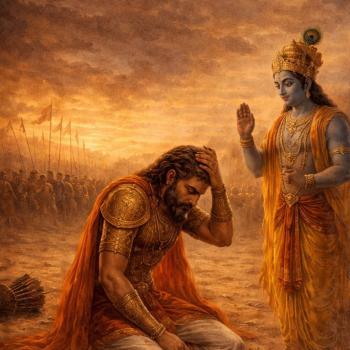
Arjuna, like Oedipus, is overwhelmed.
But Arjuna pauses.
He questions.
He seeks guidance.
Oedipus does not.
He acts first.
Understands later.
And by the time he sees clearly – it is too late.
The Gita offers a principle that Oedipus never learned:
You are responsible for your actions,
but not in control of the outcomes.
Oedipus tried to control the outcome. He never mastered his response.
The Deeper Tragedy
The tragedy of Oedipus is not that fate existed.
The tragedy is that:
He had intelligence, but not awareness.
He had power—but not inner clarity.
He solved the riddle of the Sphinx. But he could not solve the riddle of his own mind.
What This Means for Us
We do not need to debate whether fate is real.
A more useful question is:
Are we aware of the forces within us that shape our decisions?
Because whether you call it fate, karma, or circumstance life will always present uncertainty.
The real difference lies here:
- One person reacts impulsively
- Another responds with awareness
Same situation. Different outcome.
A Quiet Shift in Understanding
Perhaps the story of Oedipus is not a warning about destiny. Perhaps it is a mirror.
It shows us that:
The greatest danger is not what is written for us – but what remains unseen within us.
Oedipus ran his entire life to escape a prophecy.
But he never paused long enough to understand the mind that was making his choices.
And maybe that is the real lesson:
You don’t lose your life because fate is strong.
You lose it because awareness comes too late.












 Ad-Free & Subscriber Log-In