

What we know for sure about ANE’s culture is there was a concern for proper burials. The remaining stories in the Abraham cycle are about burials and finding a proper wife for Isaac, from among Abraham’s kin, and not from among the Canaanites . But the initial story in Gen. 23 brings to our attention the Hittites. You would not know this just from reading the Bible but the Hittites had a huge empire, including most of what is Turkey today, as well as Syria and large parts of Israel. Wikipedia summarizes as follows:
“The Hittites formed a series of polities in north-central Anatolia, including the kingdom of Kussara (before 1750 BC), the Kanesh or Nesha kingdom (c. 1750–1650 BC), and an empire centered on Hattusa (around 1650 BC).[3][4] Known in modern times as the Hittite Empire, it reached its peak during the mid-14th century BC under Šuppiluliuma I, when it encompassed most of Anatolia and parts of the northern Levant and Upper Mesopotamia, bordering the rival empires of the Hurri-Mitanni and Assyrians. Between the 15th and 13th centuries BC, the Hittites were one of the dominant powers of the Near East, coming into conflict with the New Kingdom of Egypt, the Middle Assyrian Empire and the empire of Mitanni.”
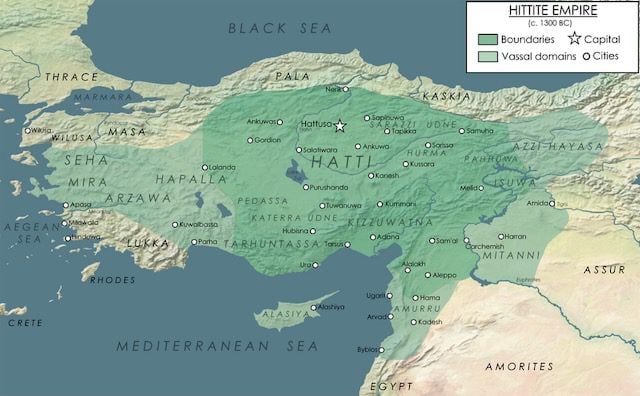
Only here in Gen. 23 do you get the sense of a large presence of Hittites holding much territory, and again this is a good 700 or more years before King David. There were a few Hittites still around as late as 800 B.C. (remember Uriah, Bathsheba’s husband) though the empire was long gone. Hatti in the above map=Hittites.
The story begins with Sarah passing away in Hebron, and Abraham, who apparently was not with her when she died, came to mourn her, including the usual ritual keening, or wailing. He now needed to find a place for Sarah to be buried, and he negotiated with the Hittites, who clearly enough respected him as ‘a prince in our midst’. But actually the Hebrew translated sojourner settler means resident alien. Which in turn means he does not have a claim on Hittite land. Bargaining in the ANE then, and now in the Middle East, involves flattery, and the term prince is probably an example of that. as is you may have your pick of the burial sites. What Abraham asks for is the cave of Machpelah which is at the end of the property of Ephron, which is mentioned to make clear Abraham will not encroach on other Hittite property, and he will pay for the cave with ‘full silver’, 400 shekels, and Ephron in essence says, it’s a deal at that price— ‘Land for 400 shekels…what does it come to?” As the text intimates we are talking about full silver being weighed for a set price, as this is actually before silver coins were being minted. But in fact this is a great deal to pay for a burial plot. We are told the cave is by Mamre which is Hebron, in the land of Canaan. In due course Abraham will be buried there as well.
In Gen. 24 we have Abraham’s final major act, of commissioning his head servant who ruled over everything, to go and find Isaac a wife from amongst his own relatives, as he doesn’t want Isaac to marry a Canaanite girl. The gesture here is– put your hand on my genitals, or on the thigh right next to my genitals swear, and this form of serious oath taking is known in several ANE contexts. Alter suggests that here it may be appropriate because Abraham is concerned about continuing his line through Isaac without intermarrying with Canaanites. Abraham assures his servant that God will send his own messenger ahead to prepare the way. The servant loads up no less than 10 camels worth of goods and goes to Nahor, and he stops at a well outside of town, and he prays that God will bring the right young woman to the well to draw water whom he will ask for water, and if she complies and even adds I’ll get water for your camels as well that should be the sign that he has found the right girl. Having barely finished this pray he looks up, and here comes a beautiful young woman, and a virgin as well. Her name was Rebekah. Notice that she lowers the water jug down from her head or shoulder so the servant can drink, and after the girl had given water to the camels, the servant gave her a golden nose ring, and two gold arm bracelets, and he asks to spend the night with her family, and she says yes, and the servant is thrilled and does obeisance bowing down to the Lord who was making this possible. Now Laban (of the later story about Jacob) makes a cameo appearance here as Rebekah’s brother. The servant then makes clear that his master Abraham is well off, and tells in full what had been his prayer, and how his encounter with Rebekah went. Laban and Rebekah’s mom conclude this has come from God, and the servant then dispenses gifts for the mother and for Laban the brother. They agreed to the betrothal arrangement and to letting Rebekah go, but they next morning they said ‘let the young woman stay with us for ten days or so, then she may go’. But servant objects— do not hold me back, then they say lets call in Rebekah and see what she says– and she said she was willing to go with Abraham’s servant so they sent her off, and with her her nurse, and they part with her with the blessing “Our sister hence become teeming myriads, may your seed take hold of the gates of its foes’. Notice the nearly identical blessing at Gen. 22.17 bestowed on Abraham. The idiom is ‘be fruitful and multiply and have victory over your enemies. The story ends beautifully by having Isaac come walking through the field and seeing the servant and Rebekah coming, and she asks the servant– whose that, and the servant tells her, and she puts on a veil over her face, and Isaac brings her into Sarah’s tent and takes her as his wife, and she becomes the matriarch of the family, since Sarah is gone. And we are told Isaac loved her, and in essence this filled the emotional void from having lost his mother. It is odd, that Abraham is not mentioned at this point, but her isn’t and some have conjectured that the beginning of this story is about a deathbed oath involving the dying Abraham, and this may be right.
However the beginning of Gen. 25 suggests that Abraham remarried, and had a brace of kinsmen by the new wife, and then died at a ripe old age on 175. Gen. 25.9 tells us that both Isaac and Ishmael bury Abraham in the cave of Machpelah. We are finally told that after the burial Isaac settled at Beer-lahai-roi.









 Ad-Free & Subscriber Log-In